Why Inventory Accuracy Has Become a Business-Critical Metric
In 2026, businesses operate in a world where customers expect faster deliveries, real-time updates, and seamless purchasing experiences. Whether you’re running an eCommerce store, distribution center, manufacturing facility, or third-party logistics operation, inventory accuracy has become one of the most important factors driving profitability and customer satisfaction.
Yet many businesses continue to struggle with inventory inaccuracies caused by manual processes, disconnected systems, poor warehouse visibility, and outdated tracking methods.
What appears to be a minor inventory discrepancy can quickly turn into lost revenue, operational inefficiencies, unhappy customers, and damaged brand reputation.
The reality is simple: inventory inaccuracy is no longer just a warehouse problem—it’s a business problem.
In this article, we’ll explore the true cost of inventory inaccuracy in 2026 and how modern Warehouse Management Systems (WMS) help organizations achieve complete inventory control.
What Is Inventory Inaccuracy?
Inventory inaccuracy occurs when recorded inventory levels differ from actual physical stock available in the warehouse.
For example:
- A system shows 100 units available, but only 75 exist.
- Inventory is physically available but recorded in the wrong location.
- Damaged products remain counted as sellable inventory.
- Stock movements aren’t updated in real time.
These discrepancies may seem small initially, but they create a chain reaction across operations.
Why Inventory Accuracy Matters More Than Ever in 2026
Today’s supply chains are more complex than ever.
Businesses are managing:
- Multiple sales channels
- Multiple warehouse locations
- Faster customer delivery expectations
- Higher SKU volumes
- Global supply chain disruptions
Without accurate inventory data, companies struggle to make informed decisions and maintain efficient operations.
Modern customers expect inventory visibility and reliable fulfillment. A single inventory error can impact customer trust and future sales opportunities.
Cost #1: Lost Revenue from Stockouts
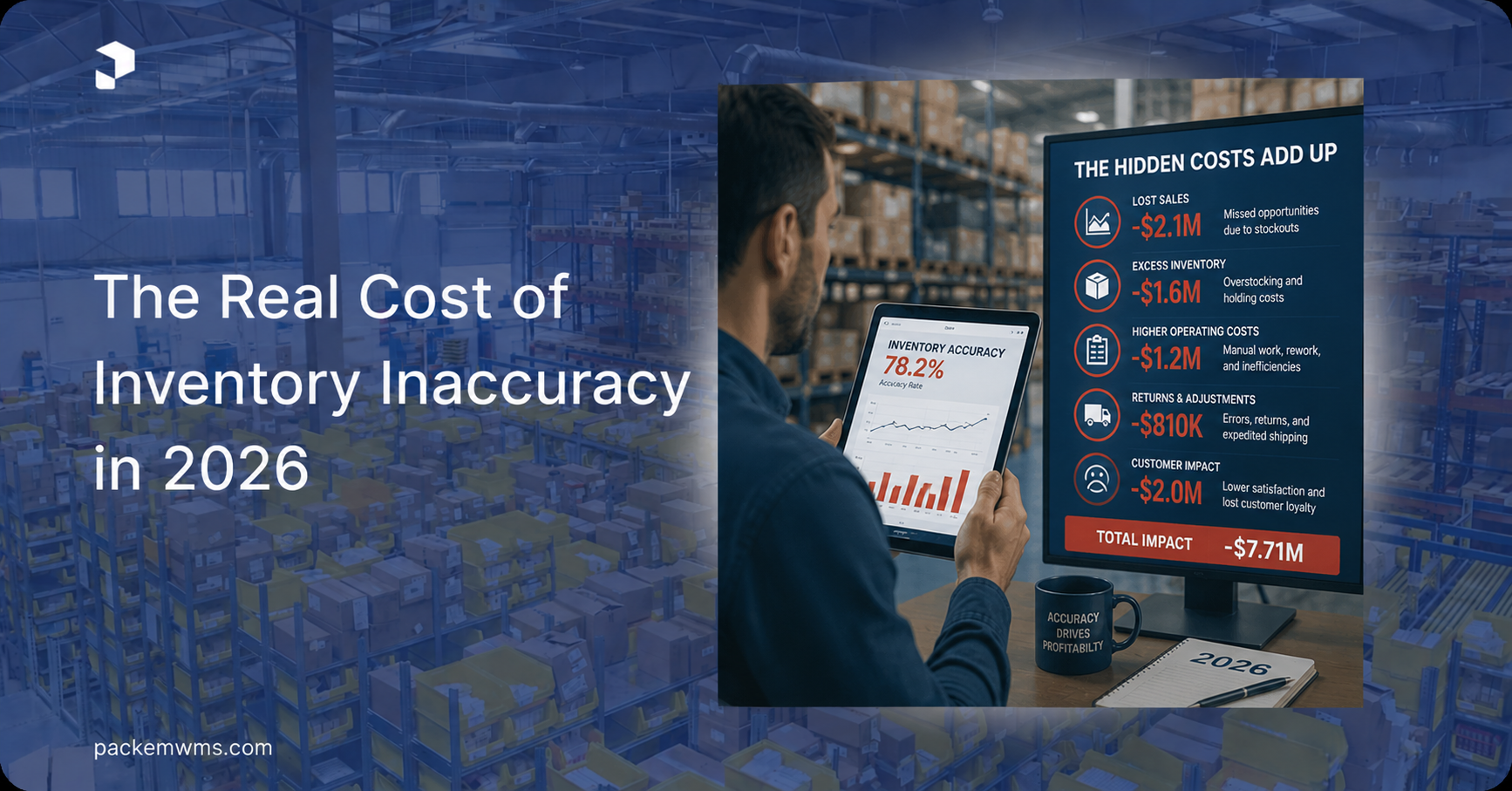
One of the biggest consequences of inventory inaccuracy is stockouts.
When inventory records indicate products are available but shelves are actually empty, businesses continue accepting orders they cannot fulfill.
The Results
- Cancelled orders
- Lost sales
- Customer dissatisfaction
- Reduced customer lifetime value
In 2026, customers have countless alternatives. If an item is unavailable, many buyers simply purchase from a competitor.
Every stockout represents immediate revenue loss and potentially a lost customer forever.
Cost #2: Excess Inventory and Cash Flow Problems
Inventory inaccuracies don’t just cause shortages—they also create overstock situations.
When inventory records are unreliable, purchasing teams often order additional stock “just to be safe.”
This leads to:
- Excess inventory
- Higher storage costs
- Increased insurance expenses
- Product obsolescence
- Reduced cash flow
Money tied up in unnecessary inventory cannot be invested in marketing, expansion, staffing, or technology improvements.
For growing businesses, this hidden cost can significantly impact profitability.
Cost #3: Increased Labor Costs
Inventory discrepancies require constant investigation and correction.
Warehouse teams spend valuable time:
- Conducting cycle counts
- Searching for missing inventory
- Correcting inventory records
- Reconciling stock discrepancies
Instead of focusing on productive warehouse activities, employees become occupied with administrative tasks.
This creates:
- Lower productivity
- Higher labor expenses
- Increased overtime costs
- Operational inefficiencies
Over time, these costs compound significantly.
Cost #4: Fulfillment Errors and Return Expenses
Inaccurate inventory often leads to picking and shipping mistakes.
Common issues include:
- Wrong products shipped
- Incorrect quantities sent
- Partial orders
- Delayed shipments
The financial impact includes:
- Return shipping costs
- Replacement products
- Customer service expenses
- Refund processing
Even more importantly, fulfillment errors damage customer trust and brand reputation.
In competitive markets, reputation is one of the most valuable assets a business possesses.
Cost #5: Poor Customer Experience
Inventory accuracy directly affects customer satisfaction.
Customers expect:
- Accurate stock availability
- Reliable delivery timelines
- Fast order fulfillment
When inventory data is incorrect, customers experience:
- Backorders
- Delays
- Unexpected cancellations
- Communication issues
Research consistently shows that customers are less likely to return after experiencing fulfillment problems.
The cost of losing repeat customers often exceeds the cost of acquiring new ones.
Cost #6: Inaccurate Forecasting and Purchasing Decisions
Inventory data drives purchasing and demand planning decisions.
When inventory records are inaccurate, businesses struggle to:
- Forecast demand
- Plan replenishment cycles
- Manage seasonal inventory
- Allocate resources effectively
Poor forecasting often results in:
- Overstocking
- Understocking
- Emergency purchasing
- Increased procurement costs
Decision-makers can only be as effective as the data available to them.
Bad inventory data leads to bad business decisions.
Cost #7: Reduced Warehouse Efficiency
Warehouse efficiency depends on accurate inventory visibility.
When inventory cannot be located quickly, employees waste time searching warehouse aisles and storage locations.
This results in:
- Longer picking times
- Slower order fulfillment
- Lower throughput
- Reduced warehouse productivity
As order volumes increase, these inefficiencies become even more expensive.
For many organizations, inventory accuracy directly influences warehouse performance metrics.
Cost #8: Supply Chain Disruptions
Inventory inaccuracies create ripple effects throughout the supply chain.
Suppliers, purchasing teams, warehouse operators, and customers all depend on accurate inventory information.
When inventory records are wrong, businesses face:
- Emergency replenishment orders
- Supplier relationship challenges
- Production delays
- Distribution disruptions
In today’s fast-moving market, supply chain agility depends heavily on real-time inventory visibility.
Cost #9: Loss of Business Intelligence
Modern organizations rely on data-driven decision-making.
Inventory data influences:
- Purchasing
- Sales planning
- Pricing strategies
- Capacity planning
- Growth initiatives
If inventory data is unreliable, business reports become unreliable as well.
Leaders lose confidence in their metrics and struggle to make informed decisions.
Accurate inventory management is essential for accurate business intelligence.
The Growing Cost of Inventory Inaccuracy in 2026
Several trends are making inventory accuracy more important than ever:
Omnichannel Selling
Businesses must synchronize inventory across online stores, marketplaces, retail locations, and warehouses.
Same-Day and Next-Day Delivery
Faster delivery expectations require real-time inventory visibility.
Rising Labor Costs
Companies cannot afford inefficient warehouse processes.
Customer Expectations
Modern customers expect transparency, speed, and accuracy.
Competitive Markets
Businesses with superior inventory control gain a significant competitive advantage.
As these trends continue, the cost of inventory inaccuracies will only increase.
How a Warehouse Management System Improves Inventory Accuracy
A modern Warehouse Management System (WMS) helps eliminate inventory discrepancies through automation and real-time tracking.
Key capabilities include:
Real-Time Inventory Visibility
Track inventory movements instantly across all warehouse locations.
Barcode Scanning
Reduce manual data entry errors and improve inventory accuracy.
Automated Inventory Updates
Ensure inventory records remain accurate as products move throughout the warehouse.
Cycle Count Management
Maintain inventory accuracy without disrupting operations.
Location Tracking
Know exactly where every product is stored.
Inventory Analytics
Identify trends, inefficiencies, and opportunities for improvement.
Why Businesses Are Investing in Inventory Accuracy
Forward-thinking businesses understand that inventory accuracy is not simply an operational metric.
It directly impacts:
- Revenue
- Customer satisfaction
- Profitability
- Efficiency
- Scalability
Organizations that invest in inventory visibility and warehouse management technology consistently outperform competitors relying on manual processes.
Conclusion
The cost of inventory inaccuracy in 2026 extends far beyond missing products or stock discrepancies.
It affects revenue, labor costs, customer experience, warehouse efficiency, forecasting accuracy, and overall business performance.
As supply chains become more complex and customer expectations continue to rise, accurate inventory management has become a strategic necessity.
Businesses that prioritize inventory accuracy gain greater control, stronger profitability, and a significant competitive advantage.
Take Control of Your Inventory with PackemWMS
PackemWMS helps businesses achieve real-time inventory visibility, improve warehouse efficiency, reduce operational costs, and eliminate costly inventory errors.
If you’re ready to transform your warehouse operations and achieve complete inventory control, PackemWMS is built to help you succeed.