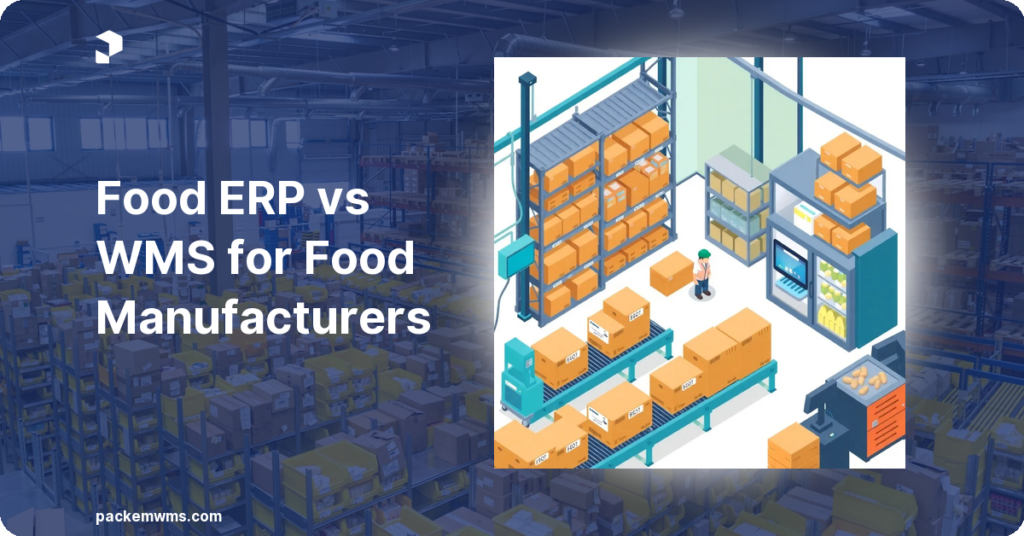
Food ERP vs WMS for food manufacturers: which does your operation actually need?
A food ERP manages your entire business, finance, HR, purchasing, production planning, while a WMS for food manufacturers controls what physically happens inside your warehouse: lot tracking, FEFO picking, expiration date management, and real-time inventory movement. Most small-to-mid-size food manufacturers need one or the other, and a growing number need both working together.
If you’re trying to figure out which system belongs in your operation, this guide breaks it down with a direct comparison, real-world scenarios, and the questions you should ask before signing any contract.
Last Updated: March 2026
What is a food ERP system?
An Enterprise Resource Planning (ERP) system connects every department in your food manufacturing business under one platform. It handles financials, procurement, production scheduling, HR, customer orders, and sometimes basic inventory counts. Major food ERP platforms include SAP Business One, Microsoft Dynamics 365, NetSuite, and Infor.
According to the FDA, 2023, the FSMA Food Traceability Rule requires food manufacturers to maintain lot-level records traceable within 24 hours — a compliance standard that most manual inventory systems cannot reliably meet.
According to ReFED, 2022, U.S. food manufacturers generated 13.1 million tons of food waste, underscoring how inventory accuracy directly impacts both operational efficiency and regulatory compliance.
ERPs are built for breadth. They give executives a single view of the business, how much raw material you’ve purchased, what’s in production, what’s shipped, and what revenue has been recognized. For a food manufacturer, an ERP typically handles:
- Purchase orders and vendor management
- Bill of materials (BOM) and production runs
- Customer invoicing and accounts receivable
- Basic stock quantities by location
- Regulatory documentation for compliance
The problem is that “basic stock quantities” is exactly what it says. ERP inventory modules track numbers on paper. They don’t direct physical warehouse workflows, enforce scan-based receiving, or guarantee that your team actually picks the lot expiring soonest. That execution gap is where food manufacturers get into trouble.
According to Panorama Consulting’s 2024 ERP Report, the average ERP implementation for a small-to-mid-size business takes 14 months and costs significantly more than the initial license fee. For a food manufacturer running on tight margins, that’s a heavy lift.
What is a WMS for food manufacturers?
A Warehouse Management System (WMS) controls the physical flow of inventory inside your facility. It directs your team through every touch point, receiving, putaway, picking, packing, and shipping, using barcode scanning to enforce accuracy at each step.
For food manufacturers specifically, a WMS handles the things that ERPs miss:
- Lot and batch tracking: Every lot receives a unique identifier. Every movement is recorded. You can trace any SKU from supplier receipt to customer shipment in seconds.
- FEFO enforcement: First Expired, First Out (FEFO) picking logic ensures your team automatically pulls the inventory with the nearest expiration date, not just the nearest pallet.
- Expiration date alerts: Configurable alerts flag inventory approaching its expiration window before it becomes a loss.
- Supplier documentation: Receive and attach certificates of analysis, safety data sheets, and country-of-origin records to specific lots.
- Real-time inventory: Stock counts update the moment a barcode is scanned, not at the end of the day, not after a sync.
According to the Warehousing Education and Research Council (WERC), operations using scan-based WMS achieve inventory accuracy rates above 99%, compared to the industry baseline of roughly 65% for operations relying on spreadsheets or ERP-only inventory management.
PackemWMS implements for food manufacturers in 2 to 5 weeks. That’s not a typo, it reflects a system designed for operations with 1 to 50 warehouse staff, not a 200-person enterprise rollout.
Where ERP and WMS overlap in food operations
Both systems track inventory quantities, and that overlap is the source of most confusion when buyers are evaluating which one to purchase.
Here’s the key distinction: ERPs track inventory at the financial and planning level. WMS tracks inventory at the execution level.
Your ERP might know you have 500 cases of Product A. Your WMS knows those 500 cases are split across three lots, Lot 220 expires June 14, Lot 221 expires August 3, and Lot 222 expires September 20, and that four of them have a damaged flag and should not be picked.
For food manufacturers subject to the FDA Food Safety Modernization Act (FSMA), that granularity isn’t optional. FSMA Section 204 requires records that trace food at the lot level from “first receiver” to “immediate subsequent receiver.” An ERP quantity count does not meet that requirement. A WMS with lot-level traceability does.
Food ERP vs WMS: side-by-side comparison
| Capability | Food ERP | WMS for food manufacturers |
|---|---|---|
| Financial management | ✅ Full | ❌ Not applicable |
| Production planning | ✅ Full | ❌ Not applicable |
| Procurement & purchasing | ✅ Full | ❌ Not applicable |
| Basic inventory quantities | ✅ Yes | ✅ Yes |
| Lot and batch tracking | ⚠️ Limited (manual or module add-on) | ✅ Built-in, scan-enforced |
| FEFO/FIFO picking logic | ⚠️ Rarely enforced at scan level | ✅ Enforced at every pick |
| Expiration date management | ⚠️ Basic alerts only | ✅ Full visibility + alerts |
| Barcode scanning at receiving | ⚠️ Optional, often manual | ✅ Required at every step |
| Real-time inventory movement | ⚠️ Depends on sync frequency | ✅ Live, scan-by-scan |
| FSMA lot traceability | ⚠️ Partial, requires manual records | ✅ Automatic, full chain |
| Supplier documentation (COA, SDS) | ⚠️ Document management only | ✅ Linked to specific lots |
| Mobile app for warehouse staff | ⚠️ Limited; desktop-first | ✅ Android/Zebra native |
| Implementation time (SMB) | ❌ 6–18 months average | ✅ 2–5 weeks |
| Starting price (SMB) | ❌ $2,000–$10,000+/month | ✅ From $750/month |
| QuickBooks integration | ✅ Replaces QB or syncs | ✅ Native QuickBooks sync |
When does a food manufacturer need a WMS instead of (or alongside) an ERP?
You need a WMS if any of these describe your operation:
- You’ve had an FDA audit or customer audit where lot traceability records were incomplete
- Your team picks by walking to the closest pallet, not the oldest expiring lot
- You’ve written off inventory because nobody caught the expiration date until it was too late
- Inventory counts at month-end don’t match your system, and you spend days reconciling
- You’re preparing for a food safety certification (SQF, BRC, FSMA Section 204 compliance)
- Your receiving process relies on someone typing numbers into a spreadsheet or ERP screen
You might not need a WMS yet if:
– You have fewer than 20 SKUs and one storage room
– You do no lot-sensitive operations (no expiration dates, no raw material traceability requirements)
– You’re a single-person operation using a simple inventory app
For most food manufacturers beyond the startup phase, the WMS is the missing piece, not the ERP. Many already have QuickBooks handling their finances. What they lack is warehouse execution.
How food manufacturers use WMS and ERP together
The strongest setup for a growing food manufacturer is an ERP handling the business layer and a WMS handling the warehouse execution layer, connected through an integration.
PackemWMS integrates with QuickBooks, Shopify, WooCommerce, and major shipping carriers out of the box. For food manufacturers already running an ERP, the integration passes:
- Inbound purchase orders from the ERP → WMS creates receiving tasks
- Outbound sales orders from the ERP → WMS generates pick lists
- Inventory adjustments and lot movements → synced back to ERP in real time
This way, your finance team sees accurate numbers in their system, and your warehouse team works from scan-based workflows on Android or Zebra devices. Each system does what it’s actually good at.
According to a 2023 study by the Warehousing Education and Research Council, food manufacturers who combined ERP with a dedicated WMS reduced inventory write-offs due to expiration by an average of 32% within the first year of implementation.
Think about what that means for a food operation losing $50,000 a year in expired inventory: that’s $16,000 back in year one.
Frequently asked questions
What is the difference between a food ERP and a WMS for food manufacturers?
A food ERP manages company-wide operations including finance, purchasing, and production planning, while a WMS manages physical warehouse execution including lot tracking, FEFO picking, and real-time inventory movement. ERP handles the business layer; WMS handles the warehouse floor. Most growing food manufacturers need both, but often only have one.
Can a food ERP replace a WMS?
For most food manufacturers, no. ERP inventory modules track quantities but don’t enforce scan-based workflows, FEFO picking logic, or lot-level traceability at the scan level. If you need FSMA compliance or have expiration-sensitive inventory, a dedicated WMS is necessary.
How much does a WMS for food manufacturers cost?
WMS pricing for small-to-mid-size food manufacturers typically starts around $750 to $1,800 per month. PackemWMS pricing starts at $750/month with transparent per-user pricing. Enterprise ERP systems with WMS modules can run $5,000 to $50,000+ per month with 6–18 month implementation timelines.
What is FEFO and why does it matter for food manufacturers?
FEFO stands for First Expired, First Out. It means your warehouse picks inventory in order of expiration date, not by location proximity or lot sequence. Without FEFO enforcement in a WMS, workers often grab the nearest pallet, which may expire sooner than other stock, leading to write-offs and potential food safety issues.
Does PackemWMS integrate with ERP systems for food manufacturers?
Yes. PackemWMS integrates with QuickBooks, Shopify, WooCommerce, and can connect to ERP systems via API. Inbound purchase orders flow from your ERP to PackemWMS for receiving, and inventory updates sync back to your ERP in real time. You keep your ERP for financials and use PackemWMS for warehouse execution.
What to do next
If your food manufacturing operation has expiration-sensitive inventory, lot traceability requirements, or is preparing for FDA or customer audits, a dedicated WMS delivers the warehouse execution layer your ERP was never designed to provide.
PackemWMS is built for small-to-mid-size food manufacturers who need FEFO, lot tracking, and real-time inventory without a six-figure implementation budget. Most customers are live in 2 to 5 weeks.
See PackemWMS features for food manufacturers or book a demo to see how it works in a food operation like yours.
You can also view transparent pricing and explore available integrations before you talk to anyone.