Food warehouse management system: the complete guide to FIFO/FEFO compliance
Last Updated: May 6, 2026
A food warehouse management system is software that controls the receiving, storage, picking, and shipping of food products while enforcing lot tracking, expiration date management, and rotation rules, such as FIFO and FEFO, to keep perishable inventory compliant with FDA and food safety regulations.
Running a food warehouse means you are working with expiration dates, lot-controlled products, allergen risks, and federal traceability requirements that other industries simply do not face. Ship the wrong lot and you trigger a client chargeback. Ship an expired product and you face an FDA recall. Neither outcome is acceptable, and neither is preventable with spreadsheets or a generic WMS that was built for apparel or electronics.
This guide breaks down what a food warehouse management system actually does, how FIFO and FEFO work inside WMS software, what FSMA 204 requires, and exactly what features you need to evaluate before choosing a system for your food operation.
What a food warehouse management system actually does
A food warehouse management system goes beyond basic inventory tracking. It manages the entire lifecycle of food products through your facility, from the moment a pallet arrives to the moment it ships, with food-specific controls at every step.
Here is what distinguishes a food WMS from a standard warehouse system:
- Lot-level receiving: Every incoming product is assigned a lot number, a receiving date, and an expiration date at the dock. Nothing goes into storage without this data captured.
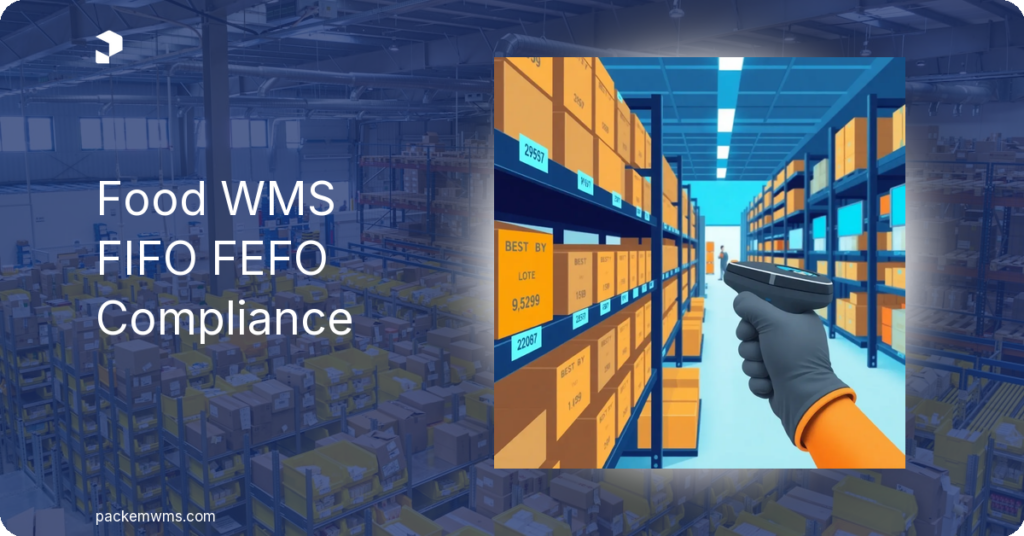
- FIFO or FEFO picking enforcement: When a picker pulls product, the system directs them to the correct lot automatically, oldest first (FIFO) or soonest-expiring first (FEFO), based on the rules you set per SKU.
- Expiration date alerts: The system flags inventory approaching expiration so you can prioritize it for outbound orders before it becomes waste.
- Lot traceability: A complete chain of custody from supplier to customer, captured at every transaction, receiving, putaway, pick, pack, and ship. This is the foundation of your recall response.
- Allergen control: Lot attributes can include allergen flags (wheat, soy, dairy, nuts) so pickers never accidentally pull a lot that violates an allergen-separation requirement.
The difference between a food warehouse management system and a standard WMS is that the food version treats every inventory transaction as a compliance event, not just a stock movement.
FIFO vs FEFO: when each rotation rule applies
First In, First Out (FIFO) and First Expired, First Out (FEFO) are both lot rotation methods, but they serve different purposes. Choosing the wrong one for a product category can lead to unnecessary waste or compliance risk.
FIFO (First In, First Out) means you ship the oldest received inventory first, regardless of expiration date. It is the standard rotation method for most food warehouses handling shelf-stable products like canned goods, dry ingredients, and packaged foods where every unit of the same lot has the same shelf life.
FEFO (First Expired, First Out) means you ship the inventory with the earliest expiration date first, regardless of when it arrived. FEFO is essential when:
- Different lots of the same product have different expiration dates (common with dairy, fresh produce, meat, and any temperature-sensitive product)
- You receive partial lots at different times with varying manufacturing dates
- A client’s retail customer requires remaining shelf life guarantees (for example, a retailer requiring 90% remaining shelf life at receipt)
In practice, a well-configured food warehouse management system lets you assign rotation rules at the SKU level. Canned tomatoes might run FIFO. Fresh cheese might run FEFO. Frozen proteins might run FEFO with an additional minimum remaining shelf life gate.
The critical point is that this logic must live in the system, not in the heads of your warehouse staff. When rotation rules are manual, they get missed. When the system enforces them at the pick step, every outbound shipment is correct by default.
Expiration date management in a food WMS
Expiration date management is one of the most important functions in any food warehouse software. Without it, you are relying on staff to visually check dates during picking, a process that fails under pressure, high volume, or staff turnover.
A food WMS handles expiration dates across three distinct workflows:
At receiving: Staff scan the product and enter the expiration date (or the system reads it from the supplier’s label or EDI/ASN data). The system assigns that date to the lot and stores it with the inventory record.
During storage and picking: The system uses expiration dates to drive pick sequencing. When an order is released, the allocation engine selects the lot that satisfies the rotation rule first. The picker’s mobile screen shows exactly which lot to pull and from which location.
For proactive alerts: A well-configured food warehouse management system sends alerts when inventory reaches a configurable threshold before expiration, for example, 30 days out. This gives your team time to prioritize that product for outbound orders, run a promotion with the client, or flag it for disposal before it becomes waste.
According to USDA estimates, food waste costs the US economy approximately $408 billion annually. Effective expiration date management in a WMS is one of the most direct ways a food warehouse can reduce its contribution to that number while protecting margins.
FSMA 204 compliance and traceability requirements
The FDA’s Food Safety Modernization Act (FSMA) Section 204, the Food Traceability Final Rule, is the most significant federal food traceability requirement in decades. The compliance deadline for most covered businesses was January 20, 2026, according to the FDA’s final rule published at FDA.gov.
FSMA 204 applies to companies that manufacture, process, pack, or hold foods on the Food Traceability List (FTL), which includes fresh produce, shell eggs, nut butters, ready-to-eat deli salads, finfish, and other high-risk foods. If you warehouse any of these categories for a manufacturer or food brand, this rule applies to your operation.
What FSMA 204 requires from a warehousing perspective:
- Traceability Lot Codes (TLCs): Every lot of a covered food must carry a unique traceability lot code that follows it from your receiving dock to your shipping dock.
- Key Data Elements (KDEs): At each Critical Tracking Event (CTE), you must record specific data, including lot code, quantity, location, and date. For warehouses, the relevant CTEs are receiving and shipping.
- Records available within 24 hours: In the event of a recall or FDA investigation, you must produce records of where product came from and where it went within 24 hours of an FDA request.
A food warehouse management system that captures lot numbers, dates, quantities, and locations at every transaction is the operational backbone of FSMA 204 compliance. The traceability lot code becomes your lot number in the WMS, and every movement in the system creates an auditable record.
Operating without this capability when handling FTL foods is not a documentation gap, it is a federal compliance failure that can result in FDA enforcement action, product holds, and reputational damage with food brand clients.
Lot and serial tracking for food recalls
The FDA issues thousands of food recalls each year. According to the FDA’s recall data published at FDA.gov, food recalls are triggered by contamination (Listeria, Salmonella, E. coli), undeclared allergens, and foreign material, all of which require fast, accurate traceability to contain the scope of the recall.
When a recall happens, you need to answer two questions quickly:
- Which specific lots of this product do I have in stock right now?
- Which lots of this product have I already shipped, to which customers, and on which dates?
In a food warehouse management system, this is a lot traceability report. You enter the lot number and the system shows you every inbound receipt, every pick, every shipment, and every unit still on hand. This report, which might take days to reconstruct manually with paper records or spreadsheets, takes seconds in a properly configured WMS.
For 3PLs handling food clients, fast lot traceability is not just an operational capability, it is a selling point. Food brands choose 3PL partners partly on the confidence that if something goes wrong, the 3PL can respond within hours, not days. A food warehouse management system gives your team that capability.
Lot tracking also enables proactive quality holds. If a supplier notifies you of a potential quality issue with a specific lot, you can immediately place a hold on that lot in the system, preventing it from being picked or shipped until the issue is resolved.
What to look for in a food WMS
Not every WMS handles food operations equally. Here is what to verify before selecting food warehouse software:
Lot tracking at every transaction: The system must capture lot numbers at receiving, putaway, pick, pack, and ship, not just at receiving. Partial lot tracking creates gaps that undermine traceability.
FIFO and FEFO enforcement: The system should enforce rotation rules automatically at the pick step, with the ability to configure different rules per SKU or product category.
Expiration date management: Look for expiration date capture at receiving, expiration-based pick sequencing, and configurable alerts for near-expiry inventory.
Lot traceability reports: You need a one-click report that shows the complete history of any lot from receipt to shipment. This is your recall response tool and your FDA audit documentation.
Allergen attribute support: Lot-level attributes for allergens allow your system to flag potential cross-contact risks during picking and putaway.
Mobile scanning for accuracy: Barcode scanning at each step eliminates manual data entry errors that corrupt traceability records. Staff should be scanning on mobile devices, not entering lot numbers by hand.
Implementation speed: Food operations cannot afford a 6-month WMS implementation. Look for systems that go live in weeks, not months.
Compliance reporting: The system should produce reports aligned with what FSMA 204 auditors and food brand clients expect to see, lot codes, quantities, dates, locations, and shipment details.
When evaluating vendors, ask for a demonstration of the full lot traceability workflow: receive a product with a lot number and expiration date, pick it on a mobile scanner, ship it, and then pull the traceability report. If the vendor cannot demonstrate this end-to-end in a demo, it is not a food-ready WMS.
For more on what to look for across all WMS categories, see our guide to key features of warehouse management systems.
Food WMS for small and mid-size food operations
Enterprise food WMS platforms are built for companies with dedicated IT teams, six-month implementation budgets, and operations running hundreds of thousands of units per day. That is not the reality for small food manufacturers, food distributors, or 3PLs handling food clients at $750–$10M in annual throughput.
PackemWMS is a food warehouse management system built for exactly this segment. Here is what that means in practice:
Lot tracking and expiration dates are core, not an add-on: PackemWMS tracks lot numbers and expiration dates at receiving, putaway, pick, pack, and ship. Every transaction creates a timestamped, scannable record that feeds directly into lot traceability reports.
FIFO and FEFO are enforced automatically: Set your rotation rule per SKU and the system handles the rest. Your pickers see the correct lot on their mobile screen. No guesswork, no manual checks.
Near-expiry alerts: PackemWMS flags inventory approaching expiration based on thresholds you configure, so your team can prioritize high-risk lots before they become waste or a compliance problem.
Traceability reporting for recalls and audits: A full lot traceability report is available in seconds. If a food brand client calls with a recall situation, your team can respond with complete inbound and outbound lot data before the call ends.
Implementation in 2–5 weeks: Most PackemWMS food operations are live within two to five weeks of contract signing. No server installation, no IT department required.
Pricing designed for growing food operations: PackemWMS starts at $750/month. There are no per-user or per-client fees. A small food manufacturer or food-focused 3PL gets the same compliance capabilities as a much larger operation, at a price point that fits a real budget.
For a look at how PackemWMS supports the full food manufacturing workflow, from raw materials through finished goods, visit our food manufacturing management software page.
If you want to see lot tracking, FIFO/FEFO enforcement, and traceability reporting in action for your specific operation, request a demo and we will walk you through the full food compliance workflow.
Frequently asked questions
What does FIFO mean in a food warehouse?
FIFO stands for First In, First Out. In a food warehouse, it means you ship the inventory that arrived earliest before shipping newer stock of the same product. FIFO is the standard rotation method for shelf-stable foods where all units of a product have the same shelf life. A food warehouse management system enforces FIFO automatically at the pick step, directing staff to the oldest lot without requiring manual date checks.
What is FEFO and when should you use it instead of FIFO?
FEFO stands for First Expired, First Out. It means you ship the inventory with the earliest expiration date first, regardless of when it arrived. FEFO is the right choice for products where different lots can have different expiration dates, dairy, fresh produce, meat, temperature-sensitive items, and any product where remaining shelf life matters to your customer. Many food warehouse systems let you assign FIFO or FEFO at the SKU level so you can apply the right rule to each product category.
Is FSMA 204 mandatory for food warehouses?
Yes, for warehouses that store foods on the FDA’s Food Traceability List (FTL). FSMA Section 204, the Food Traceability Final Rule, requires covered businesses to maintain specific traceability records, including lot codes, quantities, dates, and locations, and to produce those records within 24 hours of an FDA request. The compliance deadline was January 20, 2026 for most businesses. If you warehouse fresh produce, shell eggs, nut butters, ready-to-eat deli products, finfish, or other FTL foods, FSMA 204 applies. A food WMS that captures lot-level data at every transaction is the operational foundation for compliance.
Does a food WMS handle allergen tracking?
Yes, a purpose-built food warehouse management system supports allergen tracking through lot-level attributes. When a lot is received, allergen information (wheat, soy, dairy, tree nuts, and other regulated allergens) can be assigned to that lot record. The system can then flag allergen-containing lots during picking and putaway to prevent cross-contact with allergen-free products. This is especially important for 3PLs handling multiple food clients with different allergen profiles in the same facility.
What is the difference between lot tracking and serial number tracking in food warehouses?
Lot tracking assigns a single identifier to a group of identical units produced in the same production run, for example, a batch of 5,000 units with the same manufacturing date and expiration date. Serial number tracking assigns a unique identifier to each individual unit. In food warehousing, lot tracking is the standard because products are typically managed at the batch level for compliance, rotation, and recall purposes. Serial number tracking is more common in high-value industries like electronics or medical devices. Most food WMS platforms focus on lot tracking as their primary compliance mechanism.
The bottom line on food warehouse compliance
A food warehouse management system is not a nice-to-have for operations handling perishable or regulated food products. It is the operational infrastructure that makes lot traceability, FIFO/FEFO enforcement, expiration date management, and FSMA 204 compliance repeatable and audit-ready.
For small and mid-size food operations, the good news is that enterprise-level food WMS capabilities no longer require enterprise-level pricing or implementation timelines. PackemWMS delivers complete lot tracking, FIFO/FEFO enforcement, and traceability reporting at a price point and implementation speed designed for operations at your scale.
If you are managing food inventory today with spreadsheets, manual date checks, or a WMS that does not enforce rotation rules automatically, the risk exposure is real, and the path to fixing it is shorter than you think.
Request a demo to see how PackemWMS handles food compliance from receiving through shipping.