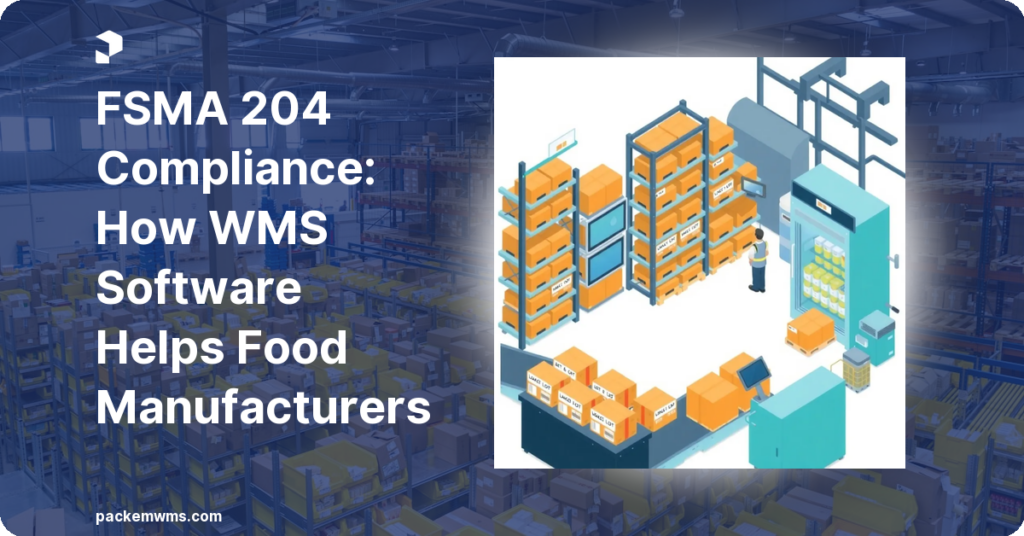
FSMA 204 Compliance: How WMS Software Helps Food Manufacturers
FSMA 204 — the FDA’s Food Safety Modernization Act Section 204 food traceability rule — requires food manufacturers, distributors, and warehouses handling foods on the FDA’s Food Traceability List (FTL) to maintain detailed lot-level records and produce traceability documentation within 24 hours of an FDA request. Warehouse management software with built-in lot tracking automates this documentation by capturing lot numbers, dates, locations, and chain of custody at every handling step — eliminating the manual recordkeeping burden that makes compliance impossible at scale.
If you’re a food manufacturer, food-grade 3PL, or cold chain distributor subject to FSMA 204, this guide covers what the rule requires, where manual systems fail, and how a WMS makes compliance operational rather than a fire drill.
What FSMA 204 Actually Requires
The FDA’s FSMA 204 food traceability rule (21 CFR Part 1, Subpart S) establishes a new traceability recordkeeping standard for foods on the Food Traceability List. The FTL includes fresh produce, shell eggs, nut butters, ready-to-eat deli salads, soft cheeses, finfish and crustaceans, and certain other fruits and vegetables.
For covered foods, FSMA 204 requires businesses to maintain Key Data Elements (KDEs) at each Critical Tracking Event (CTE). The key obligations: lot code assignment, KDE capture (TLC, quantity, date, business name), 24-hour FDA response, and two-year records retention. The rule applies to all facilities including 3PLs and cold chain warehouses.
Where Manual Recordkeeping Fails FSMA 204
Most small food manufacturers manage lot traceability with paper logs, spreadsheets, and institutional memory. Under an FDA audit, it breaks down immediately. The core problem: manual systems can’t reconstruct chain of custody quickly. When FDA requests records, your team needs to produce them in 24 hours — not compile them from five spreadsheets across three employees’ computers.
According to the FDA, the agency conducts over 15,000 facility inspections annually, and food traceability documentation is among the top cited deficiencies. The average food recall costs a manufacturer $10 million in direct costs.
How WMS Lot Tracking Automates FSMA Documentation
A WMS with integrated lot tracking makes data capture mandatory at every workflow step. At receiving, the scan captures lot number, expiration date, quantity, and supplier — the system won’t complete the event without lot data. During storage, every bin movement is logged with a timestamp. At picking, FIFO/FEFO enforcement requires scanning the correct lot. At shipping, the confirmation ties lot numbers to the outbound order, customer, carrier, and ship date.
PackemWMS captures all of these events natively. The food manufacturing WMS configuration supports lot and serial number tracking with FIFO/FEFO enforcement, expiration date alerts, and complete lot traceability reporting. When an FDA request comes in, you run a lot trace report and get the complete chain of custody in minutes.
Lot Traceability Reports: Your FSMA 204 Response Package
The most operationally valuable feature of a FSMA 204-ready WMS is the lot traceability report. In a spreadsheet-based operation, assembling this report takes 8 to 24 hours. In a WMS with complete lot tracking, it takes 5 to 10 minutes. That difference is the gap between a manageable compliance event and a crisis.
FSMA 204 Compliance for Small Food Manufacturers and 3PLs
The FSMA 204 rule applies to facilities of all sizes — there’s no small business exemption. The original compliance deadline was January 20, 2026. Congress subsequently extended enforcement via the Continuing Appropriations Act of 2026 — the FDA will not initiate enforcement prior to July 20, 2028. That extension gives food manufacturers and 3PLs more runway to build compliant systems. The practical advice: start now. Early compliance becomes a competitive advantage when your clients’ auditors request documentation.
PackemWMS provides FSMA-ready lot tracking at $750 to $1,800 per month with a 2 to 5 week implementation. Enterprise food safety platforms run $20,000 to $100,000+ annually — not appropriate for a $5M food manufacturer or 20-employee cold chain 3PL.
Getting FSMA 204-Ready: Where to Start
- Identify your FTL products.
- Audit your current KDE capture for each CTE.
- Identify the gaps — most operations find receiving lot data is inconsistent and storage movement is rarely logged.
- Implement WMS lot tracking with mandatory lot capture, FIFO/FEFO enforcement, and traceability reporting.
- Test before you need it — run a mock FDA lot trace request on real data.
Contact PackemWMS to see how the lot tracking and compliance reporting configuration works for food manufacturers and 3PLs handling FSMA-covered products.
Frequently Asked Questions
What is FSMA 204 and who does it apply to?
FSMA 204 is the FDA’s food traceability rule requiring food manufacturers, distributors, and warehouses handling foods on the Food Traceability List (FTL) to maintain lot-level traceability records and produce documentation within 24 hours of an FDA request. It applies to facilities of all sizes. The original compliance deadline was January 20, 2026; Congress extended enforcement to July 20, 2028 via the Continuing Appropriations Act of 2026.
Does WMS software help with FSMA 204 compliance?
Yes. A WMS with integrated lot tracking automates FSMA 204 Key Data Element (KDE) capture at every Critical Tracking Event (CTE) and generates lot traceability reports on demand.
What lot tracking features does a FSMA 204-compliant WMS need?
Mandatory lot number capture at receiving, FIFO/FEFO rotation enforcement at picking, expiration date tracking and alerts, location-level lot tracking through storage movements, and a lot traceability report that produces complete chain of custody within minutes.
When did FSMA 204 go into effect?
The FDA’s FSMA 204 food traceability rule originally took effect January 20, 2026. Congress subsequently extended enforcement via the Continuing Appropriations Act of 2026 — the FDA will not initiate enforcement prior to July 20, 2028. Covered facilities should use this window to implement compliant lot traceability systems.