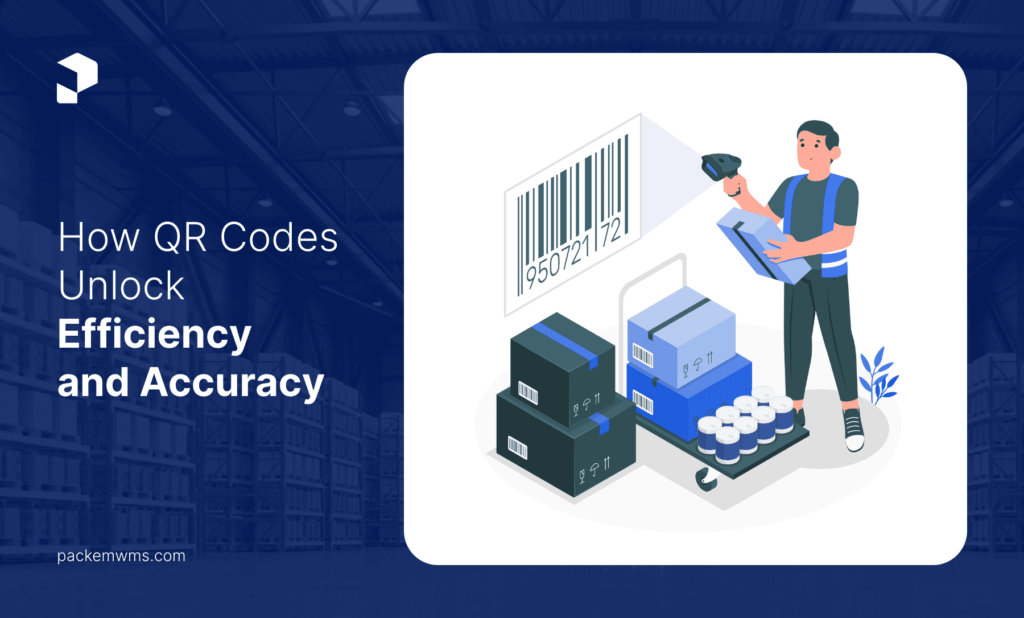
QR code inventory management: How to unlock efficiency and accuracy
Manual inventory tracking costs warehouses 20 to 40 hours per week and creates error rates as high as 25%. Those mistakes ripple through your entire operation, from billing errors and stockouts to frustrated customers and lost revenue. QR code inventory management slashes these costs by 70% while requiring zero specialized equipment beyond the smartphones your team already carries.
The shift is happening faster than most warehouse operators realize. Major brands like Coca-Cola, L’Oreal, and Procter & Gamble are transitioning to QR-based systems by 2027 as part of the Sunrise 2027 initiative to phase out traditional barcodes. Warehouses and 3PLs that adapt now position themselves ahead of this industry transformation while immediately capturing efficiency gains their competitors won’t see for years.
This guide walks through everything you need to know about QR code inventory management. You’ll learn how QR codes work, when to use them versus traditional barcodes, how to implement them in your warehouse, and what ROI to expect from the transition.
What is QR code inventory management?
QR code inventory management uses two-dimensional barcodes to track items throughout your warehouse operations. Unlike traditional one-dimensional barcodes that store 20 characters of data, QR codes hold up to 4,296 alphanumeric characters. That expanded capacity lets you embed detailed product information, lot numbers, expiration dates, locations, and tracking data directly into each code.
The technology traces back to 1994 when Denso Wave, a Toyota subsidiary, invented QR codes to track automotive parts through complex manufacturing processes. The automotive industry needed faster, more reliable tracking than traditional barcodes could provide. QR codes solved that problem by storing more data and working from any scan angle.
What makes QR code inventory management practical for warehouses today is smartphone compatibility. Your team can scan QR codes using Android devices or standard mobile scanners without investing thousands in dedicated barcode equipment. The system updates inventory counts instantly across all connected platforms including your WMS, accounting software, and customer portals.
How QR codes work for warehouse operations
QR codes encode information using patterns of black squares arranged on a white background. When you scan a code, the system reads these patterns digitally rather than relying on light reflection like traditional barcodes. This digital reading method makes QR codes more reliable in challenging warehouse environments where codes might be dirty, damaged, or positioned at awkward angles.
The codes remain readable even with up to 30% physical damage. That durability matters in warehouses where labels get scraped by pallet jacks, exposed to moisture, or partially torn during handling. Traditional barcodes become unreadable with far less damage.
Warehouse staff scan QR codes during receiving, putaway, picking, packing, and shipping. Each scan triggers real-time updates to inventory quantities, locations, and status. This eliminates the manual data entry that creates most warehouse errors while giving you instant visibility into inventory movement.
QR codes vs. barcodes: Complete comparison
Understanding the differences between QR codes and traditional barcodes helps you decide when to use each technology in your warehouse.
| Feature | QR Codes | Traditional Barcodes |
|---|---|---|
| Data capacity | 4,296 alphanumeric characters | ~20 characters |
| Damage tolerance | Readable with 30% damage | Fails with minor damage |
| Scan angle | Any angle (360 degrees) | Must be horizontally aligned |
| Equipment needed | Smartphone or standard scanner | Dedicated barcode scanner |
| Equipment cost | $0-50 (use existing phones) | $500-2,000 per scanner |
| Information types | Product details, lot numbers, locations, URLs, serial numbers | Product SKU only |
| Size flexibility | Scales from very small to large | Requires minimum width for readability |
| Error correction | Built-in redundancy | No error correction |
Technical specifications
QR codes store data in both horizontal and vertical dimensions, creating a two-dimensional matrix. This structure enables the massive data capacity difference. A standard QR code can encode:
- 4,296 alphanumeric characters
- 7,089 numeric-only characters
- 1,817 Kanji characters
- Binary data for images or files
Traditional one-dimensional barcodes read data linearly from left to right. The UPC barcodes found on retail products typically encode 12 digits. Even the longest barcode formats max out around 100 characters.
When to use QR codes versus barcodes
Use QR codes when you need to:
- Track lot numbers, serial numbers, or expiration dates at the item level
- Encode location information for multi-client warehousing
- Store detailed product specifications
- Link physical items to digital resources or documentation
- Track items through multiple checkpoints in your facility
- Implement tracking without buying dedicated scanning equipment
Stick with traditional barcodes when you:
- Only need to identify product SKUs
- Already have barcode infrastructure in place
- Work with retail partners who require UPC codes
- Handle products that already carry manufacturer barcodes
Many warehouses run hybrid systems during the transition period. You can scan traditional barcodes for basic SKU identification while adding QR codes to pallets, locations, and individual units that need detailed tracking.
Key benefits of QR code systems
QR code inventory management delivers measurable improvements across warehouse operations. The benefits compound as you expand implementation from single checkpoints to full warehouse-wide tracking.
Real-time inventory updates
QR codes eliminate the lag between physical inventory movement and system updates. When warehouse staff scan an item during receiving, your WMS updates quantities instantly. That real-time visibility prevents overselling, reduces stockouts, and gives you accurate inventory counts without manual cycle counting.
The difference matters most during peak periods when inventory moves quickly. Traditional manual entry creates delays of hours or even days between physical movement and system updates. Those delays force you to maintain safety stock buffers that tie up working capital.
Error reduction from 25% to under 5%
Manual data entry creates error rates of 20% to 25% in typical warehouse operations. QR code scanning drops that to less than 5%. The improvement comes from eliminating manual typing of SKUs, lot numbers, and quantities.
Consider receiving operations where staff manually enter product codes and quantities. Transposed numbers, typos, and misread handwriting create inventory discrepancies that cascade through your entire operation. Scanning replaces typing with automated data capture that’s accurate the first time.
Cost savings on equipment and labor
Smartphone scanning means warehouses can implement QR code tracking for $0 to $50 per device versus $500 to $2,000 for dedicated barcode scanners. Small to mid-size warehouses save $10,000 to $50,000 on equipment costs by using existing Android devices or low-cost smartphones.
Labor savings prove even more significant. QR code systems cut inventory counting time by 60% to 70%. A warehouse spending 30 hours per week on cycle counts and inventory verification can reclaim 20 hours for productive work. At $20 per hour, that’s $20,800 in annual labor savings from one improvement.
Enhanced tracking of high-value items
QR codes enable item-level tracking for high-value inventory where traditional SKU-level tracking creates too much risk. You can encode serial numbers, purchase dates, warranty information, and ownership details into codes attached to individual items.
This granular tracking matters for items like electronics, pharmaceuticals, or expensive components where you need complete chain of custody documentation. The detailed records help with compliance requirements, warranty claims, and theft prevention.
Scalability and flexibility
QR code systems scale effortlessly as warehouse operations grow. Generate new codes instantly for new products, locations, or tracking needs without waiting for pre-printed label shipments. Dynamic QR codes can be edited after printing, letting you update information without reprinting physical labels.
The flexibility extends to multi-client warehousing where you track inventory for dozens or hundreds of customers. Encode client identifiers, special handling instructions, and billing codes into item-level QR codes. Your system automatically routes items and applies correct billing without manual sorting or lookup.
Security and compliance benefits
QR codes add a security layer for high-value inventory and regulated products. You can embed authentication codes that prevent counterfeit items from entering your supply chain. This matters particularly for pharmaceuticals, luxury goods, and electronics where counterfeit products create liability and brand damage.
For regulated industries, QR codes simplify compliance with tracking requirements. Healthcare warehouses use QR codes to maintain FDA-required records for pharmaceutical lot tracking. Food warehouses encode FIFO and FEFO data to ensure proper stock rotation and expiration date management.
Static vs. dynamic QR codes for inventory management
Not all QR codes work the same way. Understanding static versus dynamic codes helps you choose the right approach for different warehouse applications.
Static QR codes
Static codes encode information directly into the code pattern. Once generated, the data cannot be changed without creating a new code. When scanned, static codes immediately reveal their embedded information without requiring internet connectivity or database lookups.
Best uses for static codes:
- Product identification codes that never change
- Location labels for fixed warehouse positions
- Equipment identification tags
- Emergency information or safety instructions
Advantages:
- Work offline without internet or system connectivity
- Faster scan-to-data retrieval (no lookup required)
- No ongoing costs or subscription fees
- Never break due to backend system issues
Limitations:
- Cannot update information after printing
- No scan tracking or analytics
- Limited to information that fits in the code itself
Dynamic QR codes
Dynamic codes contain a short URL that redirects to a database record. The code itself doesn’t change, but you can update the destination information anytime. This flexibility makes dynamic codes ideal for inventory tracking where item details, locations, and status change frequently.
Best uses for dynamic codes:
- Pallet tracking through multiple locations
- Work-in-progress inventory with changing status
- Multi-client inventory with changing ownership
- Items requiring frequent information updates
Advantages:
- Update information without reprinting labels
- Track scan history and analytics
- A/B test different workflows
- Manage from centralized dashboard
Limitations:
- Require internet connectivity to function
- Depend on backend system availability
- May have ongoing subscription costs
- Slightly slower (requires lookup step)
Recommendation for warehouse operations
Most warehouses benefit from a hybrid approach. Use static codes for fixed elements like location labels and equipment tags. Deploy dynamic codes for inventory items, pallets, and anything that moves through your facility or changes status over time.
Dynamic codes prove especially valuable in 3PL operations where the same physical location might hold inventory for different clients throughout the week. Update the QR code destination as inventory changes rather than managing separate physical labels for each client.
Implementation guide: How to get started with QR codes
Rolling out QR code inventory management doesn’t require massive upfront investment or months-long implementations. Most warehouses can start small and expand systematically.
Step 1: Assess your tracking needs
Identify where manual processes or inventory visibility gaps create the biggest problems in your current operations. Common starting points include:
- Receiving where manual data entry causes delays and errors
- Bin location tracking where staff spend too much time searching for items
- Lot and serial number tracking for compliance or quality control
- Multi-client inventory requiring detailed ownership tracking
Start with one pain point rather than trying to transform your entire operation simultaneously. Pilot success builds internal support for expanded rollout.
Step 2: Choose QR code type and generation method
Decide between static and dynamic codes based on your pilot scope. For simple location labeling, static codes work fine and cost nothing. For inventory tracking, dynamic codes provide the flexibility most warehouses need.
QR code generation options:
- Free online generators for static codes and small batches (QR Code Generator, qr-code-generator. com)
- Spreadsheet-based bulk generation using Google Sheets add-ons or Excel macros for hundreds of codes
- WMS-integrated generation where your warehouse management system creates codes automatically
- Dedicated QR platforms like Uniqode for enterprise-scale dynamic code management
Most warehouses start with free tools for pilots, then graduate to WMS integration or dedicated platforms as implementation expands.
Step 3: Integrate with existing systems
QR code scanning needs to feed data into your existing warehouse management system, ERP, or inventory tracking platform. Integration approaches include:
Direct WMS integration: Modern warehouse management systems like PackemWMS include built-in QR code support. Items, locations, and transactions link automatically without custom development.
API connections: Connect standalone QR platforms to your WMS through REST APIs. This approach works when your WMS vendor doesn’t offer native QR support.
Middleware solutions: Tools like Zapier or Make. com bridge QR scanning apps and warehouse systems through no-code integration workflows.
DIY database approach: Build custom integration using Google Forms and Google Sheets for lightweight implementations. This practical approach works for smaller warehouses not ready to invest in commercial platforms.
Practical example: Google Forms + Sheets + API integration
You can implement basic QR code tracking with free tools for pilot testing:
- Create a Google Sheet to store inventory records with columns for item ID, location, quantity, timestamp, and staff member.
- Build a Google Form that captures scans. Include fields for QR code data (auto-populated), action type (receiving, putaway, picking), and quantity.
- Generate item-specific QR codes encoding unique item identifiers using a free QR generator.
- Configure the Google Form to populate your Google Sheet automatically when staff scan codes and submit the form.
- Set up email or Slack notifications triggered by new form submissions for real-time alerts on key actions.
This approach costs nothing and runs on smartphones staff already carry. It proves the concept before you invest in commercial platforms or WMS upgrades.
Step 4: Test workflows and train staff
Run controlled tests in one warehouse area before expanding. Pick a low-risk area where mistakes won’t disrupt critical operations. Track error rates, scan times, and staff feedback during testing.
Training needs for QR codes prove surprisingly minimal. Most warehouse staff learn the scanning workflow in under 10 minutes. The smartphone interface feels familiar compared to dedicated barcode scanners with cryptic button combinations.
Focus training on:
- How to position smartphones for quick, reliable scans
- What to do when a code won’t scan (damage, lighting issues)
- How to verify the system captured the right item information
- When to use manual entry as a fallback
Document common issues and solutions in a one-page quick reference guide that staff can access on their phones.
Step 5: Scale and optimize
Expand systematically from your pilot area to additional warehouse zones. Roll out in phases rather than attempting warehouse-wide implementation overnight. Each phase teaches lessons that improve the next rollout.
Track metrics to quantify improvements:
- Time per scan (target: under 3 seconds)
- Scan error rate (target: under 2%)
- Inventory accuracy (target: 98%+)
- Staff adoption rate
- Time saved on inventory counts
Use these metrics to build the business case for expanded implementation and justify budget for commercial platforms or WMS upgrades that enable more sophisticated tracking.
Industry applications and case studies
QR code inventory management proves valuable across industries. Real-world examples show both implementation approaches and measurable results.
Retail: Wegmans and inventory visibility
Grocery chain Wegmans deployed QR codes for tracking perishable inventory across their distribution network. Each case and pallet carries a QR code encoding product details, lot numbers, and expiration dates. Warehouse staff scan codes during receiving and putaway, creating automatic FIFO rotation that prevents expired products from reaching stores.
The system cut inventory shrinkage by 40% by ensuring proper stock rotation and reducing expired product waste. Real-time tracking also enables more frequent deliveries with smaller safety stock levels, freeing up warehouse space.
Retail: Nutura Organic and counterfeit prevention
Nutura Organic uses QR codes with embedded authentication to combat counterfeit products. Each product carries a unique QR code linked to blockchain records. Consumers scan codes to verify authenticity, while retailers scan the same codes during receiving to ensure they’re stocking genuine products.
This dual-purpose approach protects brand reputation while giving Nutura complete visibility into their supply chain. They track exactly which warehouses, distributors, and retailers handle each batch of products.
Manufacturing: Toyota and automotive parts tracking
Toyota and Denso Wave originally invented QR codes to solve automotive parts tracking challenges. Today, Toyota manufacturing facilities use QR codes to track components from suppliers through assembly and into finished vehicles. The system ensures the right parts reach the right assembly stations while maintaining complete traceability for quality control and recall management.
Manufacturing speed increased 30% compared to barcode-based tracking because QR codes scan reliably even when positioned at challenging angles or partially obscured by grease and dirt.
Manufacturing: General Electric and complex assemblies
GE manufacturing facilities use QR codes to track complex assemblies through multi-stage production. Each component and subassembly carries a QR code linked to specifications, quality checks, and assembly instructions. Technicians scan codes to pull up digital work instructions specific to each unit.
This approach eliminated paper travelers that previously accompanied units through production. Digital tracking reduced errors by 60% while creating complete digital records for compliance and quality auditing.
Warehousing: Walmart and DC efficiency
Walmart deployed QR codes across their distribution center network to improve receiving and putaway accuracy. Each pallet receives a QR code encoding contents, destination store, and handling requirements. Warehouse staff scan pallets rather than individually scanning items, cutting receiving time by 45%.
The system also enables dynamic slotting where the WMS assigns putaway locations based on real-time space availability rather than fixed positions. This flexibility increases storage density by 20% compared to static location assignments.
Healthcare: Pharmaceutical tracking and compliance
Indian pharmaceutical warehouses use QR codes to comply with government tracking mandates for drug supply chains. Each package carries a QR code encoding manufacturer details, batch numbers, expiration dates, and distribution history. Pharmacies scan codes during receiving to verify authenticity and update central registries.
This system virtually eliminated counterfeit pharmaceuticals from regulated supply chains while automating compliance documentation that previously required manual paperwork at every supply chain handoff.
Logistics: Real-time shipment tracking
Logistics provider LKW Walter uses QR codes on shipments to enable real-time visibility for customers. Each shipment carries a QR code linked to a tracking portal. Drivers scan codes at pickup, checkpoints, and delivery to update shipment status automatically.
Customers access the same tracking data by scanning codes or visiting a web portal. The system reduced customer service inquiries by 70% because customers can self-serve rather than calling for status updates.
ROI and cost-benefit analysis
Understanding the financial impact helps justify QR code implementation to leadership and operations teams.
Time savings
Manual inventory processes consume 20 to 40 hours per week in typical warehouses. QR code scanning cuts this time by 60% to 70%. For a warehouse spending 30 hours weekly on inventory counts, that’s 20 hours reclaimed for productive work.
Annual labor savings calculation:
- Hours saved per week: 20
- Annual hours: 1,040 (20 hours × 52 weeks)
- Labor cost at $20/hour: $20,800
- Labor cost at $30/hour: $31,200
Even accounting for implementation time and ongoing maintenance, warehouses typically see positive ROI within 3 to 6 months from labor savings alone.
Error reduction impact
Inventory errors cost warehouses in multiple ways: wrong items shipped, stockouts, excess safety stock, and customer credits. A typical warehouse with $5 million in annual inventory value and a 20% error rate loses $1 million to error-related costs including:
- Expedited shipping to correct mistakes: $50,000
- Customer credits and refunds: $200,000
- Excess safety stock to buffer errors: $600,000
- Rework and returns processing: $150,000
Reducing errors from 20% to 5% recovers $750,000 of these costs. QR code implementation costing $50,000 delivers 15x first-year ROI from error reduction alone.
Equipment cost comparison
Traditional barcode infrastructure requires $500 to $2,000 per scanner. A 20-person warehouse operation needs 10 to 15 scanners, creating $7,500 to $30,000 in equipment costs plus ongoing maintenance and replacement.
QR code scanning using existing smartphones or low-cost Android devices runs $0 to $50 per device. The same 20-person warehouse spends $0 to $750 on equipment. Even adding $5,000 for a commercial QR platform subscription, total first-year costs remain under $6,000.
Five-year TCO comparison:
| Cost Category | Traditional Barcodes | QR Codes |
|---|---|---|
| Initial equipment | $15,000 | $1,000 |
| Software/platform | $5,000/year | $3,000/year |
| Maintenance | $2,000/year | $500/year |
| Five-year total | $50,000 | $16,000 |
| Savings | , | $34,000 |
Payback period
Most warehouses achieve payback in 3 to 6 months from combined labor savings and error reduction. Conservative calculations assume:
- Implementation cost: $10,000 (labor, software, training)
- Monthly labor savings: $1,700 (20 hours × $20/hour × 4.3 weeks)
- Monthly error reduction savings: $2,000
- Total monthly benefit: $3,700
- Payback period: 2.7 months
After payback, the warehouse captures $44,400 in annual net benefits.
The future: Sunrise 2027 and beyond
QR code adoption is accelerating beyond early adopters. Industry initiatives and technology improvements are making QR-based tracking the expected standard rather than an innovation.
The Sunrise 2027 initiative
Sunrise 2027 is a global movement led by GS1, the organization that manages barcode standards. The initiative calls for transitioning from traditional one-dimensional barcodes to two-dimensional codes like QR codes by 2027. Major brands committed to this timeline include:
- Coca-Cola
- L’Oreal
- Procter & Gamble
- Unilever
- PepsiCo
These consumer goods giants are pressuring suppliers, manufacturers, and warehouses to adopt 2D code infrastructure to maintain business relationships. Warehouses still running barcode-only systems after 2027 risk losing major customers or facing expensive rush implementations.
Why the industry is shifting
Traditional barcodes reached their capability limits years ago. Modern supply chains demand more product information, authentication capabilities, and consumer engagement than barcodes can deliver.
Two-dimensional codes solve these limitations:
- Expanded data: Store batch codes, expiration dates, and serial numbers at the item level
- Authentication: Embed security features to prevent counterfeits
- Consumer engagement: Link products to digital content, instructions, and recycling information
- Supply chain visibility: Track items through complex global networks
The COVID-19 pandemic accelerated adoption by 3 to 5 years as QR codes became ubiquitous for contactless menus, payments, and information sharing. Consumers now expect to scan products for information, creating pressure on brands to deploy QR infrastructure.
Timeline and implementation considerations
Warehouses should plan 2D code infrastructure by 2026 to avoid rushed implementations. Key milestones:
2024-2025: Test pilots and evaluate platforms. Identify which warehouse areas benefit most from QR implementation.
2025-2026: Roll out QR codes for high-value items, complex tracking needs, and customer-facing applications.
2026-2027: Expand to complete warehouse operations. Train staff on hybrid barcode/QR workflows during the transition.
2027+: Fully transitioned to 2D codes with barcode support only for legacy items and special cases.
Early adopters capture competitive advantages before market pressure forces implementation. You’ll have time to optimize workflows, train staff thoroughly, and negotiate better platform pricing before the 2027 rush creates vendor capacity constraints.
Emerging trends in warehouse tracking
QR codes integrate with complementary technologies to enable even more sophisticated inventory management:
IoT integration: Smart shelves and sensors automatically trigger QR scans when inventory moves, eliminating manual scanning.
Cloud-based platforms: Warehouse systems move to cloud infrastructure that makes real-time data accessible across distributed operations and to customers.
AI and computer vision: Cameras automatically read QR codes on items moving through the warehouse, capturing data without human intervention.
Blockchain authentication: QR codes link to blockchain records that create tamper-proof supply chain histories for regulated products.
Warehouses implementing QR infrastructure now position themselves to adopt these emerging capabilities as they mature.
PackemWMS solution overview
PackemWMS is warehouse management software built for small to mid-size 3PLs and warehouses. The platform includes built-in QR code support designed specifically for warehouses serving multiple clients.
How PackemWMS simplifies QR implementation
The system generates QR codes automatically for items, locations, and pallets during receiving and setup. No third-party tools or custom integrations required. Warehouse staff scan codes using Android mobile devices, and inventory updates flow instantly to all connected systems.
Key QR features include:
Automatic code generation: PackemWMS creates unique QR codes for every item, location, and pallet. Print labels directly from the system.
Multi-client tracking: QR codes encode client identifiers so the system automatically routes inventory and applies correct billing without manual sorting.
Lot and serial tracking: Capture and track lot numbers and serial numbers automatically during receiving. Ensure FIFO and FEFO compliance without manual record-keeping.
Real-time synchronization: Scans update your WMS, QuickBooks accounting, and customer portals simultaneously. Eliminate sync delays and duplicate data entry.
Mobile Android app: Staff scan QR codes using Android smartphones or Zebra mobile computers. The familiar interface requires minimal training.
Unique advantages for warehouse operations
PackemWMS focuses on the specific needs of small to mid-size warehouses rather than trying to serve enterprise operations with complex requirements:
Fast implementation: Most warehouses go live in 2 to 5 weeks versus months-long implementations with enterprise platforms.
Scalable pricing: Plans start at $750 per month and scale based on warehouse needs. No surprise costs or per-user fees that spiral as operations grow.
Billing automation: The built-in billing engine generates accurate invoices automatically based on QR-tracked inventory movements. Eliminate manual billing spreadsheets.
QuickBooks integration: Two-way sync keeps your accounting system updated in real-time without manual journal entries or reconciliation.
Customer success snapshot
Warehouses using PackemWMS report:
- 60% to 80% reduction in billing time through automated invoice generation
- 95%+ inventory accuracy from QR-based tracking
- 10+ hours per week saved on manual inventory counts
- 2 to 5 week implementation timelines versus months with legacy systems
The platform works for warehouses handling 100 to 10,000+ orders per month across B2B, DTC, and hybrid fulfillment models.
Key takeaways
QR code inventory management reduces warehouse errors, cuts labor costs, and positions operations ahead of the Sunrise 2027 transition away from traditional barcodes.
Core benefits:
- Reduce inventory errors from 25% to under 5%
- Cut inventory counting time by 60% to 70%
- Save $10,000 to $50,000 on scanning equipment
- Track lot numbers, serial numbers, and expiration dates automatically
- Scale effortlessly as warehouse operations grow
Implementation checklist:
- Start with one pain point (receiving, location tracking, or lot control)
- Choose dynamic QR codes for inventory items and static codes for fixed locations
- Test workflows in one warehouse area before expanding
- Integrate with existing WMS or build lightweight pilots using free tools
- Train staff on smartphone scanning (typically under 10 minutes)
- Track metrics to quantify ROI (time savings, accuracy, error reduction)
- Plan full warehouse rollout by 2026 to stay ahead of Sunrise 2027 deadline
Next steps by warehouse size:
Small warehouses (under 1,000 orders/month): Start with free QR tools and Google Sheets integration. Prove ROI before investing in commercial platforms.
Mid-size operations (1,000 to 5,000 orders/month): Implement WMS with native QR support like PackemWMS. Focus on multi-client tracking and billing automation.
Large warehouses (5,000+ orders/month): Deploy enterprise QR platforms integrated with advanced warehouse control systems. Prioritize IoT integration and automation.
The warehouse operations that thrive in the next decade will be those that adopted modern tracking infrastructure while competitors delayed. QR codes provide the foundation for this transformation with immediate ROI and long-term strategic positioning.
See how PackemWMS simplifies QR code implementation for 3PLs and warehouses. Book a demo to explore the platform and see real-time QR tracking in action.
FAQs
What is QR code inventory management?
QR code inventory management uses two-dimensional barcodes to track items throughout warehouse operations. Unlike traditional barcodes that store about 20 characters, QR codes hold up to 4,296 characters of data including product details, lot numbers, locations, and tracking information. Warehouse staff scan QR codes using smartphones or standard scanners, triggering instant updates to inventory systems.
How do QR codes differ from traditional barcodes for inventory?
QR codes store 200x more data than traditional barcodes (4,296 characters versus 20), scan from any angle instead of requiring horizontal alignment, remain readable with up to 30% physical damage, and work with smartphones instead of requiring dedicated scanners costing $500 to $2,000 each. Traditional barcodes work fine for simple SKU identification, but QR codes enable detailed item-level tracking including lot numbers, serial numbers, and real-time location data.
What are the main benefits of QR code systems?
QR code systems reduce inventory errors from 25% to under 5%, cut inventory counting time by 60% to 70%, eliminate the need for expensive scanning equipment, enable item-level tracking of lot numbers and serial numbers, scale effortlessly as operations grow, and provide security benefits including counterfeit prevention. Most warehouses see ROI within 3 to 6 months from combined labor savings and error reduction.
How can businesses incorporate QR code inventory management?
Start with one warehouse area experiencing tracking problems (receiving, location management, or lot tracking). Generate QR codes using free online tools for pilots or WMS-integrated generation for full implementations. Integrate with existing warehouse management systems through native support, API connections, or no-code tools like Zapier. Train staff on smartphone scanning (typically under 10 minutes). Test workflows before expanding warehouse-wide. Track metrics including scan time, error rates, and labor hours saved to quantify ROI.
What does the future hold for QR code tracking technology?
The Sunrise 2027 initiative is driving global transition from traditional barcodes to 2D codes by 2027. Major brands including Coca-Cola, L’Oreal, and Procter & Gamble committed to this timeline. Emerging trends include IoT integration where sensors trigger automatic scanning, AI and computer vision for hands-free code reading, blockchain authentication for supply chain security, and cloud platforms enabling real-time visibility across distributed operations. Warehouses should plan 2D infrastructure by 2026 to avoid rushed implementations.
How much does QR code inventory management cost?
Implementation costs vary from $0 for lightweight pilots using free tools and existing smartphones to $10,000 to $50,000 for commercial platforms with WMS integration. Ongoing costs include software subscriptions ($3,000 to $15,000 annually depending on scale) and minimal maintenance. This compares favorably to traditional barcode infrastructure requiring $500 to $2,000 per scanner plus ongoing replacement costs. Most warehouses achieve payback in 3 to 6 months from labor savings and error reduction.
Can QR codes work without internet connectivity?
Static QR codes work completely offline because data is encoded directly in the code pattern. When scanned, static codes immediately reveal embedded information without requiring internet or database lookups. Dynamic QR codes require internet connectivity because they contain URLs that redirect to database records. Warehouses can use static codes for location labels and equipment tags that need offline functionality, while deploying dynamic codes for inventory items where real-time system updates justify the connectivity requirement.
What industries benefit most from QR code tracking?
Healthcare and pharmaceutical warehouses use QR codes for lot tracking and regulatory compliance. Food and beverage operations leverage QR codes for expiration date management and FIFO/FEFO rotation. 3PLs and multi-client warehouses use QR codes to track inventory ownership and automate client billing. Retail distribution centers deploy QR codes for receiving accuracy and automated putaway. Manufacturing facilities use QR codes to track components through assembly and maintain quality records. Any industry requiring detailed item-level tracking or regulatory compliance sees significant benefits from QR implementation.