The US direct to consumer market is projected to exceed $212 billion in 2025. That’s a massive opportunity sitting right in front of your warehouse doors. But here’s the problem: most 3PLs built their operations around B2B fulfillment, shipping pallets and cases to retailers on scheduled deliveries. Direct to consumer fulfillment plays by completely different rules.
DTC means high-volume, single-item orders that need to ship fast with perfect accuracy. It means Shopify integrations, branded unboxing experiences, and customers who expect tracking updates the moment their order leaves your dock. Many 3PLs struggle to make this transition because their systems and workflows were never designed for it.
This guide covers everything you need to know about adding DTC fulfillment services to your 3PL operation. From the technology requirements to workflow optimization, we’ll walk through how to capture your share of this growing market without overwhelming your team or breaking your budget.
What is direct to consumer fulfillment?
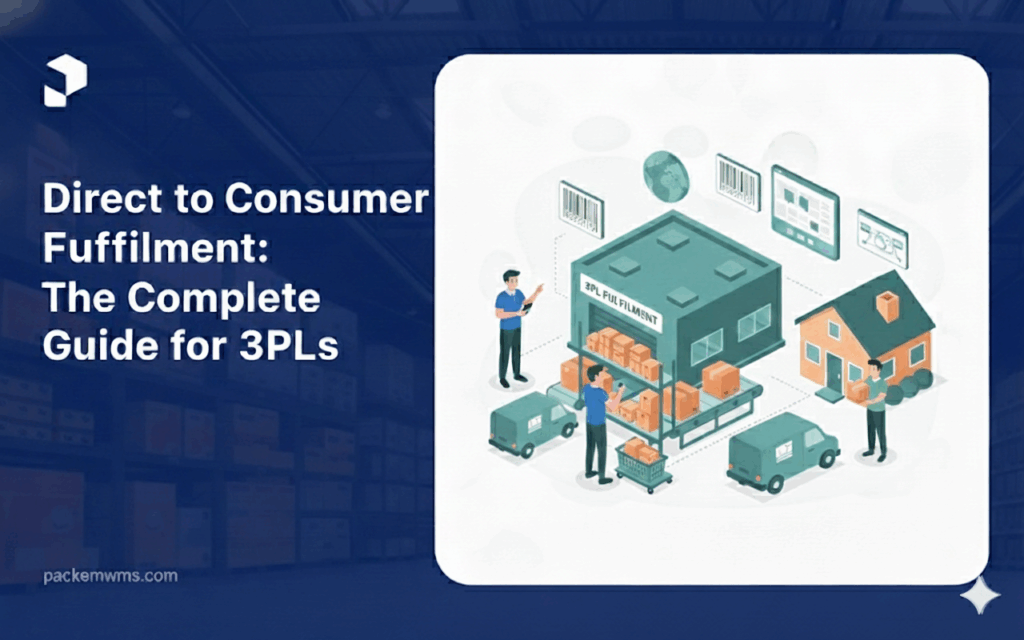
Direct to consumer (DTC) fulfillment is the process of shipping products directly from a warehouse to individual end customers, bypassing retailers and distributors entirely. For 3PLs, this means handling high-volume, single-item orders with fast turnaround times and branded packaging requirements. Unlike wholesale fulfillment where you’re shipping pallets to a retailer’s distribution center, DTC fulfillment involves picking, packing, and shipping individual items to thousands of different addresses.
The DTC model has exploded because brands want control over their customer relationships and supply chain. When a consumer buys directly from a brand’s website or marketplace store, that brand owns the entire experience from checkout to last-mile delivery. They set the prices, control the packaging, and build loyalty without a retailer in the middle.
For 3PLs, this creates a significant opportunity. According to recent industry data, 73% of high-growth DTC brands outsourced their fulfillment by the end of 2024. These brands need warehouse partners who understand the unique demands of consumer-direct shipping. The orders are smaller, the volume is higher, the speed expectations are tighter, and the tolerance for errors is basically zero.
DTC fulfillment vs B2B fulfillment: key differences
Understanding the operational differences between direct to consumer fulfillment and B2B fulfillment is critical before you start serving e-commerce brands. Direct to consumer logistics requires different warehouse layouts, different picking strategies, and often different technology than traditional wholesale operations.
Order size and volume
The most obvious difference comes down to pieces versus cases. In B2B fulfillment, you’re shipping larger quantities to fewer customers. A typical B2B order might be 50 cases going to a single retail location. In DTC fulfillment, you’re shipping one or two items to hundreds or thousands of individual customers every day.
This changes everything about how you organize your warehouse and allocate labor. B2B operations can plan around scheduled shipments and predictable volumes. DTC operations deal with constant order flow that can spike unpredictably during sales events, product launches, or social media virality.
Warehouse infrastructure
B2B warehouses are built around pallet storage with heavy racking, forklifts, and large staging areas for outbound pallets. DTC warehouse fulfillment requires pick faces, shelving for individual items, packing stations for single orders, and efficient walking paths for pickers moving through the facility multiple times per hour.
Many 3PLs handling both DTC and B2B clients create separate zones within their warehouse. The pallet area handles wholesale orders with traditional warehouse management system processes. The pick-and-pack area handles DTC orders with different workflows optimized for speed and accuracy.
Picking and packing processes
B2B picking typically happens at the pallet or case level. You’re pulling full cases from bulk storage and staging them for shipment. DTC picking requires grabbing individual items from pick faces, often using batch picking or wave picking strategies to handle multiple orders simultaneously.
Packing is equally different. B2B orders get standard packaging and compliance labels for retail receiving. DTC orders often require branded boxes, custom tissue paper, promotional inserts, and the kind of presentation that creates a memorable unboxing experience.
Customer expectations
B2B customers care about on-time delivery, accurate quantities, and proper documentation like EDI advance ship notices. DTC customers expect two-day shipping, real-time tracking updates, fast last-mile delivery, and an overall experience that matches what they get from Amazon. Missing these expectations with DTC customers has real consequences. Research shows that brands failing to meet customer service expectations see a 37% drop in repeat purchase likelihood.
The DTC order fulfillment process
Successful DTC order fulfillment follows a clear workflow from the moment an order hits your system to the final delivery confirmation. Here’s how each stage works:
Step 1: Order received and validated
Multi-channel DTC fulfillment starts when orders flow into your system from multiple channels. A brand might sell through their Shopify store, Amazon marketplace, WooCommerce site, and TikTok Shop simultaneously. Your order management system needs to import all these orders automatically, validate shipping addresses, check inventory availability, and allocate stock.
Manual order entry is a non-starter for DTC fulfillment. When you’re processing hundreds of orders daily, typing each one into your system creates bottlenecks and errors. You need e-commerce integrations that pull orders in real-time the moment a customer completes checkout.
Step 2: Pick and pack
This is where efficiency makes or breaks your DTC operation. Batch picking groups multiple orders together so a single picker can grab items for 10, 20, or even 50 orders in one trip through the warehouse. Wave picking organizes orders by shipping cutoff times to prioritize the most urgent shipments.
Your pickers need mobile scanning devices to verify every item. Picking the wrong SKU on a B2B order means a client complaint. Picking the wrong SKU on a DTC order means a negative review, a return to process, and a customer who won’t order again. A solid barcode inventory system eliminates these errors by requiring scan verification at every step.
Packing includes adding branded materials, applying shipping labels, and preparing the package for carrier pickup. Speed matters here, but presentation matters too. DTC brands invest heavily in their packaging experience, and your packing team needs to execute it consistently.
Step 3: Ship and track
Carrier rate shopping compares prices across UPS, FedEx, USPS, and other carriers to find the best combination of speed and cost for each shipment. This happens automatically through shipping integrations, printing labels and manifesting packages without manual carrier selection.
Tracking information pushes back to the sales channel and directly to customers. DTC consumers expect real-time updates showing when their order ships, where it is in transit, and when it will arrive. Your WMS needs to capture tracking numbers and sync them to Shopify, Amazon, or wherever the original order came from.
Step 4: Returns management
Returns are unavoidable in DTC order fulfillment, and how you handle them affects your client’s brand reputation. Efficient returns processing inspects returned items, restocks sellable inventory, quarantines damaged goods, and updates inventory counts in real-time. DTC brands often offer flexible return policies to compete with Amazon’s customer-friendly approach, which means your team needs streamlined workflows to process returns quickly.
Why 3PLs are adding DTC fulfillment services
The business case for adding DTC capabilities is straightforward: that’s where the growth is happening.
The market opportunity
The global D2C market is projected to grow from $225.5 billion in 2024 to $880.1 billion by 2034. Meanwhile, 86% of manufacturers and retailers report that DTC now accounts for up to half of their overall revenue. These brands need direct to consumer logistics partners who understand e-commerce operations.
Here’s the reality: DTC fulfillment becomes unmanageable for brands somewhere around 1,000 to 1,500 monthly orders. Below that threshold, they can pack orders from their garage or office. Above it, they need professional warehouse operations or a 3PL partner. That threshold is your entry point for new clients.
Revenue diversification
Relying entirely on a few large B2B accounts creates risk. Adding DTC clients spreads that risk across a larger customer base. E-commerce brands tend to grow quickly, and a client who ships 500 orders monthly this year might ship 5,000 monthly next year as their brand scales.
DTC fulfillment also typically commands higher margins than B2B. You’re providing more value-added services like branded packaging, kitting, and subscription box assembly. Those services carry fees that improve your profitability per order.
Competitive necessity
3PLs that only handle B2B are increasingly losing bids to competitors who offer both. Brands want a direct to consumer 3PL partner who can handle their entire fulfillment operation, including wholesale orders to retailers and DTC orders to consumers. If you can only do half the job, they’ll find someone who can do both.
Technology requirements for direct to consumer fulfillment
Your existing B2B systems probably won’t cut it for DTC operations. Traditional warehouse management systems were built for pallet movement and scheduled shipments, not high-velocity single-item picking.
What your WMS needs to support DTC
Real-time inventory visibility becomes critical when you’re processing orders from multiple sales channels. If your inventory counts lag behind actual stock levels, you’ll oversell products and face cancellations.
Multi-channel integration means automatic order import from Shopify, WooCommerce, BigCommerce, Amazon, TikTok Shop, and other platforms. Manual order entry at DTC volumes creates bottlenecks and errors that tank your accuracy rates.
Batch and wave picking optimization helps your pickers work efficiently. A WMS designed for DTC should generate smart pick paths that minimize walking time and group orders intelligently.
Mobile scanning support puts your WMS in your pickers’ hands. They need to verify picks, confirm packed items, and update inventory without walking back to a desktop computer. Android devices and Zebra scanners are the standard for warehouse environments.
Platform integrations matter
Your 3PL warehouse management software needs native integrations with major e-commerce platforms. When a Shopify order comes in, it should flow directly into your WMS, get picked and packed, and push tracking information back to Shopify automatically. Any manual steps in that chain slow you down and introduce error opportunities.
Carrier integrations for rate shopping and label printing are equally important. Your WMS should connect with EasyPost, eHub, or direct carrier APIs to compare rates and print labels without switching between systems.
Why traditional B2B WMS falls short
Most legacy WMS platforms were built for B2B logistics. They handle pallet receiving, bulk storage, and case picking well but struggle with the piece-level workflows DTC requires. They lack e-commerce platform integrations, force manual order entry, and don’t support the batch picking strategies that make DTC efficient.
Upgrading to modern DTC fulfillment software designed for both DTC and B2B operations saves you from running two separate systems. According to industry research, WMS technology can increase order processing speed by 35% and reduce stockouts by 45% when properly implemented.
How to handle both DTC and B2B fulfillment
Many 3PLs serve both e-commerce brands and traditional wholesale clients. Running both operation types from the same facility requires thoughtful planning.
Hybrid warehouse operations
The most common approach creates distinct zones for DTC warehouse fulfillment and B2B inventory. Your DTC zone features pick faces with individual items organized for fast picking. Your B2B zone uses pallet racking for bulk storage. Receiving and shipping areas can be shared, but the pick-and-pack workflows stay separate.
This zone approach prevents conflicts between operation types. A picker working DTC orders follows batch picking routes through the e-commerce zone. A forklift operator pulling pallets for B2B shipments works the bulk storage area without crossing paths.
WMS requirements for hybrid operations
Your WMS needs to support both operational models seamlessly. That means pallet-level tracking with LPN (License Plate Number) barcodes for B2B inventory alongside item-level picking for DTC orders. It means importing EDI purchase orders from retail customers while simultaneously pulling Shopify orders for consumer shipments.
Billing flexibility is often overlooked but essential. Your B2B clients might pay based on pallet storage and case handling. Your DTC clients pay per order with additional fees for kitting, inserts, or special packaging. Your WMS should handle both billing models without manual calculations.
PackemWMS was built specifically for 3PLs managing these hybrid operations. DTC warehouse fulfillment with batch picking, pallet management for B2B fulfillment, and customizable billing for each client type all run from the same platform. That means you’re not juggling two systems or reconciling data between them.
Scaling direct to consumer fulfillment: when you need help
Growth creates both opportunities and challenges for DTC fulfillment operations.
The scaling thresholds
Under 1,000 orders monthly, most operations can manage with basic tools and manual processes. Spreadsheet tracking, manual order entry, and paper pick lists work at this scale, even if they’re not efficient.
Between 1,000 and 5,000 monthly orders, you’re past what manual processes can handle reliably. Order accuracy drops, inventory counts drift, and your team works overtime just to keep up. This is when proper WMS technology becomes essential.
Above 5,000 monthly orders, you typically need multiple warehouse locations, more sophisticated automation, or a distributed supply chain network to maintain delivery speeds. Many DTC brands at this scale partner with a direct to consumer fulfillment center or 3PL who has the infrastructure already in place.
Signs you’ve outgrown your current system
Watch for these warning signs: picking errors increasing, late shipments becoming more common, inventory accuracy declining, and your team working overtime regularly. These indicate that your current processes can’t keep up with volume. The fix usually isn’t adding more people but rather implementing systems that let your existing team work more efficiently.
Technology investment ROI
The numbers support WMS investment for DTC operations. Proper picking and packing systems can generate up to 30% revenue improvement through faster order processing and fewer errors. Order accuracy rates of 96% to 98% become achievable with scan-verified workflows. Successful DTC implementations can drive more than 25% revenue increases according to McKinsey research.
Getting started with DTC fulfillment
Whether you’re a 3PL adding DTC services or a growing brand evaluating fulfillment options, the path forward follows similar steps.
For 3PLs adding DTC services
Start by assessing your warehouse layout for DTC zones. You need space for pick faces, packing stations, and efficient picker walking paths. Evaluate your current WMS for e-commerce integration capabilities. If it lacks Shopify, Amazon, and WooCommerce connections, you’ll need to upgrade or replace it.
Set up batch picking workflows optimized for small order quantities. Establish carrier relationships with rate shopping to offer competitive shipping prices. Create billing rate cards for DTC clients that account for pick fees, pack fees, insert handling, and specialty packaging. Following these DTC fulfillment best practices from the start prevents costly rework as you scale.
For DTC brands seeking 3PL partners
Define your current order volume and realistic growth projections. List every sales channel where you sell and the integrations you need. Specify your packaging and branding requirements in detail. Evaluate whether prospective direct to consumer logistics partners have WMS systems that support your platforms natively.
Ask about implementation timelines. Traditional enterprise WMS deployments can take three to six months. Modern cloud systems like PackemWMS typically go live in two to five weeks. That difference matters when you’re trying to scale quickly.
Key takeaways
Direct to consumer fulfillment represents one of the largest growth opportunities for 3PLs in 2025 and beyond. The $200 billion-plus market needs warehouse partners who can handle high-volume, single-item orders with speed and accuracy.
Here’s what to remember:
- DTC fulfillment differs fundamentally from B2B in order size, picking strategies, and customer expectations
- The process flows from multi-channel order integration through batch picking, shipping, and returns
- Technology requirements include real-time WMS, e-commerce integrations, and mobile scanning
- Many 3PLs successfully run hybrid operations serving both DTC and B2B clients
- Scaling thresholds around 1,000 to 1,500 monthly orders signal when professional WMS becomes essential
The brands driving DTC growth are actively looking for fulfillment partners. They need 3PLs who understand e-commerce operations, offer the right technology integrations, and can scale with their growth.
Ready to add DTC fulfillment capabilities to your 3PL? Contact PackemWMS to see how our platform handles both DTC and B2B fulfillment from a single system. Implementation typically takes two to five weeks, and pricing starts at $750 per month with no per-client fees.
Frequently asked questions
What is direct to consumer fulfillment?
Direct to consumer (DTC) fulfillment is the process of shipping products from a warehouse directly to individual end customers, bypassing retailers entirely. For 3PLs, this means handling high-volume, single-item orders from e-commerce platforms like Shopify and Amazon with fast shipping and branded packaging requirements.
How is DTC fulfillment different from B2B fulfillment?
DTC fulfillment handles individual items shipped to consumers, while B2B fulfillment handles pallets and cases shipped to retailers. DTC requires batch picking, branded packaging, and e-commerce integrations. B2B requires pallet tracking, EDI documentation, and bulk storage. Many 3PLs successfully handle both from the same facility using zoned warehouse layouts.
What technology do I need for DTC fulfillment?
You need a WMS with real-time inventory tracking, e-commerce platform integrations, batch picking support, and mobile scanning capabilities. Your system should connect natively with Shopify, WooCommerce, Amazon, and major shipping carriers. Manual order entry and paper-based picking don’t scale beyond a few hundred orders monthly.
When should a DTC brand outsource to a 3PL?
Most DTC brands hit a scaling threshold around 1,000 to 1,500 monthly orders where in-house fulfillment becomes unmanageable. Above 5,000 monthly orders, professional 3PL partnerships become essential. Signs you need help include increasing picking errors, late shipments, declining inventory accuracy, and team members working overtime regularly.