In 2024, the FDA issued over 300 food recalls affecting millions of products. Every single one traced back to inadequate lot tracking and inventory management. The right food manufacturing software makes the difference between a manageable recall and a business-ending crisis.
Food manufacturers and warehouses face strict FDA, HACCP, and FSMA compliance requirements that manual systems simply can’t handle. Spreadsheet-based lot tracking creates recall nightmares. Missing expiration dates leads to costly waste. Without real-time inventory visibility, production planning becomes guesswork. And B2B fulfillment demands pallet-level traceability that most systems ignore.
This guide reviews the best food manufacturing software for 2025, comparing production planning systems versus warehouse management solutions. You’ll learn when you need full ERP versus affordable WMS with QuickBooks integration, see real-world results from Cibao Meat Products, and get clear pricing and implementation timelines to make your decision.
What is food manufacturing software?
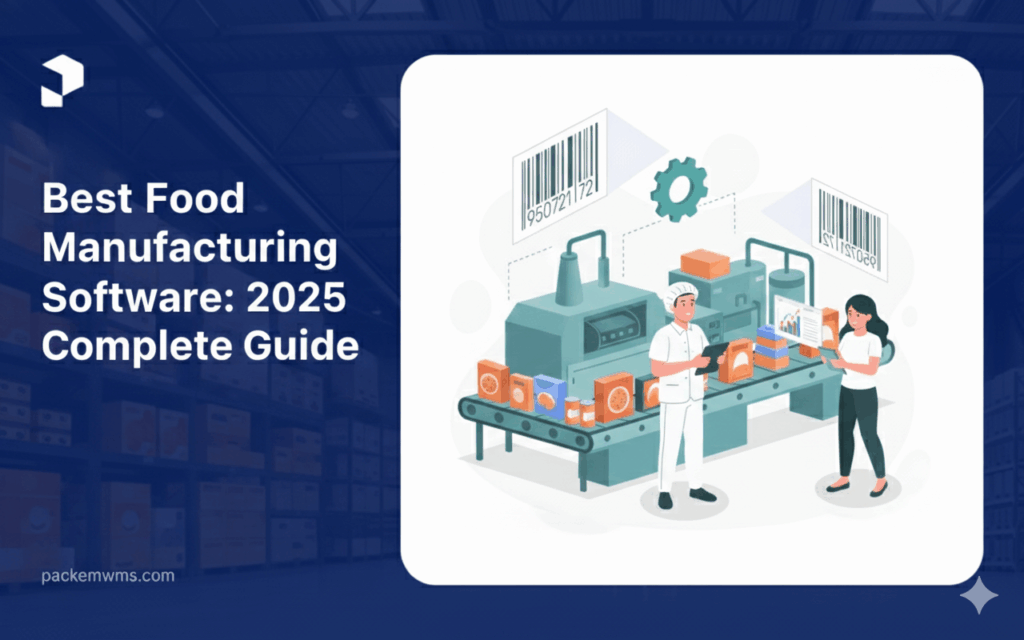
Food manufacturing software is a specialized system that manages production, inventory, and quality control for food and beverage operations. It ensures regulatory compliance through lot tracking, expiration date management, and traceability while optimizing production scheduling, recipe management, and warehouse operations from receiving to shipping.
Two main categories exist: production-focused ERP systems and warehouse-focused WMS platforms. Production ERP handles recipe management, production scheduling, material requirements planning, and costing. Warehouse WMS manages inventory tracking, lot management, picking and packing workflows, and shipping operations.
Many food operations need both capabilities, or they choose a hybrid solution. Small to mid-size manufacturers often start with WMS plus QuickBooks as an affordable ERP alternative, adding production planning tools as they scale.
Key capabilities include lot and batch tracking with forward and backward traceability, expiration date management with FIFO and FEFO rotation, regulatory compliance for FDA, HACCP, and FSMA requirements, quality control documentation, and integration with accounting systems like QuickBooks or NetSuite.
Top 10 food manufacturing software solutions for 2025
1. PackemWMS – Best WMS for food warehousing and 3PL operations
PackemWMS is a warehouse management system designed specifically for food inventory, lot tracking, and compliant fulfillment operations.
Best for:
– Small to mid-size food manufacturers managing warehouse operations
– 3PLs warehousing food products for multiple brands
– Food distributors needing pallet-level lot tracking
– Meat processors with strict USDA traceability requirements
– Operations prioritizing warehouse efficiency over complex production planning
Key strengths:
– Advanced lot tracking at pallet level with LPN (License Plate Number) system for complete traceability
– Expiration date management with automated FIFO and FEFO enforcement during picking, plus expiration alerts
– Pallet management supporting mixed pallet tracking for B2B food distribution (multiple lots per pallet)
– 3PL capabilities including multi-client food warehousing with segregated inventory and compliance documentation
– Mobile-first with Android scanning app for warehouse floor operations (receiving, putaway, picking, packing)
– Affordable pricing at $750-1,800/month versus $2,000-10,000+ for food ERP systems
– Fast implementation taking 2-5 weeks compared to 6-12 months for enterprise ERP
– QuickBooks integration with full accounting sync (affordable ERP alternative)
– B2B fulfillment supporting case pick and pallet pick with automated lot documentation
– Temperature zones to manage cold storage, frozen, and dry inventory separately
Lot tracking capability: Advanced pallet-level (LPN) with location and expiration tracking
Pricing: $750-1,800/month based on users and order volume
Implementation time: 2-5 weeks
Target company size: Small to mid-size (10-200 employees), food manufacturers and 3PL warehouses
Real customer: Cibao Meat Products uses PackemWMS for meat inventory, lot tracking, expiration management, and B2B pallet fulfillment (detailed case study below).
2. BatchMaster ERP
BatchMaster excels for food manufacturers working to expand and grow their operations, with embedded functionality for batch production, costing, and inventory management.
Best for: Small to mid-sized food manufacturers needing strong batch production controls and formula management
Key strengths: Recipe and formula management, batch costing, production scheduling, quality control integration
Pricing: $50,000+ implementation, $2,000-5,000/month
Implementation time: 3-6 months
3. Deacom ERP
Deacom, now part of ECI Software Solutions, provides a unified ERP platform explicitly built for batch and process manufacturers. It offers a centralized platform for managing the food manufacturing process.
Best for: Mid-size manufacturers needing comprehensive ERP with production planning
Key strengths: Quality management, inventory control, sales forecasting, production planning
Pricing: $100,000+ implementation, contact for monthly costs
Implementation time: 6-12 months
4. MRPeasy
This powerful cloud-based ERP software is used by hundreds of small and medium food manufacturers worldwide. MRPeasy integrates all aspects of business from inventory management and production planning to traceability and sales.
Best for: Small manufacturers under 50 employees needing affordable production planning
Key strengths: Affordable entry pricing, production scheduling, basic lot tracking, recipe management
Pricing: $49-500+/month depending on features
Implementation time: 4-8 weeks
5. Sage X3
Sage X3 gives managers a full view of the manufacturing process, making it easier to find inefficiencies and unnecessary risks and gauge the performance of the supply chain.
Best for: Mid to large manufacturers needing enterprise ERP capabilities
Key strengths: Financial management, supply chain visibility, production planning, multi-site support
Pricing: $150,000+ implementation, $5,000-10,000+/month
Implementation time: 9-18 months
6. Infor CloudSuite M3
Infor M3 is an enterprise-grade cloud ERP solution designed for process manufacturers, combining industry-specific functionality with advanced technologies like AI and machine learning to support complex food and beverage operations.
Best for: Large food manufacturers with multiple facilities and complex operations
Key strengths: AI-powered forecasting, global operations support, advanced analytics, supply chain management
Pricing: Enterprise (contact sales), typically $200,000+ implementation
Implementation time: 12-24 months
7. Aptean Food & Beverage ERP
Designed for food manufacturers to spot industry trends and make data-based decisions, helping companies be proactive in their manufacturing approach.
Best for: Mid to large food manufacturers needing industry-specific ERP
Key strengths: Regulatory compliance tools, quality management, traceability, production planning
Pricing: $100,000+ implementation, $3,000-8,000/month
Implementation time: 6-12 months
8. NetSuite (Food & Beverage Edition)
Cloud-based ERP that gives businesses the visibility and control needed to make decisions and grow.
Best for: Growing food businesses needing scalable cloud ERP
Key strengths: Cloud infrastructure, financial management, e-commerce integration, scalability
Pricing: $99,000+ per year (approximately $8,000+/month)
Implementation time: 6-12 months
9. Fishbowl Inventory
A general inventory management system with food industry capabilities, though lacking food-specific depth compared to specialized solutions.
Best for: Small businesses needing basic inventory management with QuickBooks
Key strengths: QuickBooks integration, affordable pricing, simple interface
Weaknesses: Limited lot tracking detail, no pallet-level LPN tracking, basic warehouse features
Pricing: $4,395 one-time plus $395/month
Implementation time: 4-8 weeks
10. Katana MRP
A cloud-based manufacturing execution system with visual production planning and inventory management for small food manufacturers.
Best for: Small food manufacturers with simple recipes and production
Key strengths: Visual interface, recipe management, Shopify integration, affordable pricing
Weaknesses: Limited warehouse depth, no 3PL capabilities, basic mobile features
Pricing: $179-999+/month
Implementation time: 2-4 weeks
Food warehouse management: What most software gets wrong
Most food manufacturing software focuses on production planning, recipes, bills of materials, and scheduling. But the real operational challenge happens after production: managing food inventory in the warehouse with strict lot tracking, expiration control, and compliant fulfillment.
This is where warehouse management systems like PackemWMS excel over production-focused ERP systems.
Receiving and putaway with lot control
The challenge is real: multiple ingredient lots arrive daily (flour lot 2024-11-A, sugar lot 2024-10-B, and so on). Each lot carries different expiration dates. You need to track which warehouse location stores which lot. Temperature-controlled zones require separate storage for frozen, refrigerated, and dry products.
WMS solutions like PackemWMS handle this through mobile scanning that captures lot number and expiration during receiving. The system assigns storage locations based on product and temperature zone requirements. It generates pallet LPN (License Plate Number) linking lot, expiration, and location together. You get bin, rack, and pallet level inventory for precise lot location tracking.
Production ERP systems fall short here. Most ERPs track “lot received” but not warehouse location. They lack mobile scanning workflows for the warehouse floor. Bin and location management is weak. They can’t track pallet-level mixed lots effectively.
FIFO and FEFO picking enforcement
Picture this: your warehouse stores five pallets of ground beef, lots A through E with expiration dates from December 1 to December 5. The picker needs to automatically select lot A (expires December 1) first. The system must prevent picking lot E while lot A still has inventory available. You need lot documentation for the customer, especially for B2B orders.
PackemWMS solves this by showing only valid lots on the picking screen, with oldest expiration first. FEFO enforcement prevents picking newer lots. The system generates lot documentation automatically for each order. The mobile app guides pickers to the exact location with the oldest inventory.
Production ERP systems may report FIFO violations after the fact, but they don’t prevent them. Pickers choose lots manually, introducing human error. There are no mobile workflows for the warehouse floor. Location-based inventory is weak.
Pallet management for B2B food distribution
B2B customers order full pallets or case quantities. A single pallet might contain multiple lots (mixed pallet). Each lot needs documentation for the customer. Pallet-level tracking is required for freight and delivery.
WMS solutions provide LPN tracking at the pallet level. They support mixed pallets with multiple lots on a single pallet. Pallet pick workflows handle B2B orders smoothly. Automatic lot documentation by pallet makes shipping efficient.
Production ERP systems typically track cases, not pallets. They lack LPN pallet tracking. Support for mixed pallets is weak. B2B fulfillment workflows are often missing entirely.
3PL food warehousing for multi-client operations
3PL warehouses store food products for multiple brand customers. Each brand requires segregated inventory and lot tracking. Billing per brand covers storage fees, handling, and temperature zones. Compliance documentation must be maintained per customer.
PackemWMS delivers multi-client inventory management with segregation by customer. The 3PL billing engine handles storage by pallet, handling fees, and temperature zones. Customer portals give brands visibility into their inventory. Compliance documentation is maintained per client for audits.
Production ERP systems are designed for single manufacturers, not multi-client 3PLs. They have no 3PL billing capabilities. Customer portals don’t exist. They can’t segregate inventory by brand.
The bottom line: if your operation focuses on warehouse management (receiving, inventory, picking, packing, shipping) more than production planning (recipes, BOMs, scheduling), you need a WMS-first solution like PackemWMS, not a production-focused ERP.
Case study: How Cibao Meat Products manages inventory with PackemWMS
Cibao Meat Products is a meat processing and distribution company serving restaurants, grocery stores, and food service operations across their region. They manage fresh, frozen, and processed meat products with strict USDA traceability requirements and complex B2B fulfillment needs.
The challenge
Before PackemWMS, Cibao Meat Products managed inventory using spreadsheets and manual processes that created serious operational and compliance risks.
Lot tracking challenges:
Multiple lots of the same meat product existed with different kill dates. Expiration dates were calculated from kill date plus shelf life, varying for fresh versus frozen products. USDA requires complete traceability from supplier to customer. Manual lot tracking created recall risks and USDA audit failures.
Expiration management problems:
Pickers didn’t know which lot expired first, so older inventory got buried behind newer inventory (FIFO violations). Expired products were discovered during inventory counts, resulting in costly waste. There were no automated alerts for approaching expirations.
B2B fulfillment complexity:
Restaurant and food service customers ordered by pallet or case. Mixed pallets contained different lots on the same pallet. Each lot required documentation for the customer (lot number, kill date, expiration date). Manual paperwork slowed shipping and created errors.
Inventory visibility gaps:
Staff couldn’t quickly locate a specific lot in the warehouse. There was no real-time inventory by lot and expiration. Inventory counts took days with manual counting. Temperature zone tracking for frozen versus refrigerated storage didn’t exist.
The PackemWMS solution
Lot tracking implementation:
Mobile scanning captures lot number, kill date, and expiration at receiving. The system generates a pallet LPN linking lot, expiration, and warehouse location. Real-time visibility answers questions like “Where is lot 2024-11-15A?” with “Bay 3, Rack B, Frozen Zone.” Forward traceability tracks ingredient lot to finished product lot to customer order. Backward traceability traces customer complaints to orders to lots to suppliers.
Automated FIFO and FEFO enforcement:
The picking screen shows only the oldest lots using FEFO (First Expired, First Out). The system prevents picking newer lots while older inventory exists. The mobile app guides pickers to the exact location with the oldest expiring inventory. Expiration alerts notify management seven days before expiration.
Pallet management for B2B orders:
The LPN system tracks pallet-level inventory, not just SKU-level. Mixed pallet support handles multiple lots on a single pallet with full documentation. Pallet pick workflows serve restaurant orders efficiently. Automatic lot documentation prints for each pallet, showing lot numbers, kill dates, and expirations.
Temperature zone management:
Separate inventory tracking exists for frozen, refrigerated, and dry storage. Putaway rules assign products to the correct temperature zone automatically. Inventory visibility by temperature zone is instant. Temperature compliance reporting supports USDA audits.
Results and benefits
Improved traceability:
Cibao achieved 100% lot traceability from supplier to customer. USDA audit preparation dropped from three days to three hours. Recall simulation now locates affected inventory in minutes, not days.
Reduced waste:
Expired product write-offs decreased significantly. FIFO enforcement ensures oldest inventory ships first. Expiration alerts prevent surprises during inventory counts.
Faster B2B fulfillment:
Pallet picking time per order improved dramatically. Automatic lot documentation eliminates manual paperwork. Mixed pallet accuracy increased substantially.
Real-time inventory visibility:
Staff get instant answers to “Where is lot X?” questions. Inventory counts reduced from multiple days to several hours. Management dashboards show expiring inventory across all zones.
PackemWMS transformed Cibao’s lot tracking from a manual nightmare into an automated system they trust for USDA audits and customer compliance. The warehouse runs more efficiently while maintaining strict food safety standards.
Pallet management and LPN tracking for food distribution
A License Plate Number (LPN) is a unique identifier assigned to a pallet, creating a “license plate” for tracking inventory at the pallet level, not just the SKU level.
Why food distributors need pallet-level tracking
Traditional inventory systems track “100 cases of ground beef” but don’t track which pallet contains which lot number, which warehouse location stores which pallet, expiration dates at the pallet level, or mixed pallets with multiple lots on a single pallet.
LPN solutions like PackemWMS assign a unique LPN to each pallet, linking pallet ID (LPN-2024-11-30-001), product SKU (Ground Beef 80/20, 10lb cases), lot number (LOT-2024-11-15A), quantity (50 cases), expiration date (2025-01-15), and warehouse location (Frozen Zone, Bay 3, Rack B, Level 2).
Benefits of LPN pallet tracking
Precise lot location answers “Where is lot 2024-11-15A?” with the exact pallet and location. Mixed pallet management tracks multiple lots on a single pallet for partial pallet picks. B2B fulfillment picks full pallets with automatic lot documentation. Expiration control tracks expiration at the pallet level, not just SKU level. Cycle counting by pallet LPN makes inventory faster and more accurate. Recall efficiency locates all pallets containing affected lots in seconds.
Example: B2B pallet pick workflow
A restaurant orders three pallets of chicken breast (150 cases total). The system selects three pallets with the oldest expiration dates using FEFO. The mobile app guides the forklift operator to pallet locations. The operator scans the LPN barcode on each pallet to confirm the pick. The system generates shipping documents with lot numbers for all three pallets. The customer receives pallets with complete traceability documentation.
LPN pallet tracking serves food distributors fulfilling B2B orders to restaurants, food service, and retail. It benefits meat processors shipping by pallet, 3PL warehouses managing food products for multiple brands, and operations with high-volume pallet movements beyond just case picks.
Food manufacturing software versus food ERP: Understanding the difference
Production-focused food ERP systems
Production ERP systems manage the manufacturing process from raw materials through production. Key capabilities include recipe and formula management (BOMs, ingredient scaling), production scheduling and capacity planning, shop floor control (work orders, labor tracking), costing and yield analysis, material requirements planning (MRP), and full financial management (accounting, payroll, financials).
They work best for food manufacturers with complex production planning needs, operations managing multiple production lines, companies needing detailed costing and yield tracking, and larger operations justifying $100,000-500,000+ ERP investments.
Examples include Deacom, Aptean, Sage X3, Infor M3, and BatchMaster.
Warehouse-focused food WMS systems
Warehouse WMS platforms manage warehouse operations including receiving, storage, picking, packing, and shipping. Key capabilities include lot tracking at warehouse touchpoints (receiving, putaway, picking, shipping), expiration date management with FIFO and FEFO enforcement, pallet-level LPN tracking for B2B distribution, mobile scanning workflows for warehouse floor staff, real-time inventory visibility by lot, location, and expiration, 3PL multi-client management (optional), and QuickBooks integration for accounting as an ERP alternative.
They work best for food warehouses and distribution centers, food manufacturers prioritizing warehouse efficiency over production planning, 3PLs warehousing food products, and small to mid companies not ready for full ERP investment at $750-1,800/month versus $2,000-10,000+.
Examples include PackemWMS, Fishbowl Inventory (with limitations), HighJump, and Manhattan WMS.
Do you need both?
Some operations need both ERP for production and WMS for the warehouse. Large food manufacturers often implement food ERP plus specialized WMS. Small to mid operations usually start with WMS plus QuickBooks as an affordable alternative. 3PL warehouses need WMS only since they have no production planning requirements.
When WMS plus QuickBooks is enough, you can avoid expensive food ERP by combining PackemWMS for warehouse management, lot tracking, expiration control, and fulfillment with QuickBooks for accounting, invoicing, and financial reporting. Total cost runs $900-2,000/month versus $3,000-10,000+ for food ERP.
How to choose the best food manufacturing software
Step 1: Determine your primary need – production versus warehouse
Ask yourself whether you need complex production scheduling and recipe management or warehouse efficiency with lot tracking and fulfillment.
If production-focused, consider food ERP systems like Deacom, BatchMaster, or Sage X3. If warehouse-focused, consider food WMS systems like PackemWMS or Fishbowl. If you need both, decide whether to invest in full ERP or combine WMS with QuickBooks.
Step 2: Evaluate lot tracking depth
Ask vendors whether they track lots at SKU level or pallet level (LPN), if they can prevent picking wrong lots (enforcement versus reporting), if they support mixed pallets (multiple lots on single pallet), and if they can show the exact warehouse location of a specific lot.
Red flags include “we track lots in reports” (not real-time), “pickers choose lots manually” (no enforcement), and no pallet-level LPN tracking (B2B limitation).
Step 3: Confirm expiration date management
Must-have capabilities include automated FIFO or FEFO enforcement during picking (not just reporting), expiration alerts before products expire, shelf life calculation (manufactured date plus shelf life equals expiration), and expiration visibility in inventory screens.
Test question: “If I have five pallets with different expiration dates, how does your system ensure the picker grabs the oldest expiration first?”
Good answer: “Mobile app only shows oldest lot, system won’t let picker select newer lots.” Bad answer: “We generate FIFO violation reports so you can investigate after.”
Step 4: Verify regulatory compliance support
Required for FDA, HACCP, and FSMA compliance: forward traceability (ingredient lot to finished product lot to customer), backward traceability (customer complaint to finished lot to ingredients), audit trails (who received, who picked, who shipped), temperature zone tracking (cold chain documentation), and recall simulation capability.
Ask vendors: “Can you demonstrate full traceability from ingredient lot to customer shipment?”
Step 5: Assess implementation time and cost
Questions to ask include total cost of ownership (software, implementation, training, hardware), typical implementation time (2-5 weeks versus 6-12 months), whether you need IT staff or consultants (cloud versus on-premise), and required hardware (mobile scanners, label printers).
PackemWMS advantages include 2-5 week implementation versus 6-12 months for food ERP, $750-1,800/month all-in versus $3,000-10,000+ for ERP, no IT staff required (cloud-based), and standard hardware (Android scanners, Zebra printers).
Step 6: Consider 3PL capabilities if relevant
If you’re a 3PL warehousing food products, look for multi-client inventory management (segregated lots per customer), 3PL billing engine (storage, handling, temperature zones), customer portals for brand visibility, and per-client compliance documentation.
PackemWMS is one of few systems purpose-built for 3PL food warehousing.
Best food manufacturing software for small businesses
Small food manufacturers (1-50 employees) face unique challenges: they can’t afford $100,000+ ERP implementations, don’t have IT staff for complex systems, need fast ROI (3-6 months, not 2-3 years), and require simple user interfaces for hourly warehouse staff.
Top 3 affordable options
1. PackemWMS ($750-1,800/month)
Best for small food manufacturers and 3PLs prioritizing warehouse management.
Why small businesses choose it: affordable pricing (10x cheaper than food ERP systems), fast implementation (2-5 weeks, not months), no IT staff required (cloud-based, mobile-ready), QuickBooks integration (avoid expensive ERP financials), advanced lot tracking and expiration management, and scales as you grow (multi-location ready).
Sweet spot: 10-200 employees, warehouse-focused operations.
2. MRPeasy ($49-500+/month)
Best for small food manufacturers needing production planning plus basic inventory.
Strengths: very affordable entry pricing, production scheduling and recipe management, basic lot tracking, good for operations under 25 employees.
Limitations: limited warehouse depth (weak WMS features), no pallet-level LPN tracking, basic mobile capabilities.
3. Katana MRP ($179-999+/month)
Best for small food manufacturers with simple recipes and production.
Strengths: modern user interface, recipe management and BOMs, production scheduling, Shopify and e-commerce integrations.
Limitations: light on warehouse management, no 3PL capabilities, limited expiration date enforcement.
Bottom line for small businesses
Choose production ERP (MRPeasy, Katana) if you have complex recipes with ingredient scaling, multiple production lines with scheduling conflicts, and detailed costing and yield analysis as critical requirements.
Choose warehouse WMS (PackemWMS) if most work happens after production (warehouse operations), lot tracking and expiration management are critical, you have B2B fulfillment with pallet picking, or you run 3PL operations managing multiple brands.
Best first step: start with WMS plus QuickBooks (affordable), add production ERP later if needed.
Regulatory compliance requirements for food software
Food manufacturers and warehouses must comply with multiple regulatory frameworks. Your software should support compliance, not create gaps.
FDA Food Safety Modernization Act (FSMA)
Key requirements include hazard analysis and preventive controls, supplier verification programs, traceability records (lot tracking from supplier to customer), sanitation controls documentation, and recall plans with mock recall testing.
Software support needed: forward and backward lot traceability, audit trails (who, what, when for every transaction), supplier management and documentation, and recall simulation capability.
HACCP (Hazard Analysis Critical Control Points)
Key requirements include identifying critical control points in food handling, monitoring critical limits (temperature, time, pH), corrective actions when limits are exceeded, and verification and record-keeping.
Software support needed: temperature monitoring integration, quality control checkpoints, non-conformance tracking, and HACCP documentation and reports.
USDA requirements for meat and poultry processors
Key requirements include lot identification from slaughter to retail, product temperature tracking (cold chain), label accuracy and verification, and sanitation standard operating procedures (SSOPs).
Software support needed: detailed lot tracking (kill date, process date, pack date), temperature zone management (freezer, cooler, dry), label printing with lot and date information, and sanitation checklists and documentation.
PackemWMS compliance features
PackemWMS provides lot tracking at every warehouse touchpoint, expiration date management with alerts, temperature zone inventory tracking, audit trails for FDA inspections, recall simulation to locate affected lots in minutes, and documentation printing (lot certificates, certificates of analysis).
Compliance test question: ask potential vendors, “If FDA requests traceability records during an inspection, how quickly can your system show ingredient lot to finished product lot to customer shipment?”
Good answer: “Real-time traceability report in under five minutes.” Bad answer: “We can compile that information from multiple reports.”
Frequently asked questions
What is the best food manufacturing software for small business?
The best food manufacturing software for small business depends on whether you need production planning or warehouse management. For warehouse-focused operations, PackemWMS ($750-$1,800/month) offers lot tracking, FIFO/FEFO enforcement, and FDA compliance without enterprise complexity. For production-focused needs, MRPeasy ($49-$500/month) provides affordable batch management. Small food manufacturers should prioritize lot traceability, expiration date management, and QuickBooks integration over advanced features they won’t use.
How much does food manufacturing software cost?
Food manufacturing software costs range from $49 to $10,000+ per month depending on capabilities. Entry-level solutions like MRPeasy start at $49/month for basic batch tracking. Mid-tier WMS platforms like PackemWMS run $750-$1,800/month with full lot tracking and compliance features. Enterprise ERP systems like BatchMaster ($2,000-$5,000/month) or Deacom ($100,000+ implementation) suit larger operations. Most small food manufacturers find the $500-$2,000/month range delivers the best balance of features and ROI.
What is the cheapest food traceability software that actually works?
The cheapest food traceability software options that deliver real lot tracking include MRPeasy starting at $49/month for startups, Katana MRP at $99/month for small manufacturers, and Fishbowl Inventory around $329/month. For warehouse-focused traceability, PackemWMS at $750/month provides more robust FIFO/FEFO enforcement and FDA audit trails. Avoid free spreadsheet solutions—one recall without proper traceability documentation can cost $10 million or more.
Does food manufacturing software integrate with QuickBooks?
Yes, most food manufacturing software integrates with QuickBooks, but integration depth varies significantly. PackemWMS offers real-time two-way sync with QuickBooks Online and Desktop for inventory, invoicing, and cost tracking. BatchMaster and Fishbowl also provide QuickBooks integration. When evaluating, check whether the integration handles lot-specific costs, COGS by batch, and automatic invoice generation—not just basic inventory counts. Poor QuickBooks integration is the #1 complaint from small food manufacturers.
What’s the difference between food ERP and food WMS software?
Food ERP (Enterprise Resource Planning) manages production—recipes, batch scheduling, ingredient sourcing, and manufacturing processes. Food WMS (Warehouse Management System) manages inventory—receiving, storage, picking, shipping, and lot traceability. Most food manufacturers need both: ERP for production planning and WMS for warehouse execution. Some platforms like BatchMaster combine both, while others like PackemWMS specialize in warehouse management and integrate with separate production systems. Choose based on whether your bottleneck is production planning or warehouse operations.
How do I ensure FDA and USDA compliance with food software?
To ensure FDA and USDA compliance, your food manufacturing software must provide complete lot traceability (tracking ingredients from receipt to finished product), FIFO/FEFO inventory rotation enforcement, expiration date management with alerts, and audit-ready reporting that documents the chain of custody. Look for software that generates recall reports within minutes—FDA requires one-up/one-down traceability within 24 hours. PackemWMS users report reducing USDA audit prep from 3 days to 3 hours through automated documentation.
Conclusion
The best food manufacturing software depends on your primary need: production planning (ERP) versus warehouse management (WMS). Critical features include advanced lot tracking, expiration date management, regulatory compliance, and complete traceability.
Small to mid food operations can avoid expensive ERP systems by using the WMS plus QuickBooks approach. PackemWMS combined with QuickBooks provides warehouse management, lot tracking, expiration control, and fulfillment alongside accounting, invoicing, and financial reporting at $900-2,000/month instead of $3,000-10,000+ for ERP.
3PL food warehouses need multi-client capabilities, which PackemWMS delivers as a core strength. Real-world proof comes from Cibao Meat Products, which achieves USDA compliance with PackemWMS lot tracking and LPN pallet management.
If you’re a food manufacturer or 3PL warehouse prioritizing lot tracking and expiration management, B2B pallet fulfillment, warehouse efficiency over production planning, and affordable implementation at $750-1,800/month versus $3,000-10,000+ for ERP, see PackemWMS in action.
Schedule a demo to see live lot tracking, expiration management, and LPN pallet workflows.
If you’re a larger operation needing production planning, consider food ERP systems like Deacom, BatchMaster, or Aptean for recipe management, production scheduling, and shop floor control.
Still deciding? Review our complete WMS features guide or read about 3PL warehouse management.