Best WMS for small 3PLs: 2026 buyer’s guide
Last Updated: May 6, 2026
Picking the right WMS for a small 3PL is harder than it looks. The market is full of platforms built for enterprise warehouses with IT teams and six-figure software budgets. If you run one to three warehouses and serve fewer than 50 clients, most of those platforms are overkill, overpriced, or both.
What is a WMS for small 3PLs? A warehouse management system (WMS) for small 3PLs is cloud software that manages receiving, putaway, picking, packing, shipping, and client billing across multiple client inventories. Unlike basic inventory tools, a 3PL WMS tracks each client separately, automates invoicing, and gives clients real-time portal access to their own inventory and orders.
This guide compares the best WMS for small 3PL operations in 2026 across six platforms. The rankings are honest: PackemWMS ranks first for small-to-mid operations, but we flag where other platforms are the better call.
According to industry research, the global 3PL market is projected to reach $1.59 trillion by 2028, with small regional 3PLs making up the majority of facilities in North America. Choosing the right WMS now means you scale without having to migrate again in two years.
What to look for in the best WMS for small 3PLs
Not all WMS platforms are built with small 3PLs in mind. Enterprise systems add complexity, longer implementation timelines, and pricing models that punish growth. Here are the five things that matter most when evaluating 3PL warehouse management software for a smaller operation.
Multi-client billing automation
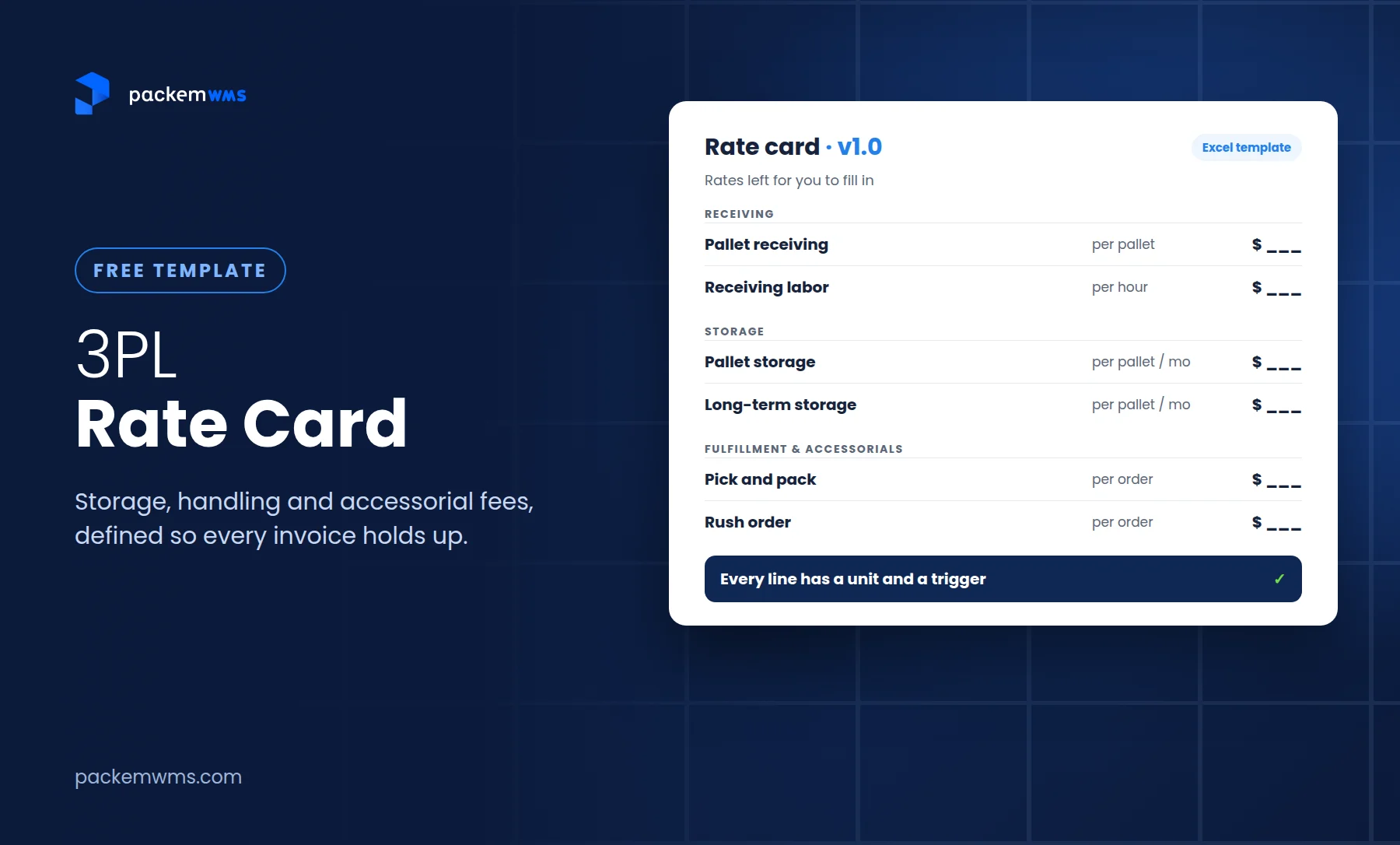
Manual billing is the number one operational drag for small 3PLs. You need a system that tracks billable activities automatically, supports custom rate cards per client, and generates invoices without manual calculation. Bonus points if the system syncs invoices directly to QuickBooks.
Transparent pricing with no per-client fees
Some platforms charge per client or per user on top of the base subscription. That model punishes growth. The best WMS for small 3PLs charges a flat monthly fee that scales with order volume, not headcount or client count.
Fast implementation
Enterprise WMS implementations average 8-16 weeks, according to supply chain industry benchmarks. For a small 3PL, that downtime is unacceptable. Look for platforms that commit to a go-live date within two to five weeks.
QuickBooks integration depth
About 29 million US businesses use QuickBooks, per Intuit’s own figures. For most small 3PLs, the accounting question is not whether the WMS connects to QuickBooks but how well it connects. A native sync that automatically pushes invoices is different from a connector that requires manual reconciliation.
White-label client portal
Your clients want to see their inventory without calling you. A client portal cuts down on “where’s my order?” calls. If it can be white-labeled with your logo and domain, it makes your 3PL look like a larger, more professional operation.
To understand the full list of key WMS features to evaluate, the linked guide covers each capability in detail.
The top 6 WMS platforms for small 3PLs compared
The table below covers the six most relevant platforms for small-to-mid 3PL operators in 2026. Pricing is sourced from each vendor’s public pricing pages and verified third-party sources as of May 2026.
| Platform | Starting price | Target ICP | Implementation time | QuickBooks | 3PL billing | Food vertical |
|---|---|---|---|---|---|---|
| PackemWMS | $750/mo (unlimited users, clients, SKUs) | Small-mid 3PL, food manufacturers | 2-5 weeks | Native invoice sync (QBO + Desktop) | Core feature: rate cards, auto-invoicing | Yes: lot tracking, FIFO/FEFO, expiration alerts |
| Extensiv | ~$599/mo (per-client fees apply) | SMB-to-mid 3PL, marketplace sellers | Weeks to months | Via connector | Add-on module (Billing Manager) | No dedicated content or feature set |
| ShipHero | $1,995/mo + $2,000 onboarding | Mid-market, high-volume DTC 3PLs | Months | Manual reconciliation required | Pain point in G2 reviews | No |
| Logiwa | Contact sales (~$20K-100K/yr) | High-volume omnichannel 3PLs | Months | Not a focus | Has a solution page | No recent content |
| Zenventory | $499/mo (1 warehouse, 10K shipments) | SMB 3PLs, ecommerce-first | Unknown | Native QBO (Plus required) | Core feature, lighter than PackemWMS | No food-specific content |
| Packiyo | $699/mo (3PL Startup, 3 users) | Ecommerce brands and small 3PLs | Unknown | QBO only, light bridge | 3PL billing on all plans | No |
A few things stand out in this comparison. ShipHero’s starting price ($1,995/mo) makes it impractical for most small 3PLs. Logiwa’s custom pricing pushes it firmly into enterprise territory. Zenventory’s entry price is the lowest in the group, but its per-user overages ($95/user/month) and single-warehouse starter plan add up quickly for operations with multiple clients and warehouse staff.
PackemWMS: best overall for small to mid-size 3PLs
PackemWMS ranks first in this guide for small-to-mid 3PL operations. The reasons come down to four specific capabilities that small 3PLs actually need.
Billing engine built for 3PLs. PackemWMS tracks every billable activity, including storage by pallet, carton, or bin, pick and pack fees, receiving fees, kitting fees, and custom ad-hoc charges. Each client gets their own rate card. The system generates invoices automatically and syncs them directly to QuickBooks, including chart of accounts mapping. For a small 3PL spending three to five hours a week on manual billing, that alone is worth the subscription.
LPN and pallet-level tracking. Most WMS platforms in this price range focus on individual item tracking. PackemWMS assigns a License Plate Number (LPN) to each pallet during receiving, so you can track pallets through putaway, storage, and shipping with full SKU-level visibility, including mixed pallets. This is a B2B fulfillment requirement that platforms like ShipHero do not support.
White-label client portal. Every client gets secure portal access to their inventory, orders, invoices, and reports in real time. The portal runs on your domain with your logo, so you look like a professional operation regardless of your size.
Food and regulated goods support. Lot tracking, FIFO and FEFO rotation, and expiration date alerts are built into PackemWMS at the standard tier. This matters for 3PLs serving food manufacturers, distributors, or any client with compliance requirements.
Pricing. At $750-1,800/month based on order volume, PackemWMS includes unlimited users, unlimited clients, and unlimited SKUs. There are no per-client or per-user fees. Implementation runs $500-1,000 one time and takes two to five weeks.
Where Extensiv is stronger. Extensiv has a larger 3PL network (1,500+ 3PLs) and a more established brand. If your clients specifically ask whether their 3PL uses a recognized network platform, Extensiv wins that conversation. For a 3PL that prioritizes brand credibility over cost, Extensiv is worth evaluating. That said, Extensiv’s per-client fee model and longer implementation timeline are real drawbacks for a growing small 3PL.
To see how PackemWMS handles QuickBooks sync and e-commerce integrations, the integrations directory has the full list of connected platforms.
Extensiv: best for established 3PLs with network ambitions
Extensiv (formerly 3PL Central) is the market leader in the 3PL WMS space. It has 1,500+ 3PLs on its network and a track record that most small WMS vendors cannot match.
The main strengths: strong reporting, a recognizable brand in the 3PL industry, and a broad ecosystem that includes Order Manager and Billing Manager as add-ons. If your clients are enterprise brands that require an established platform, Extensiv carries weight.
The main limitations for small 3PLs: per-client fees scale up as you grow, implementation takes longer than two to five weeks for most deployments, and the billing module is an add-on (Billing Manager), not built into the core subscription. G2 reviews from small 3PL operators frequently cite billing complexity as a frustration. Extensiv’s base price (~$599/month) looks attractive until per-client charges and module fees are added.
ShipHero, Logiwa, Zenventory, and Packiyo: who each serves best
ShipHero
ShipHero markets itself as the top WMS for high-volume DTC fulfillment. At $1,995/month to start (with a $2,000 onboarding fee on the 3PL plan), it is priced out of reach for most small 3PLs. ShipHero’s hardware pivot in 2025 (Pick-to-Light, Pack-to-Light systems) adds further complexity that is unnecessary for a sub-50-client 3PL. Its G2 reviews flag manual QuickBooks reconciliation as an ongoing pain point.
Best for: Mid-market DTC 3PLs processing 10,000+ orders per month with capital to invest in hardware.
Logiwa
Logiwa has rebranded itself as a “Fulfillment Management System” and targets high-volume omnichannel 3PLs. Pricing is custom and estimated in the $20,000-100,000 per year range by third-party analysts. It is not a small 3PL solution and does not publish pricing or small-3PL-specific content.
Best for: Large 3PLs managing multiple warehouses with high order volumes and dedicated IT resources.
Zenventory
Zenventory is the lowest-cost platform in this comparison at $499/month for the Starter plan. It is explicitly built for SMB 3PLs and includes unlimited users, clients, and integrations on all plans. QuickBooks Online integration is native on all plans, though it requires QuickBooks Plus or above.
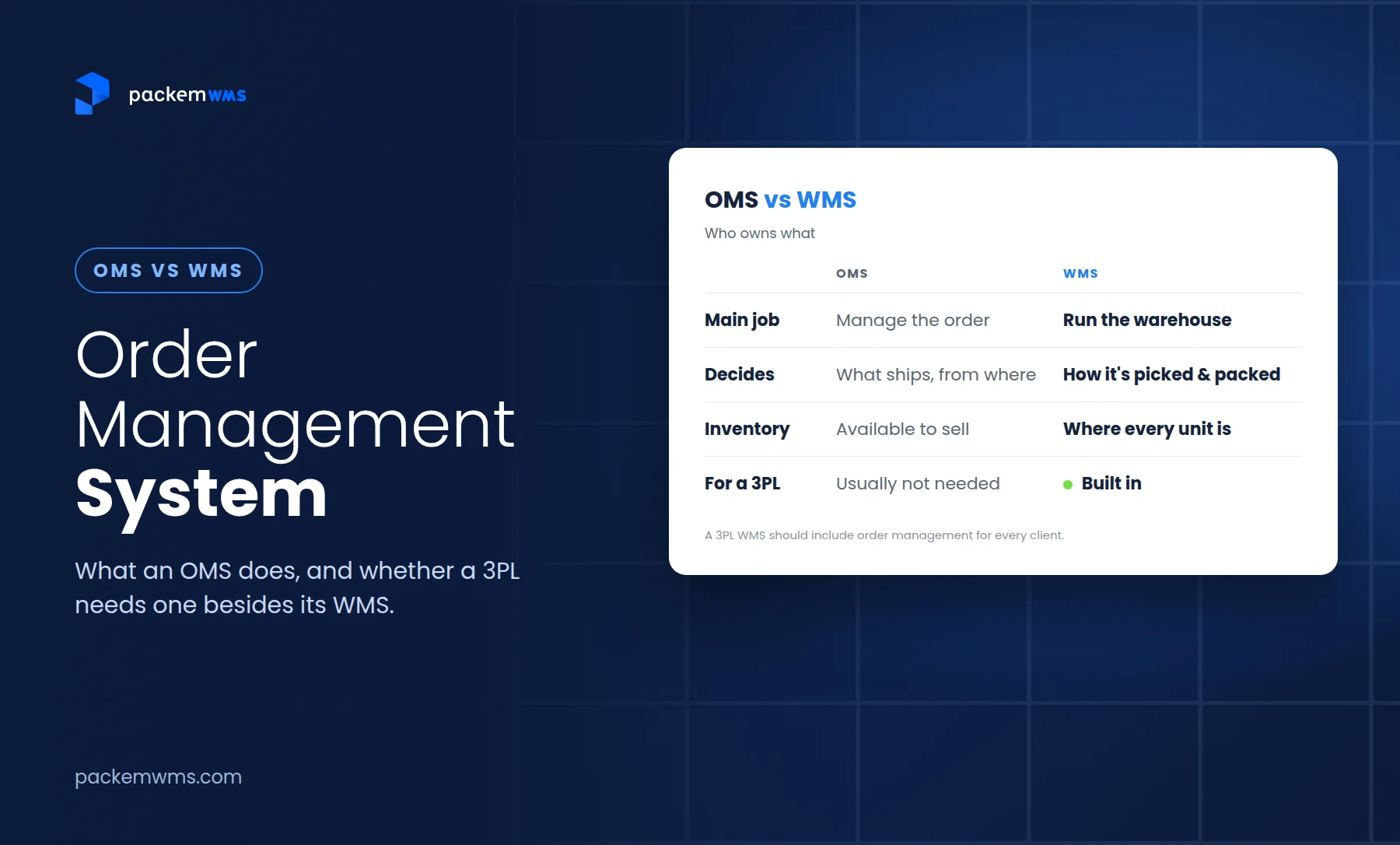
Comparing Zenventory against other options? See our Zenventory alternatives guide for pricing, EDI and accounting sync side by side.
Where Zenventory falls short: its billing features are lighter than PackemWMS (less flexibility on rate card customization and fee types). It has no food vertical content or lot tracking positioning. Warehouse add-ons cost $100/month each, so a multi-warehouse 3PL will pay more than the base price suggests.
Best for: Very small 3PLs looking for the lowest entry point with basic multi-client billing.
Packiyo
Packiyo was founded by a ShipHero co-founder and targets ecommerce-first small 3PLs. The 3PL Startup plan runs $699/month for three users with 3PL billing and client portals. QuickBooks Online integration is available but described as a light accounting bridge rather than a native two-way sync.
For a deeper look, we compare six Packiyo alternatives on cost per user, retail EDI and support.
Packiyo’s biggest limitation is a near-zero content and community footprint. It has published no blog articles in 2025 or 2026, so there is limited third-party validation for buyers doing research.
Best for: Small ecommerce-focused 3PLs that primarily ship DTC orders and do not need deep B2B pallet management.
How to choose the best WMS for your small 3PL
No single platform is the right answer for every 3PL. Use this framework to narrow down your choice.
If you serve food manufacturers, pharma, or any client with lot tracking requirements: PackemWMS is the only option in this group with built-in lot tracking, FIFO/FEFO, and expiration alerts at the standard tier. If compliance traceability matters to your clients, this is the deciding factor.
If most of your volume is DTC ecommerce and you ship fewer than 500 orders per month: Zenventory’s $499/month entry plan covers the basics at the lowest cost. You will likely outgrow it as you add clients or need more complex billing.
If B2B pallet fulfillment is a significant part of your business: PackemWMS is the only option here with LPN/pallet-level tracking built in. ShipHero and Packiyo do not offer this at any price tier.
If your clients specifically ask for an established network platform: Extensiv’s 1,500+ 3PL network is a real differentiator. Evaluate whether that network access is worth the per-client fee model.
Questions to ask in any WMS demo:
– How does billing work when a client has a split pallet or a partial bin?
– How long has the implementation taken for a 3PL similar to mine in the past 12 months?
– What does the QuickBooks sync actually do, step by step?
– Can my clients access their own portal from a custom domain?
– What happens if I add a second warehouse?
For a deeper look at what a WMS actually does before you start demo calls, the linked guide covers the core workflows from receiving through shipping.
FAQ: best WMS for small 3PLs
What is the best WMS for a small 3PL just getting started?
For a small 3PL getting started, PackemWMS and Zenventory are the two strongest options. PackemWMS starts at $750/month with unlimited clients and users and a two-to-five-week implementation. Zenventory starts at $499/month but limits you to one warehouse and 10,000 shipments per month on the base plan. If you serve food clients or need pallet-level tracking from day one, PackemWMS is the better foundation.
How much does 3PL warehouse management software cost?
3PL WMS pricing ranges from $499/month (Zenventory Starter) to $2,000+ per month (ShipHero). Mid-tier platforms like PackemWMS ($750-1,800/month) and Extensiv (~$599/month plus per-client fees) sit in between. Enterprise platforms like Logiwa are custom-priced and typically cost $20,000 or more per year. Implementation fees are typically $500-1,000 one time for small 3PL platforms.
Does a small 3PL need a WMS or can I use spreadsheets?
Spreadsheets work up to a point, usually around five to ten clients. Beyond that, billing errors, inventory discrepancies, and the time cost of manual processes outweigh any software savings. A WMS pays for itself when it eliminates billing mistakes and reduces the hours your team spends on data entry. Most small 3PLs that switch to a WMS find the ROI is visible within the first two billing cycles.
What WMS integrates best with QuickBooks for a 3PL?
PackemWMS and Zenventory both offer native QuickBooks Online integration. PackemWMS also supports QuickBooks Desktop and includes automatic invoice synchronization with chart of accounts mapping, which means invoices generated in PackemWMS appear in QuickBooks without any manual export. ShipHero requires manual reconciliation. Extensiv uses a connector rather than a native sync.
How long does WMS implementation take for a small 3PL?
For platforms built for small 3PLs, implementation should take two to five weeks. PackemWMS targets two to five weeks from contract signing to go-live, including data migration, system configuration, and staff training. Enterprise platforms like Logiwa and Deposco typically take several months. If a vendor cannot commit to a go-live timeline, ask them to walk you through the last three implementations for operations similar to yours.
Ready to see PackemWMS in action?
If you operate one to three warehouses, manage between 5 and 50 clients, and are tired of manual billing or a WMS that was not built for 3PL operations, PackemWMS is worth 30 minutes of your time.
The demo covers your specific workflows: how billing works with your rate structure, how the client portal looks to your clients, and how quickly your team can get trained on the mobile scanning app (Android and Zebra devices). Most small 3PLs go live within two to five weeks of signing.
Request a demo at packemwms.com and see how the platform handles your operation specifically.