AI Is Changing How 3PLs Think About Inventory
For years, inventory management has largely been reactive.
A warehouse checks current stock levels, compares them against predefined reorder points, reviews recent orders, and then decides what needs to happen next.
That approach can work when inventory volumes are small and demand is relatively predictable.
But 3PL operations become much more complicated as they grow.
A warehouse may manage:
- Hundreds or thousands of SKUs
- Multiple clients
- Multiple warehouses
- Seasonal demand
- Different order patterns
- Variable lead times
- Returns
- Promotions
- Ecommerce fluctuations
- Fast- and slow-moving inventory
At that point, simply knowing how much inventory you have today isn’t enough.
You also need to understand:
What is likely to happen next?
That’s where AI-powered inventory and demand forecasting can make a difference.
Instead of relying entirely on historical averages and fixed reorder rules, AI can analyze large amounts of operational data to identify patterns, predict future demand, and help warehouse teams make better inventory decisions.
For 3PLs, this can mean fewer surprises, better capacity planning, and more proactive inventory management.
What Is AI-Powered Inventory and Demand Forecasting?
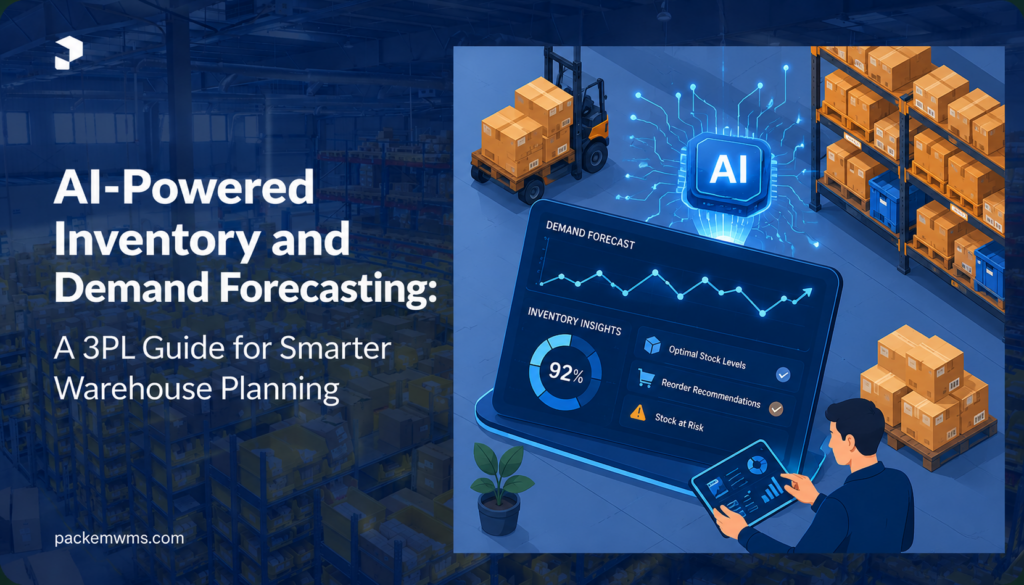
AI-powered inventory and demand forecasting uses artificial intelligence, machine learning, historical data, and real-time operational information to predict future inventory requirements and demand patterns.
A traditional forecasting approach might look at:
Average sales over the last three months.
An AI-powered approach can potentially consider:
- Historical order volume
- SKU velocity
- Seasonal patterns
- Client-specific demand
- Order frequency
- Lead times
- Promotions
- Returns
- Inventory levels
- Warehouse capacity
- Recent demand changes
- External variables
The objective is not simply to predict a number.
The objective is to give warehouse operators better information for making inventory decisions.
Why Demand Forecasting Matters for 3PLs
A 3PL doesn’t always own the inventory it stores.
But it is responsible for managing that inventory efficiently.
If demand changes unexpectedly, the consequences can affect the entire operation.
A sudden increase in demand can create:
- Picking pressure
- Labor shortages
- Storage constraints
- Replenishment issues
- Shipping delays
- SLA risks
A sudden decrease can result in:
- Slow-moving inventory
- Excess warehouse space consumption
- Lower inventory turnover
- Higher storage requirements
- Reduced warehouse efficiency
Better forecasting allows a 3PL and its clients to prepare earlier.
Instead of reacting to demand after it changes, the warehouse can begin planning before the impact arrives.
Traditional Forecasting vs. AI-Powered Forecasting
The difference can be summarized simply.
| Traditional Forecasting | AI-Powered Forecasting |
| Relies heavily on historical averages | Analyzes multiple data patterns |
| Often uses fixed rules | Can adapt to changing patterns |
| Manual analysis | Automated analysis |
| Limited data inputs | Can combine multiple data sources |
| Periodic forecasting | Continuous forecasting |
| Reactive adjustments | Predictive insights |
| Difficult to scale across thousands of SKUs | Designed to analyze large datasets |
| Often requires spreadsheet work | Integrated into digital workflows |
AI doesn’t make traditional forecasting useless.
Instead, it can make forecasting more dynamic and data-driven.
8 Ways AI-Powered Forecasting Can Help 3PLs
1. Predict Potential Stockouts
One of the most obvious applications is identifying inventory that may run out before the next replenishment arrives.
Imagine a SKU normally sells 100 units per week.
But over the past three weeks, demand has increased to 150 units.
A simple reorder rule may not respond quickly enough.
An AI forecasting system can identify the changing demand pattern and flag the SKU for attention.
This gives warehouse teams and clients more time to:
- Replenish inventory
- Adjust purchasing
- Move stock between warehouses
- Change fulfillment priorities
- Communicate potential risks
The goal isn’t to eliminate every stockout.
It’s to identify potential stockouts before they become operational problems.
2. Improve Inventory Replenishment
Traditional replenishment often relies on rules such as:
Reorder when inventory falls below 100 units.
But a fixed threshold doesn’t necessarily account for changing demand.
A better approach considers:
Current inventory + demand velocity + lead time + expected future demand
AI can help identify when replenishment should occur based on changing conditions.
For example:
A product with stable demand may require little adjustment.
A product experiencing rapid growth may need earlier replenishment.
A seasonal product may require a completely different inventory strategy.
This creates a more dynamic approach to predictive inventory management.
3. Forecast Demand Across Multiple Clients
This is especially important for 3PLs.
A warehouse may have hundreds of clients, each with different inventory behavior.
Client A may have predictable weekly orders.
Client B may have seasonal demand.
Client C may experience sudden spikes during promotions.
Client D may be growing rapidly.
A 3PL shouldn’t necessarily treat all inventory the same.
AI-powered demand forecasting can help identify different demand patterns across clients and SKUs.
This can help warehouse operators anticipate:
- Order volume
- Storage requirements
- Picking workload
- Receiving requirements
- Labor requirements
Instead of asking:
“How busy was the warehouse last month?”
operators can start asking:
“How busy is the warehouse likely to become next month?”
4. Improve Warehouse Labor Planning
Inventory demand affects labor.
More orders usually mean more:
- Picking
- Packing
- Receiving
- Shipping
- Returns
If demand is expected to increase significantly, warehouse managers need to prepare.
AI-powered demand forecasting can help estimate future workload based on historical and current order patterns.
For example:
“Order volume for Client A is expected to increase significantly next week.”
That information could influence:
- Staff scheduling
- Shift planning
- Temporary labor
- Picking capacity
- Packing capacity
This connects inventory forecasting with warehouse workforce planning.
5. Optimize Warehouse Capacity
Inventory forecasting isn’t only about preventing stockouts.
It’s also about understanding future space requirements.
Suppose a 3PL currently has 75% warehouse utilization.
That sounds manageable.
But if incoming inventory and expected demand suggest utilization will reach 95% within the next two months, the warehouse needs to act early.
AI-powered forecasting can help identify potential capacity constraints.
Operators can then consider:
- Re-slotting inventory
- Moving slow-moving products
- Expanding storage
- Adding overflow space
- Transferring inventory
- Adjusting client storage plans
This turns warehouse capacity planning into a forward-looking process.
6. Identify Slow-Moving and Excess Inventory
Not every inventory problem is caused by too little stock.
Sometimes the problem is too much stock.
Slow-moving inventory can consume valuable warehouse space and increase storage costs.
AI can analyze inventory movement and identify SKUs that show signs of declining demand.
This can help 3PLs and their clients identify:
- Slow-moving SKUs
- Aging inventory
- Excess inventory
- Dead stock
- Declining demand patterns
For a 3PL, this can also create a useful client conversation:
“These SKUs have occupied storage for six months with very limited movement. Would you like to review your inventory strategy?”
That turns warehouse data into a potential value-added service.
7. Detect Changes in Demand Earlier
Demand doesn’t always change gradually.
A product can suddenly become popular because of:
- A marketing campaign
- Seasonal demand
- A product launch
- A social media trend
- A promotion
- A new sales channel
- A major customer order
AI-powered forecasting can continuously analyze new data and detect changes in demand patterns.
This is important because a forecast that was accurate last month may not be accurate today.
The best forecasting systems therefore shouldn’t simply generate a forecast once.
They should continuously update the forecast as new information becomes available.
8. Improve Multi-Warehouse Inventory Planning
For 3PLs operating multiple warehouses, forecasting becomes even more complicated.
You may need to determine:
- Which warehouse should hold inventory?
- Where is demand increasing?
- Where is inventory moving slowly?
- Should inventory be transferred?
- Which warehouse will need additional capacity?
- Which warehouse is at risk of running out?
AI-powered inventory analytics can help identify these patterns across locations.
Instead of looking at each warehouse independently, operators can analyze the network as a whole.
This can support better:
- Inventory allocation
- Warehouse transfers
- Capacity planning
- Fulfillment decisions
- Client service
What Data Does AI Need for Demand Forecasting?
AI forecasting doesn’t magically know what will happen.
It needs useful data.
The quality and consistency of the underlying data are therefore critical.
Useful forecasting inputs can include:
Historical Orders
- Order quantities
- Order frequency
- Order timing
- Client order patterns
Inventory
- Current stock
- Inventory velocity
- Adjustments
- Stock movements
- Aging inventory
Product Information
- SKU
- Category
- Product lifecycle
- Seasonal characteristics
Warehouse Data
- Location
- Available capacity
- Receiving schedules
- Fulfillment activity
Client Data
- Historical demand
- Growth patterns
- Promotions
- Seasonal cycles
Supply Data
- Supplier lead times
- Purchase orders
- Incoming inventory
- Replenishment schedules
The more complete the data, the more useful the forecasting model can become.
AI Forecasting Starts With a Strong WMS
This is an important point for growing 3PLs.
AI isn’t a replacement for a Warehouse Management System.
In fact, a strong WMS can be the foundation that makes AI forecasting possible.
A WMS captures operational data from:
- Receiving
- Putaway
- Inventory movements
- Picking
- Packing
- Shipping
- Returns
- Transfers
- Cycle counts
That data creates the historical record required for analytics and forecasting.
The technology progression looks something like this:
Warehouse activity
↓
WMS data
↓
Analytics
↓
AI forecasting
↓
Predictive insights
↓
Better operational decisions
Without reliable warehouse data, AI forecasting can quickly become a case of “garbage in, garbage out.”
AI Forecasting Doesn’t Mean Removing Humans
There is a common misconception that AI should make inventory decisions completely automatically.
That isn’t necessarily the best approach.
Warehouse and supply chain teams still understand things that historical data may not capture.
For example:
- A client may be launching a new product.
- A major promotion may be planned.
- A supplier may be experiencing disruption.
- A customer may have signed a major new contract.
- A product may be discontinued.
AI can identify patterns.
Humans provide context.
The strongest model is therefore often:
AI prediction + human judgment
rather than:
AI prediction + no human oversight
How 3PLs Can Start Using AI Forecasting
You don’t need thousands of SKUs or a massive data science team.
A growing 3PL can start small.
Step 1: Clean Your Data
Make sure SKU, inventory, order, client, and warehouse information is accurate.
Step 2: Centralize Operational Data
Use a WMS or connected system to create a consistent source of warehouse information.
Step 3: Start With High-Value SKUs
Don’t forecast everything immediately.
Start with products where demand accuracy has the biggest impact.
Step 4: Identify Simple Use Cases
Start with:
- Stockout prediction
- Demand forecasting
- Replenishment alerts
- Slow-moving inventory
Step 5: Compare Predictions With Reality
Track forecast accuracy over time.
Step 6: Expand
Once the system proves useful, expand forecasting across more clients, SKUs, and warehouses.
How to Measure AI Forecasting Success
AI forecasting should have measurable outcomes.
Useful metrics include:
Forecast Accuracy
How close was predicted demand to actual demand?
Stockout Rate
How frequently did inventory run out?
Inventory Turnover
How efficiently is inventory moving?
Excess Inventory
How much inventory is sitting longer than expected?
Order Fill Rate
How many orders can be fulfilled from available inventory?
Warehouse Utilization
How efficiently is storage capacity being used?
Replenishment Accuracy
Are inventory replenishment decisions improving?
The goal isn’t to achieve a perfect forecast.
The goal is to make better decisions than you were making before.
Common Mistakes When Implementing AI Inventory Forecasting
Mistake 1: Using Poor Data
AI cannot compensate for inaccurate inventory records.
Mistake 2: Forecasting Everything Immediately
Start with high-value use cases.
Mistake 3: Ignoring Business Context
Human knowledge still matters.
Mistake 4: Treating Every SKU the Same
Different products have different demand patterns.
Mistake 5: Measuring AI Adoption Instead of Business Results
The important question isn’t:
“Are we using AI?”
It’s:
“Did AI improve our inventory decisions?”
What Does the Future of Inventory Forecasting Look Like?
The next generation of inventory management will become increasingly predictive.
Instead of simply asking:
“How much inventory do we have?”
warehouse operators will ask:
“How much inventory are we likely to need?”
Then:
“Where will we need it?”
Then:
“When should we replenish it?”
And eventually:
“What action should we take?”
AI-powered forecasting can help move inventory management through this progression:
Visibility → Prediction → Recommendation → Action
For 3PLs, that shift could become particularly valuable as warehouses manage more clients, more SKUs, and more complex fulfillment requirements.
Final Thoughts
Inventory management has traditionally been about responding to what is happening now.
AI-powered inventory and demand forecasting makes it possible to start planning for what is likely to happen next.
For growing 3PLs, the benefits can extend beyond inventory.
Better forecasting can support:
- Improved inventory availability
- Lower stockout risk
- Reduced excess inventory
- Better warehouse capacity planning
- More efficient labor scheduling
- Smarter multi-warehouse allocation
- Better client conversations
- More proactive fulfillment planning
But AI should not be treated as a magic solution.
The strongest results come from combining accurate warehouse data, a modern WMS, reliable analytics, AI-powered forecasting, and experienced human decision-making.
The future of inventory management isn’t simply knowing what you have.
It’s knowing what you’ll need before you need it.
Ready to build a smarter inventory operation?
PackemWMS gives growing 3PLs a centralized platform for managing inventory, orders, warehouses, clients, billing, and operational data.
With the right WMS foundation, your warehouse can move from reactive inventory management toward data-driven and predictive operations.
Explore PackemWMS and build the foundation for smarter warehouse management.