Last updated: October 3, 2026 · By Sam Ranjbari, founder of Packem
The best Zenventory alternatives for small 3PLs are Packem (DTC and B2B with retail EDI), Extensiv (large integration ecosystem), Packiyo (e-commerce-heavy 3PLs), ShipHero (high-volume DTC), Logiwa (automation-heavy operations) and CartonCloud (WMS plus transport). Zenventory is a solid, fairly priced WMS. Most 3PLs look elsewhere when they need retail EDI, Xero, TikTok Shop, pallet-level B2B work or deeper billing.
If you’re comparing options right now, you’re probably weighing price against what your next client will ask for. This guide gives Zenventory honest credit, shows where it runs out, and compares six alternatives on the things that decide fit for a 3PL with a lean team. Want a number first? Try our WMS cost calculator.
Key Takeaways
- Zenventory publishes its pricing: $499/month (Starter) or $799/month (Growth), plus a $1,000 setup fee, with unlimited clients, users and SKUs.
- Its 3PL product page doesn’t list EDI, Xero or pallet/LPN management, which are the most common reasons B2B-minded 3PLs look elsewhere.
- Packem starts at $850/month with 10 users included, and we typically waive the onboarding fee for smaller 3PLs. It costs more than Zenventory and adds retail EDI, Xero, TikTok Shop and deeper billing.
- If you’re single-warehouse, DTC-only and on QuickBooks Online, Zenventory may be all you need.
- Before switching, run a demo with your real rate card and one real retailer order.
What Zenventory does well
Zenventory is built for small and mid-size 3PLs, and it shows. Credit where it’s due:
- Transparent pricing. Starter is $499/month for one warehouse and up to 10,000 shipments a month. Growth is $799/month for three warehouses and up to 50,000 shipments. New customers get 50% off the first three months, and each plan carries a $1,000 setup fee (Zenventory pricing, checked October 2026).
- Unlimited clients, users, integrations and SKUs on every plan, so there’s no per-client or per-user penalty as you grow.
- 3PL billing and a white-label client portal. Zenventory calculates shipping upcharges, handling, receiving, storage and value-added services, exports statements as CSV or PDF, and syncs to QuickBooks Online (Zenventory 3PL WMS).
- Core e-commerce integrations: Amazon, Shopify, eBay, Walmart, WooCommerce, BigCommerce and ShipStation, plus an Android scanning app for picking and cycle counts.
Reviewers on G2 (4.4 out of 5 from six reviews) praise the interface, the unlimited users and the support team.
Why small 3PLs look for a Zenventory alternative
Zenventory works well for DTC fulfillment out of one building. The friction shows up as your client mix changes:
- Retail EDI. Zenventory’s 3PL page doesn’t mention EDI. If a client starts selling to Petco, Target or Walmart, you’ll need to receive purchase orders and send advance ship notices electronically.
- Accounting beyond QuickBooks Online. Zenventory lists QuickBooks Online sync; Xero isn’t listed.
- Channels like TikTok Shop. TikTok Shop isn’t among Zenventory’s listed integrations.
- Pallet and B2B work. The product pages don’t describe pallet or license plate number (LPN) management, which matters for wholesale and retail shipments.
- Growth costs. Starter covers one warehouse and 10,000 shipments a month; each extra warehouse is $100/month, and every plan has a $1,000 setup fee.
- Depth. G2 reviewers mention reports that don’t all export to Excel, cycle counts but no year-end physical inventory process, and one calling it “almost too simple.”
We see this in real deals. One of our current clients, a 3PL, chose between Zenventory and Packem. Price wasn’t what decided it.
They needed invoices to sync to both QuickBooks and Xero, because their clients use both. They were onboarding TikTok Shop sellers. And they wanted billing that could handle every fee their contracts actually charge. Those three things made the difference.
What to look for in a Zenventory alternative
- Billing depth: a rate card per client, automatic capture of storage, handling, receiving and accessorials, and accounting sync to the system your clients use.
- Channel coverage: the marketplaces your clients sell on today and next year, including TikTok Shop.
- Retail readiness: EDI for purchase orders and ASNs, GS1-128 carton labels and pallet building.
- Honest total cost: monthly fee, setup or onboarding, extra users, extra warehouses.
- Implementation and support: a realistic go-live date and a team that answers the same day.
Zenventory alternatives compared
| Software | Best for | Watch out for |
|---|---|---|
| Packem | Small to mid-size 3PLs doing DTC and B2B, with retail EDI, QuickBooks or Xero, and TikTok Shop | Costs more than Zenventory’s entry plan |
| Extensiv (formerly 3PL Central) | Established 3PLs that want a large integration ecosystem | Per-client fees and a multi-product setup that can be heavy for small teams |
| Packiyo | E-commerce-heavy 3PLs that want a modern DTC workflow | Check depth for retail EDI and B2B |
| ShipHero | High-volume DTC fulfillment | Less focused on B2B, pallets and retail EDI |
| Logiwa | Automation-heavy, high-volume operations | More platform than most small 3PLs need |
| CartonCloud | 3PLs that also run trucks and want WMS and TMS together | Strongest in Australia and New Zealand; check US support hours |
Zenventory vs Packem at a glance
| Zenventory | Packem | |
|---|---|---|
| Starting price | $499/month + $1,000 setup | $850/month, 10 users included; onboarding fee typically waived for smaller 3PLs |
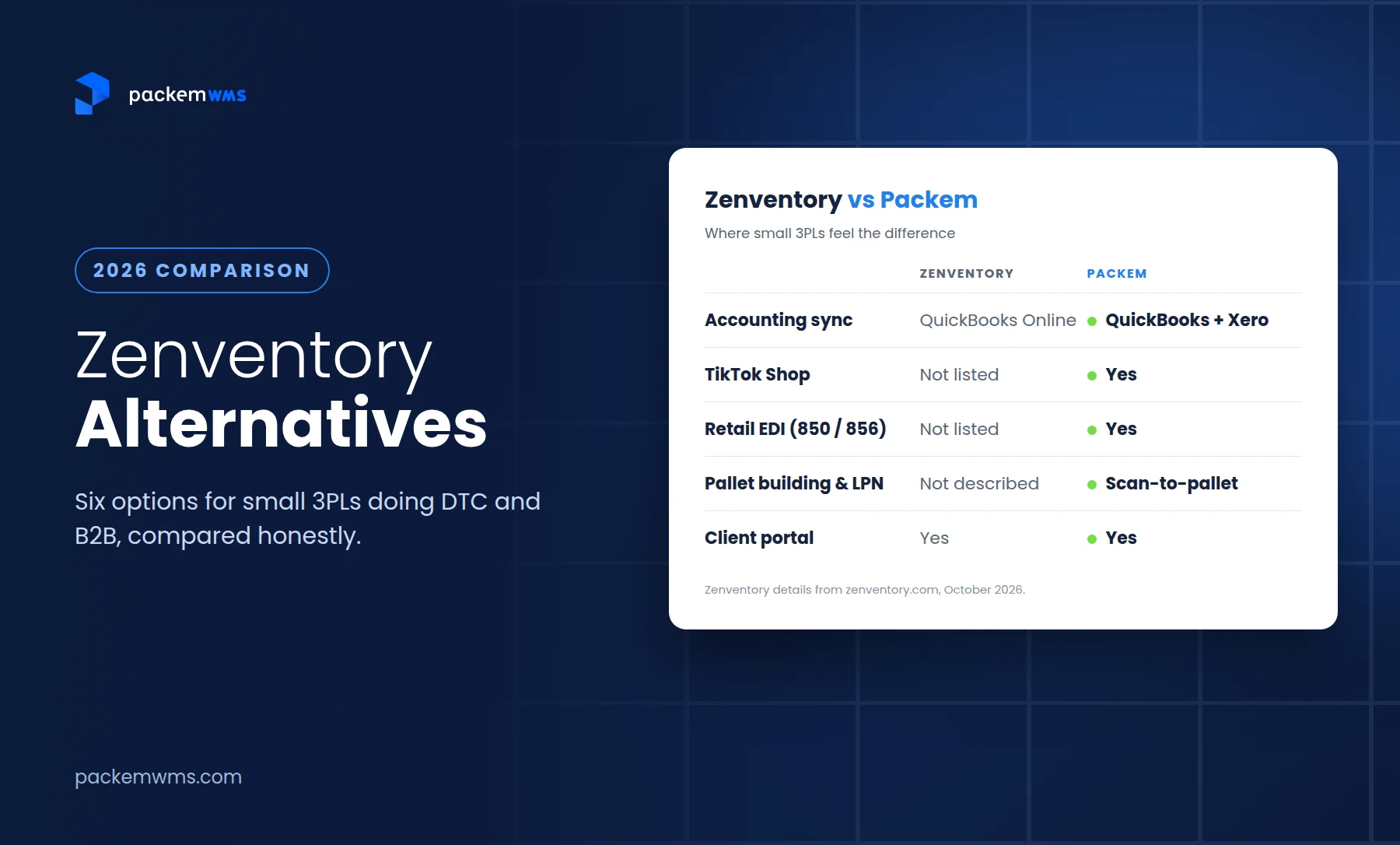
| Accounting sync | QuickBooks Online | QuickBooks and Xero |
| TikTok Shop | Not listed | Yes |
| Retail EDI | Not listed | Yes (purchase orders in, ASNs out) |
| Pallet building / LPN | Not described | Yes, scan-to-pallet with carton labels |
| Client portal | Yes (white-label) | Yes |
Zenventory details from zenventory.com, checked October 2026.
The 6 best Zenventory alternatives
1. Packem: best for 3PLs doing DTC and B2B
Packem is a cloud WMS for small and mid-size 3PLs that serve both e-commerce brands and retail suppliers. It competes more with ShipHero and Extensiv than with entry-level tools, and it’s priced that way: plans start at $850/month with 10 users included, and we typically waive the onboarding fee for smaller 3PLs.
What you get for the difference:
- Billing that matches your contracts: rate cards per client; storage, receiving, pick and pack and accessorial fees captured automatically; invoices synced to QuickBooks or Xero. See our 3PL billing software guide.
- Channels your clients are adding: Shopify, WooCommerce, ShipStation, TikTok Shop and EDI.
- Retail EDI built into the warehouse flow. Here’s how it works for one of our clients shipping to Petco:

How a Petco order flows through Packem, from purchase order to advance ship notice.
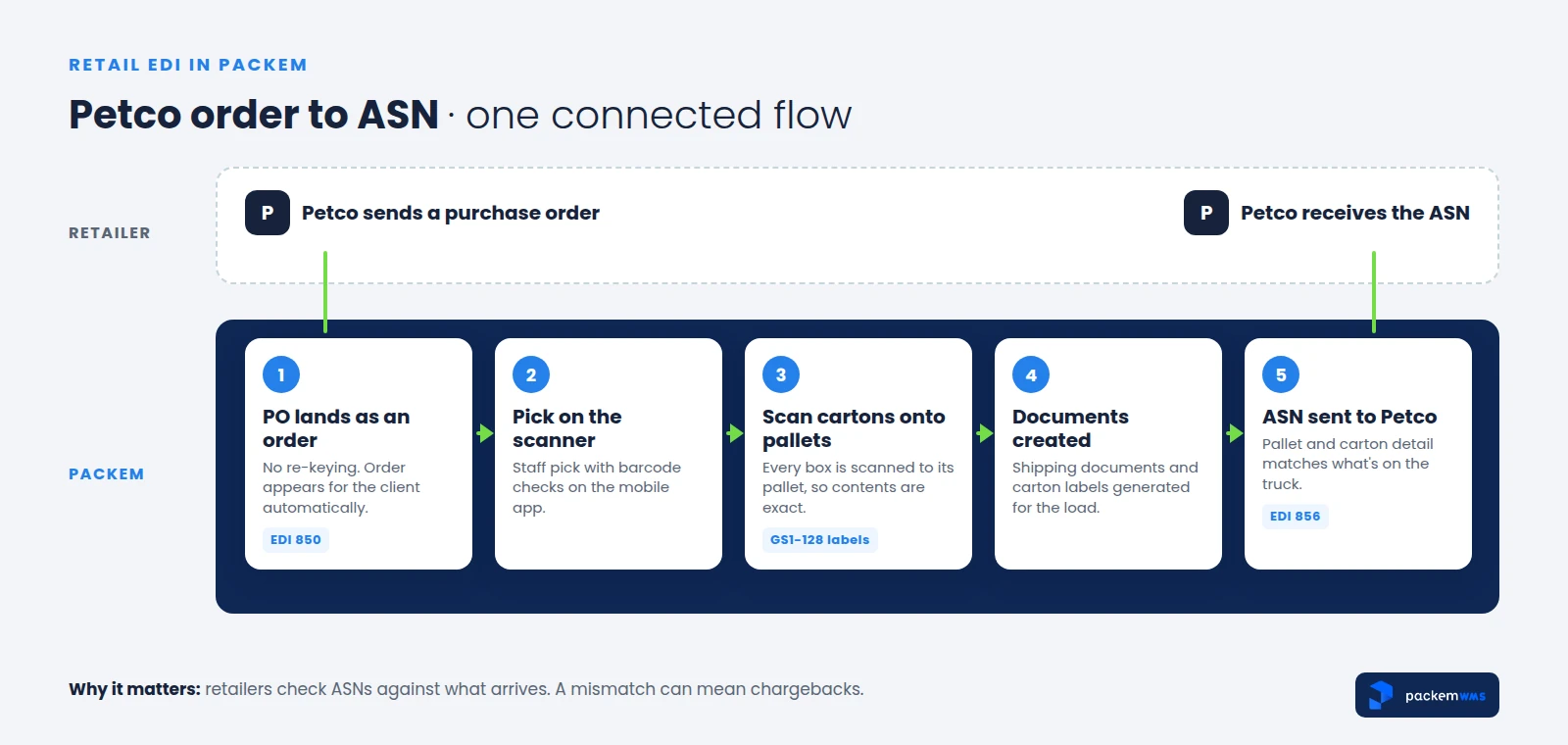
- Petco sends a purchase order (EDI 850) and it lands in Packem as an order.
- The warehouse picks it on the scanner app.
- Staff build pallets by scanning each carton onto a pallet, so Packem knows exactly what’s on every pallet.
- Packem creates the shipping documents and carton labels.
- Packem sends the advance ship notice (EDI 856) back to Petco with the pallet and carton detail.
No re-keying, and the ASN matches what’s on the truck. That’s the part retailers penalize when it’s wrong. Our EDI integration guide explains the transactions.
Packem is also US-based, offers in-person implementation on request, and builds client-specific features when a workflow needs it. If that sounds like your operation, book a 30-minute demo and bring a real retailer order.
2. Extensiv: best for established 3PLs that want an ecosystem
Extensiv (formerly 3PL Central) is one of the most widely used 3PL platforms, with a large integration marketplace and a fulfillment network. It suits 3PLs that want breadth and have the team to configure it. Small operators often cite per-client fees and the multi-product setup. See our Extensiv alternatives guide.
3. Packiyo: best for e-commerce-heavy 3PLs
Packiyo is popular with small and mid-size 3PLs focused on DTC, with a modern interface and Shopify-first workflows. If most of your clients sell online and few ship to retailers, it’s worth a look. Check its depth for EDI and pallet-level B2B before committing.
4. ShipHero: best for high-volume DTC
ShipHero is built for fast DTC fulfillment at volume. It’s a strong pick for 3PLs shipping thousands of parcels a day. It’s less focused on B2B, pallets and retail compliance. Our ShipHero alternatives guide covers when it fits.
5. Logiwa: best for automation-heavy operations
Logiwa targets high-volume operations that want advanced automation and optimization. For most small 3PLs it’s more platform, and more implementation, than they need. See Packem vs Logiwa.
6. CartonCloud: best if you also run trucks
CartonCloud combines a WMS with a transport management system, which is useful if your 3PL also delivers freight. It’s strongest in Australia and New Zealand, so US-based 3PLs should confirm support hours and local integrations.
When to stay with Zenventory
Switching costs time, so be honest about fit. Zenventory is probably enough if:
- You run one warehouse and ship mostly DTC parcels.
- Your clients all use QuickBooks Online.
- No client sells to big-box retailers or needs EDI.
- You want the lowest published entry price.
If two or more of those stop being true in the next year, plan your move before a retail client forces it.
How to switch from Zenventory
- Export your data: items, client lists, locations and on-hand inventory.
- Rebuild rate cards in the new system and test them against last month’s invoices.
- Move clients in phases: new clients first, simple clients next, complex clients last.
- Cut over integrations one channel at a time and reconcile inventory after each.
Our guide on how to switch 3PL WMS and the WMS demo checklist walk through each step.
Frequently asked questions
Is Zenventory good for 3PLs?
Yes, for many small 3PLs. Zenventory includes unlimited clients and users, a white-label client portal, 3PL billing and QuickBooks Online sync, starting at $499/month plus a $1,000 setup fee. It fits best for single-warehouse, DTC-focused operations without retail EDI needs.
How much does Zenventory cost?
As of October 2026, Zenventory Starter is $499/month (one warehouse, up to 10,000 shipments) and Growth is $799/month (three warehouses, up to 50,000 shipments). Both have a $1,000 setup fee, new customers get 50% off the first three months, and extra warehouses are $100/month.
Does Zenventory support EDI?
Zenventory’s 3PL product page doesn’t list EDI. If a client sells to retailers like Petco, Target or Walmart, you’ll need a WMS that receives EDI purchase orders and sends advance ship notices. Confirm current EDI options directly with Zenventory before deciding.
What’s the best Zenventory alternative for B2B and retail?
For small and mid-size 3PLs, Packem is built for DTC and B2B together: EDI purchase orders and ASNs, scan-to-pallet building with carton labels, QuickBooks and Xero sync, and TikTok Shop. Larger 3PLs that want a big integration marketplace often consider Extensiv.
How long does it take to switch from Zenventory?
Most small 3PLs can switch in 2 to 5 weeks with clean data and a phased rollout: new clients first, then simple clients, then complex ones. Test rate cards against a past month’s invoices before go-live.
Choosing your Zenventory alternative
Zenventory earns its place for single-warehouse DTC 3PLs. The case for switching is about what’s next: a client selling to Petco, a seller on TikTok Shop, a client on Xero, or contracts with fees your billing can’t capture.
This week: list the three things your next client will ask for that you can’t do today. This month: demo two alternatives using a real rate card and one real retailer order.
If retail EDI, Xero or deeper billing is on that list, book a 30-minute Packem demo. We’ll walk a sample PO through to the ASN, live.