If you’re running a small 3PL and paying for ShipHero, you already know the sting: $1,995/month for the Standard plan, $2,145 for the 3PL plan—before you add extra users at $150 each. For an operation managing a handful of clients and a few thousand orders a month, that’s a steep bill for software that wasn’t actually designed with your business model in mind.
ShipHero is a solid platform for mid-market fulfillment operations. But small 3PLs face a specific set of challenges that ShipHero doesn’t fully address: native 3PL billing, multi-client management, and cost structures that make sense at lower volumes. If you’re shopping for ShipHero alternatives, you’re likely looking for something more purpose-built—and more affordable.
Here are the five best ShipHero alternatives for small 3PLs in 2026, with honest pricing and feature comparisons.
Last Updated: April 2026
Why Small 3PLs Look for ShipHero Alternatives
ShipHero’s primary audience is mid-to-large DTC fulfillment operations. Its pricing reflects that. The platform charges $1,995/month on the base plan, which includes only 5 users—each additional seat costs $150/month. That adds up fast when you’re onboarding new warehouse staff.
According to Armstrong & Associates, 2024, the U.S. 3PL market totaled $307.9 billion in gross revenues, with mid-market and small 3PLs driving a growing share of new warehouse software adoption.
Beyond price, three issues consistently surface in reviews from small 3PLs:
- No native 3PL billing engine. ShipHero doesn’t automatically calculate storage fees, pick/pack charges, or handling costs per client. You’re manually reconciling invoices in QuickBooks—which defeats the purpose of automation software.
- DTC-first design. The platform optimizes heavily for DTC (direct-to-consumer) order fulfillment. B2B operations—pallets, LTL, EDI connections, wholesale billing—are often an afterthought.
- Onboarding friction. The 3PL plan charges a $2,000 onboarding fee. For smaller operations, that’s a significant upfront cost before you’ve seen any ROI.
If any of those issues sound familiar, the alternatives below are worth a look. To understand what separates good 3PL warehouse management software from generic WMS platforms, this guide breaks down the key differences.
What to Look for in a ShipHero Alternative
Not every WMS is built for third-party logistics. Before evaluating alternatives, know what features actually matter for your operation:
- Native 3PL billing. The ability to automatically calculate and generate invoices per client based on storage, pick/pack, and handling rates—without manual data entry.
- Multi-client management. Separate inventory, reporting, and customer portals for each client in one platform.
- Receiving and putaway workflows. Efficient inbound receiving with ASN support and directed putaway that works at your volume.
- Integrations. Shopify, WooCommerce, QuickBooks, and major carrier connections are table stakes. EDI matters if you have B2B clients.
- Pricing transparency. Monthly cost should be predictable. Per-order fees or usage-based pricing can balloon quickly as volume grows.
With those criteria in mind, here are the top picks.
5 Best ShipHero Alternatives for Small 3PLs
1. PackemWMS — Best Overall for Small 3PLs
Pricing: $750–$1,800/month
Best for: Small to mid-size 3PLs managing multiple clients with B2B and DTC orders
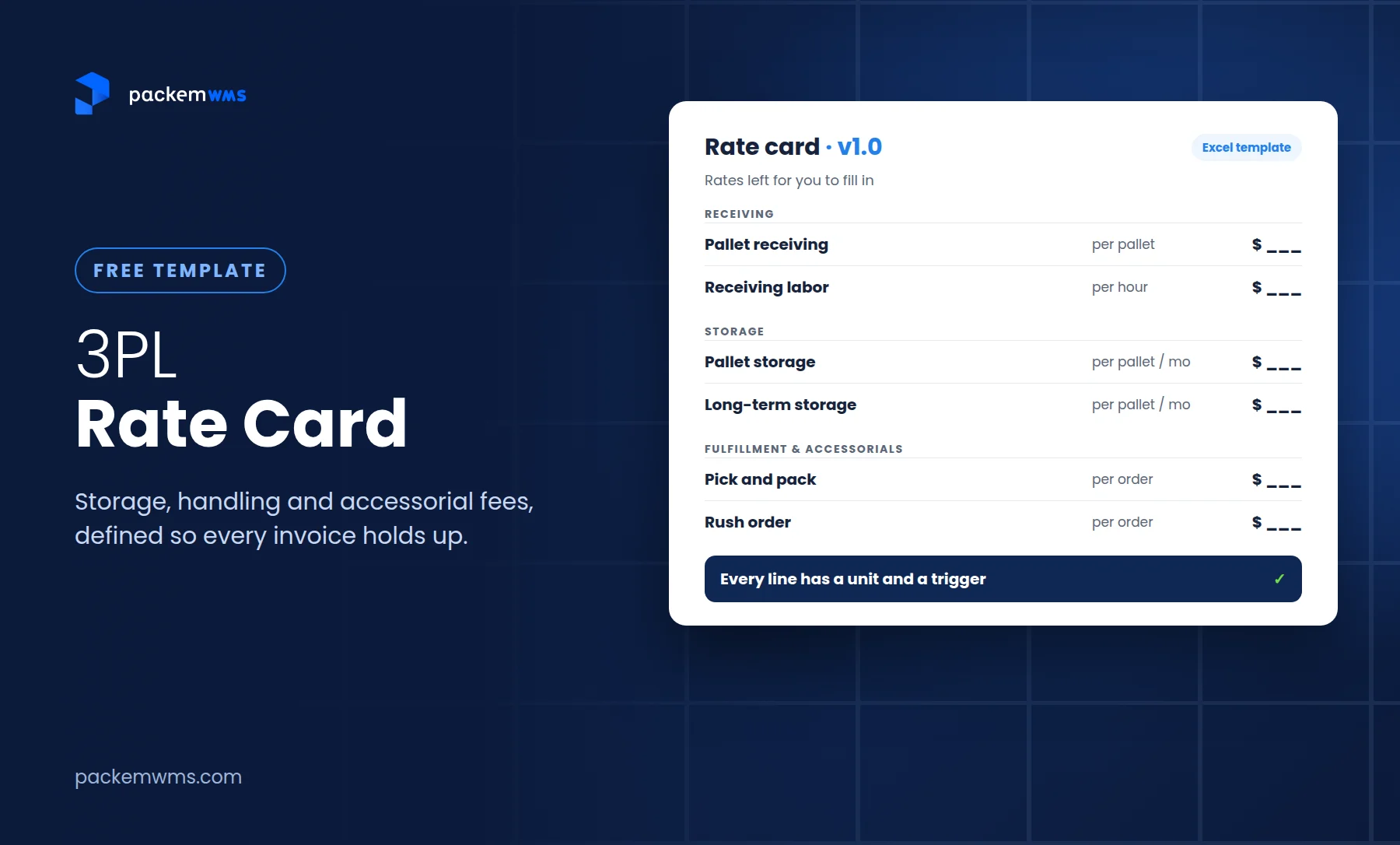
PackemWMS is built specifically for small and mid-size 3PLs—not retrofitted from an enterprise platform. Where ShipHero lacks a native billing engine, PackemWMS ships with built-in 3PL billing that automatically calculates per-client fees for storage, receiving, pick/pack, and custom charges. You generate invoices directly from the WMS without touching a spreadsheet.
The platform handles both DTC and B2B fulfillment workflows. Pallet management with LPN (License Plate Number) tracking, lot and serial number support, and EDI integration make it viable for wholesale and retail clients alongside ecommerce. ShipHero’s strength is DTC volume—PackemWMS covers the full mix that most small 3PLs actually manage.
Implementation runs 2–5 weeks, and the pricing doesn’t include per-user fees or onboarding charges that inflate your first invoice. The mobile Android app works on Zebra scanners, which is standard hardware for most warehouse operations.
What it does better than ShipHero: Native 3PL billing, B2B pallet workflows, predictable pricing, faster implementation
What to know: iOS devices aren’t supported—Android and Zebra only
See PackemWMS pricing details or the full feature list to evaluate fit.
2. Zenventory — Best for Multi-Channel eCommerce 3PLs
Pricing: ~$399–$999/month
Best for: 3PLs focused on multi-channel ecommerce fulfillment
Zenventory positions itself as an inventory and order management platform for 3PLs and small fulfillment operations. It has strong multi-channel ecommerce integrations (Amazon, Shopify, Walmart, eBay) and a clean interface that’s easy to onboard staff onto.
Weighing Zenventory specifically? We compare six Zenventory alternatives on billing, EDI, TikTok Shop and Xero.
The billing module is available, though it’s less robust than what PackemWMS ships with by default. Where Zenventory wins is ecommerce breadth—if your client roster is predominantly Shopify/Amazon sellers, its channel connections are mature.
What it does better than ShipHero: Lower entry price, multi-channel ecommerce depth
Limitations: Less suited for B2B/wholesale operations; billing setup requires more configuration
3. Packiyo — Best for DTC-Focused Fulfillment Centers
Pricing: ~$499–$999/month
Best for: 3PLs with a DTC-heavy client base and high pick/pack volume
Packiyo is a newer entrant built specifically for 3PL fulfillment centers. It has a clean, modern UI and strong Shopify integration. The client portal is well-designed, giving your clients real-time visibility into their inventory and orders without requiring them to log into your WMS directly.
If Packiyo is on your shortlist, see our full Packiyo comparison for current pricing and where small 3PLs outgrow it.
Like ShipHero, Packiyo is DTC-first. If your clients are primarily Shopify brands doing high-volume DTC fulfillment, Packiyo is worth evaluating. For operations with significant B2B volume, pallets, or lot tracking requirements, you’ll hit limitations quickly.
What it does better than ShipHero: Lower cost, modern interface, purpose-built client portals
Limitations: Limited B2B and compliance features; newer platform with smaller support ecosystem
4. CartonCloud — Best for Owner-Operator 3PLs
Pricing: ~$200–$600/month (AUD-based pricing; USD equivalent varies)
Best for: Small owner-operated 3PLs and regional warehouses
CartonCloud is an Australian-based WMS and TMS (transportation management system) that has expanded into North American markets. It’s designed for small warehouse operators and freight companies that need both warehousing and transport management in one tool.
The pricing is genuinely low by WMS standards, and the interface is straightforward. If you’re running a small regional 3PL with some transport component, the combined WMS+TMS is a differentiator. For pure warehousing operations with complex billing requirements, the billing capabilities are less comprehensive than PackemWMS.
What it does better than ShipHero: Significant cost reduction; built-in TMS for transport operations
Limitations: Primarily designed for Australian market; feature depth can lag behind US-focused platforms
5. Logiwa — Best for High-Volume Operations Ready to Scale
Pricing: Custom, typically $20,000–$100,000/year
Best for: 3PLs processing 10,000+ orders/month with dedicated IT resources
Logiwa sits at the higher end of the market—well above ShipHero’s price range. If you’re looking at ShipHero alternatives because of cost, Logiwa isn’t the answer. But if your concern is feature depth and scale, and your operation has grown beyond what ShipHero can handle, Logiwa is worth knowing about.
It’s a cloud-native WMS designed for high-volume fulfillment. The implementation is complex, typically requiring dedicated IT resources and a multi-month rollout. For operations processing several thousand orders daily with enterprise retailer EDI connections, Logiwa provides that infrastructure. For small 3PLs, it’s overbuilt and overpriced.
What it does better than ShipHero: Enterprise-grade scale, deep EDI and carrier connections
Limitations: $20K+ entry cost, long implementation timeline, overkill for most small 3PLs
ShipHero Alternatives Comparison
| Platform | Starting Price | Native 3PL Billing | B2B/Pallet Support | Best For |
|---|---|---|---|---|
| PackemWMS | $750/mo | Yes | Yes | Small–mid 3PLs, mixed DTC+B2B |
| Zenventory | ~$399/mo | Partial | Limited | eCommerce-heavy 3PLs |
| Packiyo | ~$499/mo | Partial | Limited | DTC fulfillment centers |
| CartonCloud | ~$200/mo | Basic | Moderate | Owner-operators with transport needs |
| Logiwa | $20K+/yr | Yes | Yes | High-volume enterprise 3PLs |
| ShipHero | $1,995/mo | No | Limited | Mid-market DTC fulfillment |
How to Choose the Right ShipHero Alternative for Your 3PL
The right choice comes down to three variables: your current volume, your client mix, and your billing complexity.
If you run a mixed DTC and B2B operation with multiple clients and need automated billing, PackemWMS is the most complete fit. The native billing engine alone eliminates hours of manual invoicing per month. Understanding the key features of warehouse management systems helps clarify why billing depth matters as you scale.
If your clients are primarily ecommerce brands on Shopify or Amazon, Zenventory or Packiyo offer lower entry prices with strong channel integrations. You’ll likely outgrow their billing capabilities as you add clients, but for early-stage operations they’re viable.
If you’re a small owner-operator running a tight regional operation with some transport involvement, CartonCloud’s combined WMS+TMS at a lower price point makes sense.
If volume is the constraint—processing tens of thousands of orders monthly with enterprise retailer connections—then Logiwa is worth the investment. But most small 3PLs aren’t there yet.
One factor that rarely shows up in comparison articles: implementation time. ShipHero’s 3PL plan charges $2,000 upfront and often takes months to fully configure. PackemWMS typically runs 2–5 weeks to go live. When you’re paying monthly fees from day one, faster implementation directly reduces your total cost to value. A cloud-based WMS with streamlined onboarding keeps your team running without extended disruption.
The Bottom Line
ShipHero is a good platform—for the right operation. If you’re running a mid-market DTC fulfillment center with 50+ employees and deep Shopify integrations, it does the job. But small 3PLs managing a diverse client base, B2B orders, and manual billing workflows are paying enterprise prices for a platform that doesn’t fit.
For most small 3PLs, PackemWMS is the most balanced ShipHero alternative: purpose-built for third-party logistics, native billing included, and priced to make sense at smaller volumes. Zenventory and Packiyo work if you’re ecommerce-focused and want a lower entry price. CartonCloud is worth a look if you’re managing transport alongside warehousing.
If you want to see how PackemWMS specifically compares to ShipHero for your operation, you can schedule a demo and walk through your client mix, billing requirements, and volume with the team.