Last updated: October 4, 2026 · By Sam Ranjbari, founder of Packem
The best Packiyo alternatives for small 3PLs are Packem (lower cost per user, built-in retail EDI), Extensiv (large integration ecosystem), ShipHero (high-volume DTC), Zenventory (lowest published entry price), Logiwa (automation-heavy operations) and CartonCloud (WMS plus transport). Packiyo is a modern, well-integrated WMS. 3PLs usually start looking elsewhere over support response times, per-user costs as the team grows, or retail EDI.
Packiyo is one of the stronger platforms built for small and mid-size 3PLs, so this isn’t a “Packiyo is bad” article. It’s for operators who like what Packiyo does but have hit one of its limits. If you want a number first, try our WMS cost calculator.
Key Takeaways
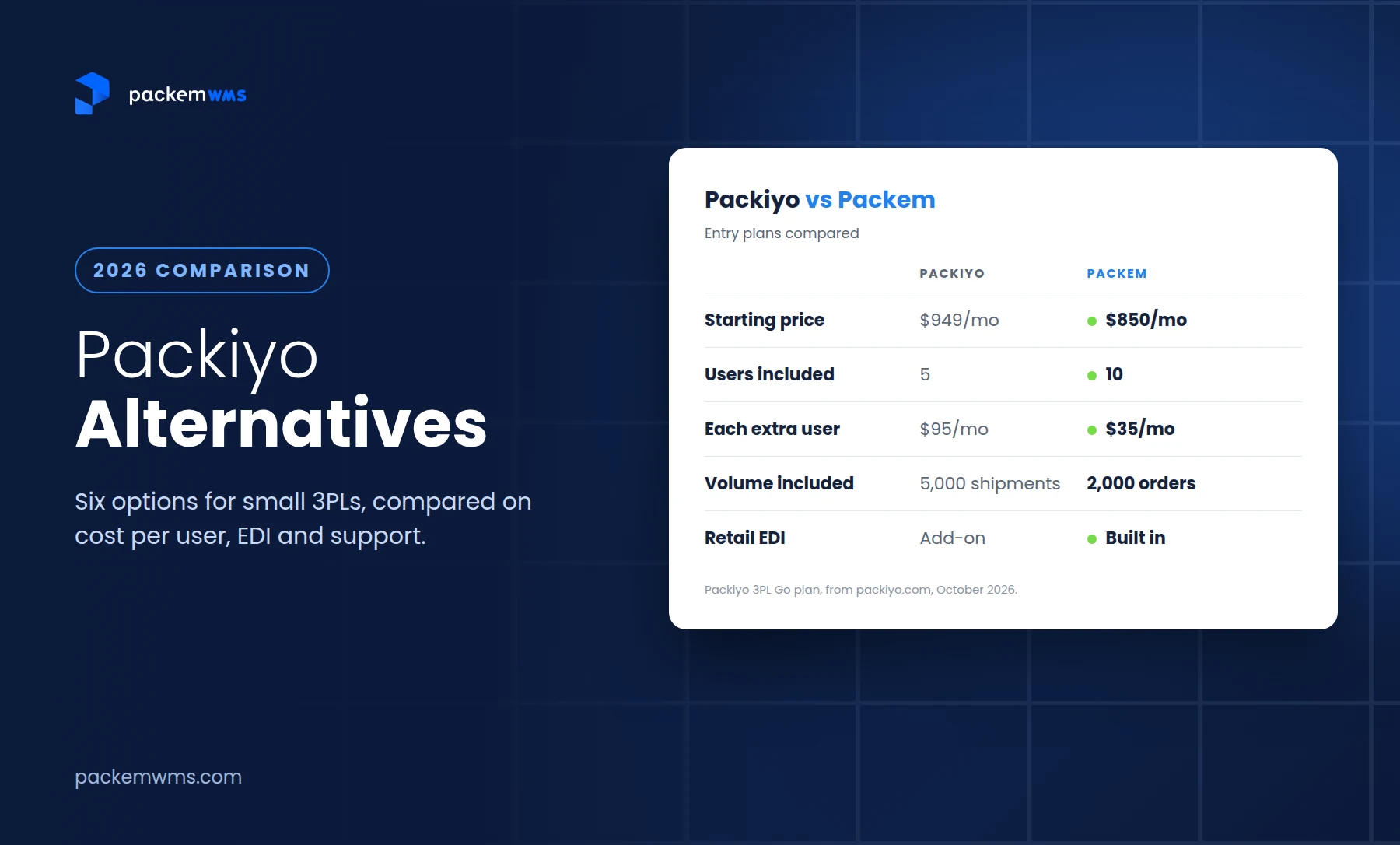
- Packiyo’s 3PL Go plan is $949/month with 5 users and 5,000 shipments; extra users are $95 each per month and extra shipments are 6 cents each.
- Packem starts at $850/month with 10 users and 2,000 orders a month included; extra users are $35 each per month. Packiyo includes more volume at its entry tier; Packem includes more people.
- Both sync to QuickBooks and Xero and connect to TikTok, so accounting and channels aren’t the deciding factor between them.
- The real differences are retail EDI (built into Packem, a premium connector at Packiyo) and how support works after go-live.
- If you’re DTC-only, under 5 users and happy with Packiyo’s support, staying put is reasonable.
What Packiyo does well
Packiyo launched in 2021 and has grown fast with small and mid-size 3PLs. fulfill.com’s ranking of WMS platforms for 3PLs lists it third, as the pick for “small-to-mid 3PLs” (fulfill.com). Credit where it’s due:
- Modern, intuitive interface, the most common praise in reviews.
- Broad integrations: Shopify, Amazon, Walmart, WooCommerce, BigCommerce, TikTok, Faire and more, plus UPS, FedEx, USPS, DHL and EasyPost (Packiyo integrations).
- 3PL billing that syncs to QuickBooks Online and Xero.
- Mobile apps on iOS and Android, and AI features for automation.
- Published pricing and fast onboarding, typically 1 to 3 weeks, with no onboarding fee on the 3PL Go plan (Packiyo pricing, checked October 2026).
On Trustpilot, Packiyo holds 4.4 out of 5 from 24 reviews, with several reviewers naming support reps who helped them.
Why small 3PLs look for a Packiyo alternative
The reasons we hear are rarely about features. They’re about cost as you grow and what happens after go-live:
- Cost per user. 3PL Go includes 5 users. Each extra user is $95 a month, so a 10-person team on 3PL Go pays $1,424, or moves to 3PL Pro at $1,799.
- Overage pricing. Shipments over your plan’s allowance are 6 cents each.
- Support after onboarding. Packiyo’s support team gets real praise. Recent Trustpilot reviews also describe email-only help once onboarding ends, with one 3PL saying issues “take a week going back and forth.”
- Documentation. Reviewers in 2026 mention outdated help articles and videos.
- Retail EDI. Packiyo’s integrations page doesn’t list an EDI provider, and third-party profiles describe EDI as a premium connector. If you have clients shipping to big-box retailers, confirm what’s included and what it costs.
We’ve seen this firsthand. A 3PL that came to Packem from Packiyo told us two things decided it. Support tickets were taking too long to resolve. And for their order volume, they felt they were paying more than the platform was doing for them.
What to look for in a Packiyo alternative
- Total cost at your real team size and volume: users included, extra-user price, orders or shipments included, overage rates.
- Support you can reach after go-live: channels (Slack, email, phone), who answers, and how fast issues are resolved, not just first response.
- Retail readiness: EDI purchase orders and ASNs, carton labels and pallet building, without a separate integration project.
- Billing depth: rate cards per client, accessorials, and accounting sync to QuickBooks or Xero.
- Implementation: a realistic go-live date and hands-on training.
Packiyo alternatives compared
| Software | Best for | Watch out for |
|---|---|---|
| Packem | Small to mid-size 3PLs doing DTC and B2B that want retail EDI and lower cost per user | Fewer orders included at the entry plan (2,000/month) |
| Extensiv (formerly 3PL Central) | Established 3PLs that want a large integration ecosystem | Per-client fees and a multi-product setup that can be heavy for small teams |
| ShipHero | High-volume DTC fulfillment | Less focused on B2B, pallets and retail EDI |
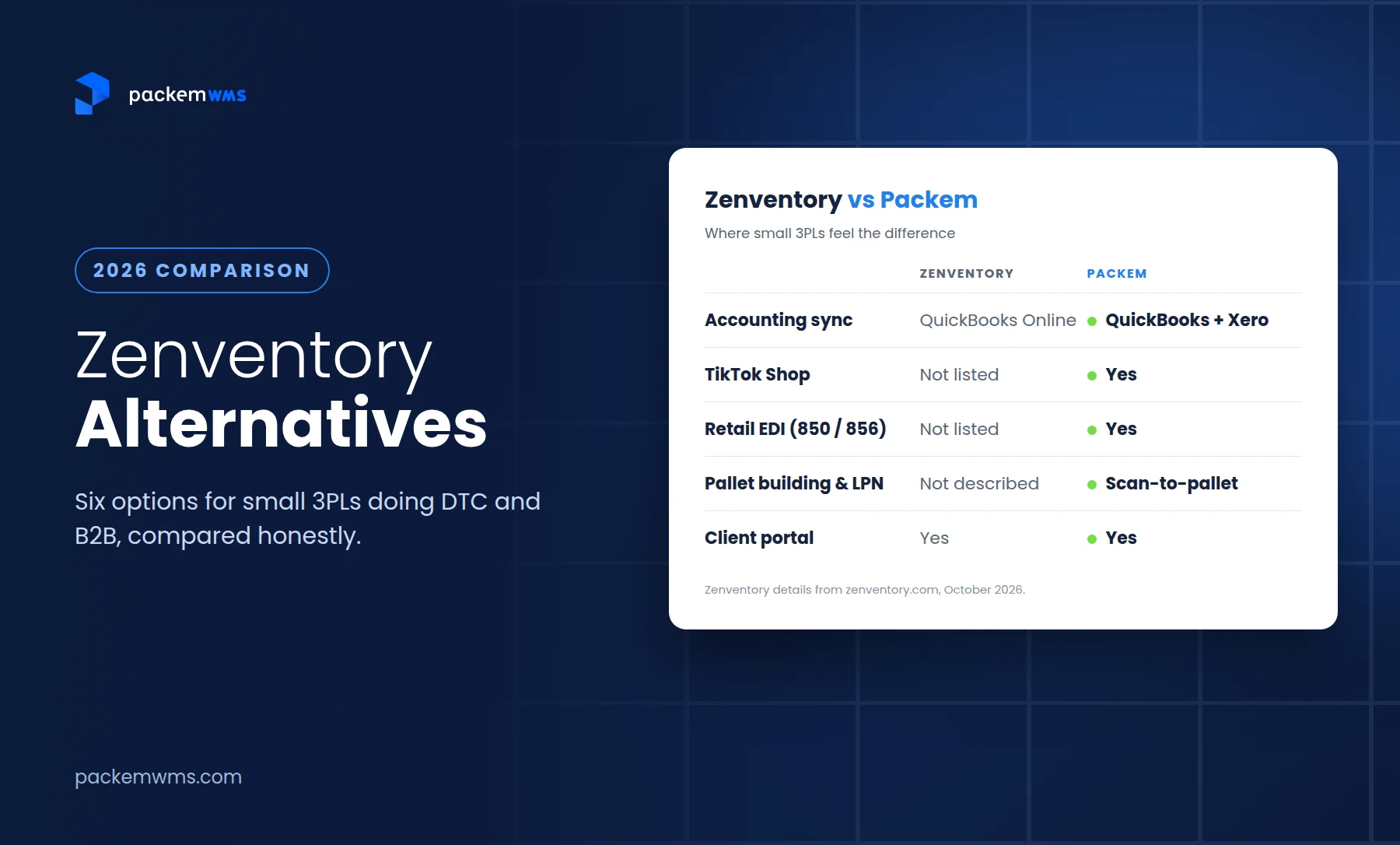
| Zenventory | The lowest published entry price | No EDI listed; QuickBooks Online only |
| Logiwa | Automation-heavy, high-volume operations | More platform than most small 3PLs need |
| CartonCloud | 3PLs that also run trucks and want WMS and TMS together | Strongest in Australia and New Zealand; check US support hours |
Packiyo vs Packem at a glance
| Packiyo (3PL Go) | Packem | |
|---|---|---|
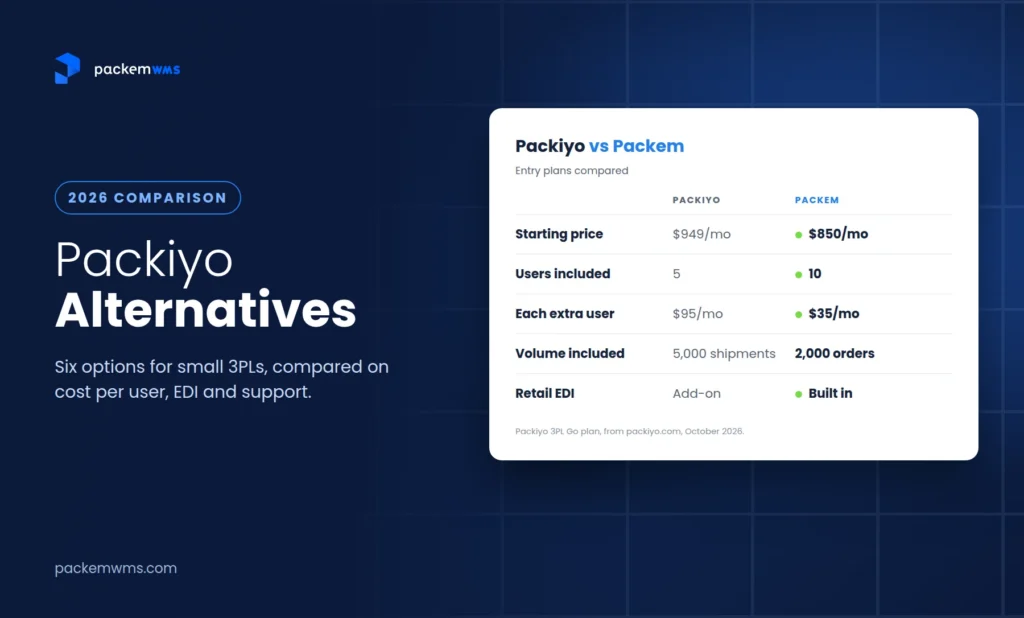
| Starting price | $949/month | $850/month |
| Users included | 5 | 10 |
| Extra users | $95/user/month | $35/user/month |
| Volume included | 5,000 shipments/month | 2,000 orders/month |
| Accounting sync | QuickBooks Online, Xero | QuickBooks, Xero |
| Retail EDI | Premium connector (confirm cost) | Built in (purchase orders in, ASNs out) |
| Support | Email and chat; reviews mention email-only after onboarding | Slack and email; phone on the premium support plan |
Packiyo details from packiyo.com, checked October 2026.
The 6 best Packiyo alternatives
1. Packem: best for lower cost per user and retail EDI
Packem is a cloud WMS for small and mid-size 3PLs serving both e-commerce brands and retail suppliers. Plans start at $850/month with 10 users and 2,000 orders a month included, and additional users are $35 each.
What makes the difference after go-live:
- Support you can reach. Every client gets support over Slack and email. We prioritize by severity and aim to resolve issues within 2 to 6 hours, depending on complexity. Phone support is available on our premium support plan.
-
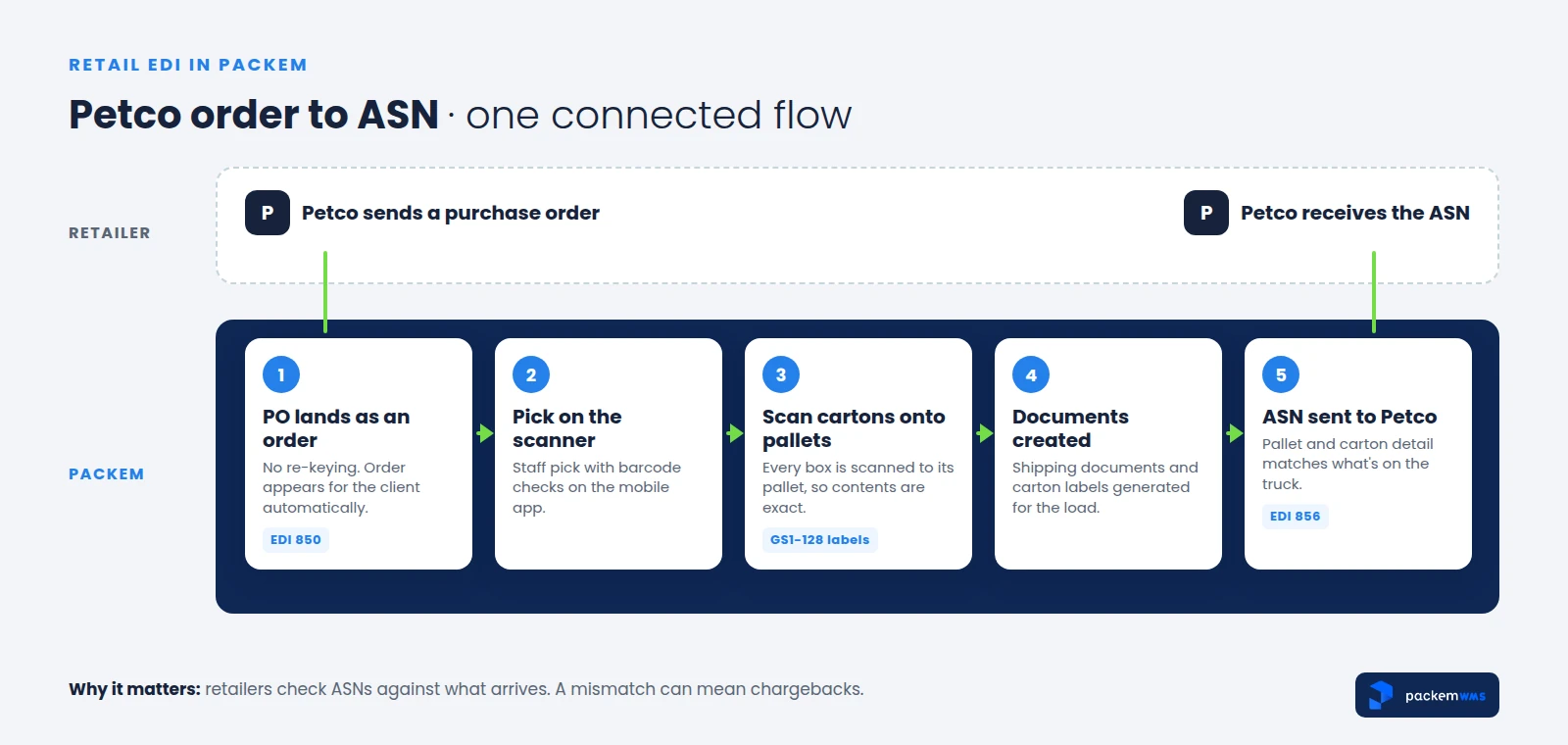
Retail EDI in the warehouse flow. For one of our clients shipping to Petco, the purchase order arrives in Packem, the team picks it, scans every carton onto its pallet, and Packem creates the documents and sends the advance ship notice back to Petco.

How a Petco order flows through Packem, from purchase order to advance ship notice. -
Billing for every fee in your contracts: rate cards per client, storage, receiving, pick and pack and accessorials captured automatically, with invoices synced to QuickBooks or Xero. See our 3PL billing software guide.
Packem is US-based, offers in-person implementation on request, and builds client-specific features when a workflow needs it. If that sounds like a fit, book a 30-minute demo and bring your current Packiyo invoice so we can compare costs at your volume.
2. Extensiv: best for established 3PLs that want an ecosystem
Extensiv (formerly 3PL Central) offers a large integration marketplace and a fulfillment network. It suits 3PLs with the team to configure a multi-product platform. Smaller operators often cite per-client fees and complexity. See our Extensiv alternatives guide.
3. ShipHero: best for high-volume DTC
ShipHero is built for fast DTC fulfillment at volume and is a strong fit for 3PLs shipping thousands of parcels a day. It’s less focused on B2B, pallets and retail compliance. Our ShipHero alternatives guide covers when it fits.
4. Zenventory: best for the lowest entry price
Zenventory starts at $499/month plus a $1,000 setup fee, with unlimited users and clients. Its 3PL page doesn’t list EDI or Xero, so it fits single-warehouse DTC operations best. See our Zenventory alternatives guide.
5. Logiwa: best for automation-heavy operations
Logiwa targets high-volume operations that want advanced automation. For most small 3PLs it’s more platform, and more implementation, than they need. See Packem vs Logiwa.
6. CartonCloud: best if you also run trucks
CartonCloud combines a WMS with transport management. It’s strongest in Australia and New Zealand, so US-based 3PLs should confirm support hours and local integrations.
When to stay with Packiyo
Switching costs time. Packiyo is probably still right if:
- Your team fits within 5 users, or the extra-user cost doesn’t bother you.
- You ship mostly DTC parcels and value the included 5,000 shipments.
- No client needs retail EDI.
- Support has been responsive for you.
If support delays or per-user costs are already hurting, plan the move before your busy season, not during it.
How to switch from Packiyo
- Export your data: items, clients, locations, on-hand inventory and open orders.
- Rebuild rate cards in the new system and test them against last month’s invoices.
- Move clients in phases: new clients first, simple clients next, complex clients last.
- Cut over integrations one channel at a time and reconcile inventory after each.
Our guide on how to switch 3PL WMS and the WMS demo checklist walk through each step.
Frequently asked questions
Is Packiyo good for small 3PLs?
Yes. Packiyo is built for small and mid-size 3PLs, with a modern interface, broad e-commerce integrations, QuickBooks and Xero billing sync, and 1 to 3 week onboarding. It fits best for DTC-focused 3PLs with small teams that don’t need retail EDI.
How much does Packiyo cost?
As of October 2026, Packiyo 3PL Go is $949/month with 5 users and 5,000 shipments, and 3PL Pro is $1,799/month with 10 users and 20,000 shipments. Extra users cost $95 per month each and extra shipments 6 cents each. Enterprise pricing is custom.
Does Packiyo support EDI?
Packiyo’s integrations page doesn’t list an EDI provider, and third-party profiles describe EDI connectors as a premium integration. If a client sells to retailers like Petco, Target or Walmart, confirm with Packiyo which trading partners are supported and what it costs.
What’s the difference between Packiyo and Packem?
Packiyo includes more shipments at its entry plan (5,000 vs 2,000 orders), while Packem includes more users (10 vs 5) and charges less per extra user ($35 vs $95). Packem builds retail EDI into the warehouse flow and offers Slack support with a 2 to 6 hour resolution target.
How long does it take to switch from Packiyo?
Most small 3PLs can switch in 2 to 5 weeks with clean data and a phased rollout: new clients first, then simple clients, then complex ones. Test rate cards against a past month’s invoices before go-live.
Choosing your Packiyo alternative
Packiyo earns its spot as a modern WMS for small 3PLs. The case for switching usually comes down to two things you feel every week: how fast problems get fixed, and what each new team member costs.
This week: pull your last three months of Packiyo invoices and support tickets. This month: demo two alternatives with that data in hand and compare total cost at your real team size.
If support speed or per-user cost is on your list, book a 30-minute Packem demo. Bring your current invoice and we’ll compare costs line by line.