AI Is Changing What Warehouse Data Can Do
Warehouses have never had a shortage of data.
Every receiving transaction, inventory movement, picking task, shipment, return, labor activity, and client order creates another data point.
The problem is that having warehouse data is not the same as knowing what to do with it.
Traditional warehouse reporting typically answers questions such as:
- How many orders did we ship yesterday?
- How much inventory do we have?
- Which orders are still pending?
- How productive was the warehouse team?
- Which SKUs are running low?
These answers are useful—but they are largely backward-looking.
AI-powered warehouse analytics takes the next step.
Instead of only showing what happened, AI can analyze historical and real-time warehouse data to identify patterns, predict potential problems, surface anomalies, and help warehouse managers make faster decisions.
For 3PLs managing multiple clients, SKUs, orders, locations, and service-level commitments, this shift can be particularly valuable.
What Is AI-Powered Warehouse Analytics?
AI-powered warehouse analytics is the use of artificial intelligence, machine learning, predictive analytics, and real-time operational data to understand warehouse performance and generate actionable insights.
A traditional dashboard might tell you:
“Order volume increased 18% this week.”
An AI-powered analytics system could go further:
“Order volume for Client A is trending 24% above its four-week average. Based on historical patterns, volume is likely to remain elevated for the next seven days. Consider reallocating picking capacity.”
That difference is important.
Traditional analytics helps you see the warehouse.
AI-powered analytics helps you understand and anticipate the warehouse.
Modern warehouse platforms are already combining real-time dashboards, KPI tracking, predictive analytics, intelligent slotting, and AI-driven workflows.
Why Warehouse Analytics Matters for 3PLs
3PL operations are inherently data-heavy.
A single warehouse may manage:
- Multiple clients
- Thousands of SKUs
- Different inventory ownership rules
- Receiving and putaway
- Picking and packing
- Returns
- Multiple carriers
- Different billing structures
- Client-specific SLAs
- Variable order volumes
- Labor and storage costs
As the operation grows, spreadsheets and static reports become increasingly difficult to manage.
For a 3PL, warehouse analytics can help answer questions such as:
Which clients are consuming the most warehouse resources?
Which SKUs are creating unnecessary storage costs?
Where are picking delays occurring?
Which orders are at risk of missing SLA targets?
Which clients are generating the highest operational margin?
Where could warehouse capacity become constrained next month?
This is where AI becomes more interesting than conventional reporting.
7 Ways AI-Powered Warehouse Analytics Can Transform Operations
1. Predictive Inventory Analytics
Inventory management is one of the biggest areas where AI can add value.
Traditional inventory reports show current stock levels.
Predictive inventory analytics can combine:
- Historical demand
- Order frequency
- Seasonal patterns
- Lead times
- Stock movement
- Reorder history
- Client demand patterns
to identify potential future inventory problems.
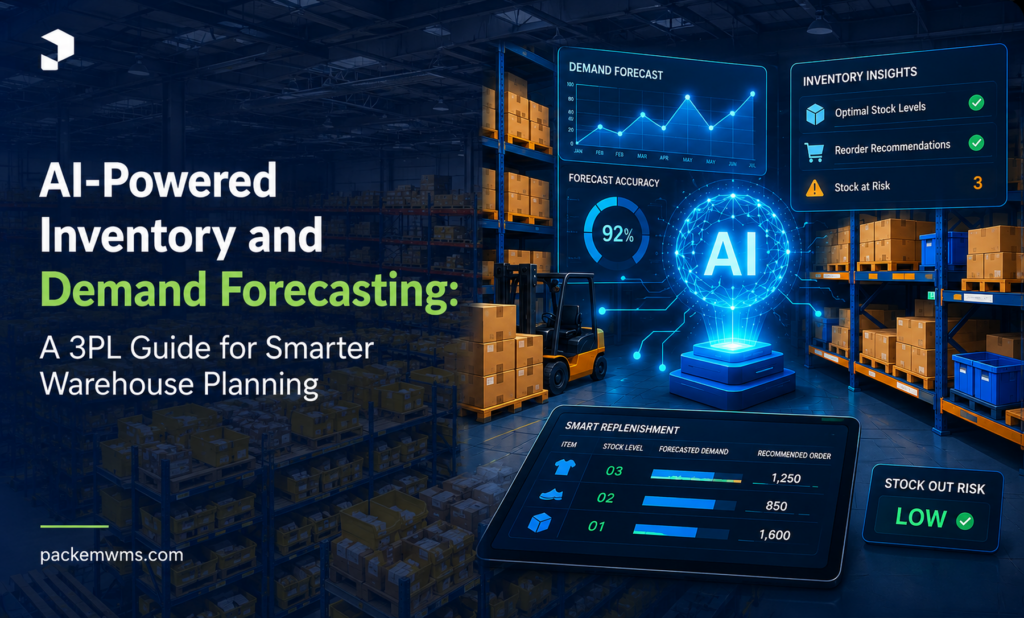
For example, instead of waiting until an SKU reaches a predefined reorder point, AI can identify that its consumption rate is accelerating and flag a potential stockout earlier.
This can support:
- Better replenishment planning
- Lower stockout risk
- Reduced excess inventory
- Improved inventory turnover
- Better working capital management
Predictive analytics is increasingly being positioned as a way for warehouses to move from reactive decision-making toward forward-looking inventory and labor planning.
2. AI-Powered Warehouse KPI Analytics
Warehouse managers often track KPIs such as:
- Order accuracy
- Pick rate
- Pick accuracy
- Inventory accuracy
- Order cycle time
- Dock-to-stock time
- On-time shipment rate
- Warehouse utilization
- Labor productivity
- Return rate
The challenge is not collecting these metrics.
The challenge is identifying which metrics actually require attention.
AI-powered warehouse analytics can continuously analyze KPI trends and highlight unusual changes.
For example:
“Picking productivity has decreased 11% over the last five days in Zone B.”
Instead of forcing a manager to manually compare multiple reports, the system can surface the issue automatically.
The next step is even more valuable: identifying the likely causes.
3. Predictive Warehouse Capacity Planning
Warehouse space is expensive.
For 3PLs, inefficient space utilization can directly affect profitability.
AI can analyze:
- Historical inventory levels
- SKU velocity
- Client growth
- Seasonal demand
- Receiving schedules
- Outbound volume
- Available warehouse locations
to help forecast future space requirements.
Imagine knowing several weeks ahead that a major client is likely to exceed its current storage allocation.
Instead of reacting when the warehouse is already crowded, the operator can plan:
- Additional storage
- Slotting changes
- Inventory transfers
- Labor requirements
- Client discussions
- Temporary capacity
This turns warehouse capacity planning from a reactive exercise into a predictive process.
4. Intelligent Warehouse Slotting
Where an SKU is stored can have a major impact on picking efficiency.
Fast-moving products positioned far away from packing stations can create unnecessary travel.
AI-powered slotting can analyze SKU velocity, order combinations, product dimensions, picking frequency, and warehouse layout to identify better storage locations.
Instead of manually reviewing warehouse locations, operators can receive recommendations such as:
“Move these 25 high-velocity SKUs closer to the primary picking zone.”
Over time, the system can continuously evaluate whether the warehouse layout is still optimal.
This is one area where AI-powered WMS platforms are moving beyond static warehouse rules toward dynamic optimization.
5. AI for 3PL Client and Profitability Analytics
For a 3PL, not every client has the same operational profile.
One client may generate large order volumes but require very little handling.
Another may have fewer orders but require:
- More receiving
- More returns
- More storage
- More special handling
- More customer service
- More manual work
Looking only at revenue can therefore provide an incomplete picture.
AI-powered 3PL analytics can help operators evaluate profitability across dimensions such as:
Client → Warehouse → SKU → Order → Service → Cost
This can help identify:
- High-value clients
- High-cost clients
- Margin leakage
- Underpriced services
- Excessive handling requirements
- Storage inefficiencies
- Billing opportunities
Modern 3PL analytics platforms are increasingly focusing on profitability and billing leakage alongside operational KPIs.
6. Predictive SLA and Fulfillment Analytics
For 3PLs, missing an SLA can damage both profitability and client relationships.
AI can monitor order queues, warehouse workload, picking progress, packing status, carrier cutoffs, and historical fulfillment patterns.
It can then identify orders that may be at risk.
For example:
“37 orders for Client B have a high probability of missing today’s carrier cutoff.”
That gives the warehouse team time to intervene.
Instead of discovering a problem after the shipment is late, operators can act while there is still time to fix it.
This is one of the biggest differences between descriptive analytics and predictive warehouse analytics.
7. Natural-Language Warehouse Analytics
Perhaps one of the most interesting developments in AI-powered warehouse management is the ability to interact with warehouse data using natural language.
Instead of navigating through multiple dashboards, a warehouse manager could ask:
“Which client had the highest storage growth this month?”
Or:
“Show me the five slowest-moving SKUs.”
Or:
“Why did picking productivity drop last week?”
Or:
“Which clients are most likely to exceed their storage allocation next month?”
The AI layer can translate those questions into analysis and return the relevant information.
This creates a more accessible interface between warehouse operators and their data.
AI-Powered Analytics vs. Traditional Warehouse Reporting
| Traditional Warehouse Reporting | AI-Powered Warehouse Analytics |
| Shows historical performance | Identifies trends and predicts outcomes |
| Static dashboards | Dynamic insights |
| Manual investigation | Automated anomaly detection |
| Fixed reports | Natural-language questions |
| Reactive decisions | Predictive decisions |
| Basic KPI tracking | Contextual KPI analysis |
| Manual forecasting | AI-assisted forecasting |
| Periodic reporting | Continuous monitoring |
| Data visualization | Actionable recommendations |
The goal isn’t to eliminate dashboards.
The goal is to make dashboards smarter.
What Data Does AI Need to Analyze a Warehouse?
AI is only as useful as the data behind it.
An AI-powered warehouse analytics system can potentially use data from:
Inventory
- Stock levels
- SKU velocity
- Inventory adjustments
- Cycle counts
- Stock movements
Orders
- Order volume
- Order frequency
- Picking time
- Packing time
- Shipping status
Warehouse Operations
- Receiving
- Putaway
- Picking
- Packing
- Returns
- Transfers
Labor
- Tasks completed
- Productivity
- Workload
- Shift performance
Clients
- Order patterns
- Storage utilization
- Handling requirements
- Billing activity
- SLA performance
Financial Data
- Storage charges
- Handling fees
- Shipping costs
- Billing records
- Operational costs
Connecting these datasets gives AI a much richer picture of warehouse performance.
The Role of a Modern WMS in AI-Powered Analytics
AI doesn’t replace a warehouse management system.
In many cases, the WMS becomes the foundation for AI.
A modern WMS captures operational events throughout the warehouse.
Receiving creates data.
Putaway creates data.
Inventory movements create data.
Picking creates data.
Packing creates data.
Shipping creates data.
Returns create data.
Billing creates data.
When these data points are connected, an AI analytics layer can turn them into operational intelligence.
That is why choosing a modern, cloud-based warehouse management system with strong data structures, integrations, APIs, and reporting capabilities can become increasingly important as AI adoption grows.
The broader WMS market is also being driven by real-time visibility, cloud adoption, warehouse automation, and AI-powered capabilities.
How 3PLs Can Prepare for AI
You don’t need to turn your warehouse into a fully autonomous facility overnight.
A practical AI roadmap can start with the basics.
Step 1: Centralize your warehouse data
Bring inventory, orders, clients, receiving, fulfillment, and billing data into connected systems.
Step 2: Establish reliable KPIs
Define the metrics that actually matter to your operation.
Step 3: Automate repetitive reporting
Stop spending hours manually creating operational reports.
Step 4: Introduce predictive analytics
Start with high-value use cases such as inventory forecasting, capacity planning, and SLA prediction.
Step 5: Add AI-assisted decision-making
Let AI surface anomalies, trends, and recommendations while keeping humans in control.
Step 6: Move toward conversational analytics
Give managers the ability to ask questions about warehouse performance in natural language.
The objective shouldn’t be AI for the sake of AI.
The objective should be better warehouse decisions with less manual analysis.
What Does the Future of Warehouse Analytics Look Like?
The next generation of warehouse analytics will likely move beyond dashboards.
Instead of asking:
“What happened?”
warehouse managers will increasingly ask:
“Why did it happen?”
Then:
“What is likely to happen next?”
And eventually:
“What should we do about it?”
That progression—from descriptive to diagnostic to predictive and eventually prescriptive analytics—is where AI can create significant value.
For 3PLs, this could mean a warehouse management system that doesn’t simply record operations but continuously learns from them.
It could identify emerging bottlenecks, forecast demand, highlight profitability issues, recommend better resource allocation, and help managers respond before small problems become expensive ones.
Final Thoughts
AI-powered warehouse analytics is changing the role of warehouse data.
For years, warehouse analytics was primarily about reporting performance.
Now, the opportunity is to use AI to turn operational data into predictions, insights, and recommendations.
For growing 3PLs, this can mean better inventory visibility, smarter capacity planning, improved labor productivity, stronger SLA performance, and greater control over profitability.
The warehouses that benefit most won’t necessarily be the ones with the most AI.
They’ll be the ones that combine clean operational data, a capable WMS, practical AI use cases, and experienced people who know how to act on the insights.
The future of warehouse analytics isn’t just knowing what happened. It’s knowing what is likely to happen next—and deciding what to do about it.
Ready to make your warehouse data work harder?
PackemWMS gives growing 3PLs a connected platform for managing inventory, orders, warehouse operations, clients, billing, and more—creating the operational foundation needed for smarter, data-driven warehouse management.
Explore PackemWMS and see how modern warehouse management can help your 3PL scale.