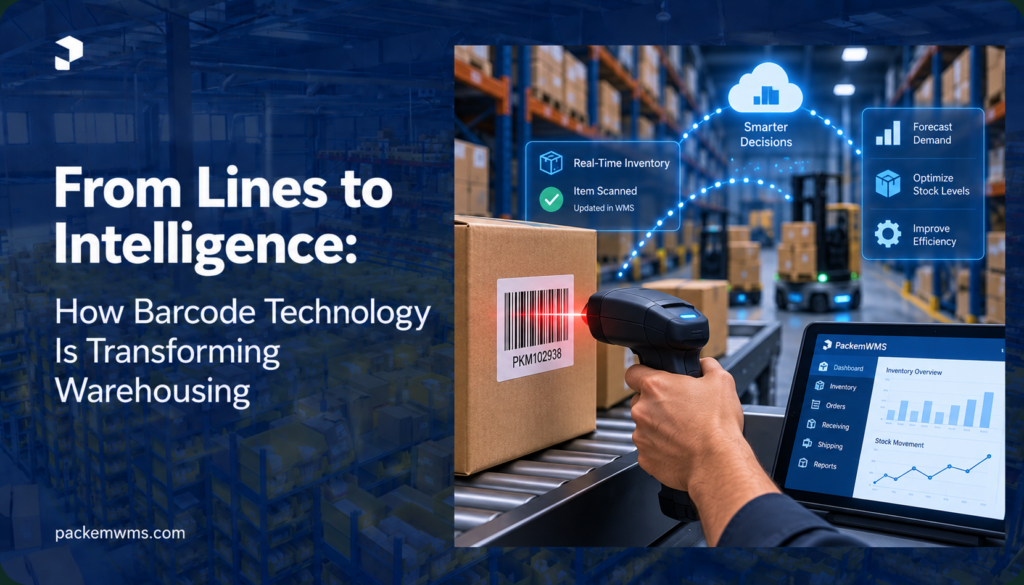
Barcodes have been around for decades. But the way warehouses use them is changing faster than ever.
For years, the humble barcode has been one of the most reliable tools in warehousing. A simple pattern of lines and numbers helped warehouse teams identify products, track inventory and reduce manual data entry.
Today, barcodes are no longer just identification tools. Combined with modern Warehouse Management Systems (WMS), mobile devices, automation and AI, they are becoming part of a much larger digital ecosystem.
So, where did barcode technology come from — and where is it going next?
The Past: When a Barcode Meant a Simple Scan
The early days of barcode-based warehousing were relatively straightforward.
A product arrived at the warehouse. An employee scanned its barcode. The system recorded the transaction. When the product moved, it was scanned again.
This was a major improvement over handwritten records and manual data entry.
Barcodes helped warehouses:
Reduce manual entry errors
Identify products faster
Improve inventory counting
Track goods through warehouse processes
Standardize product identification
Improve order-picking accuracy
But traditional barcode systems had limitations.
Information was often limited to a product or SKU identifier. Warehouse employees still had to rely heavily on the WMS, paper instructions or their own knowledge to understand what should happen next.
The barcode answered:
“What is this?”
It didn’t necessarily answer:
“Where should it go, what should happen next, and why?”
The Present: Barcodes Become Connected
Modern warehouses have moved far beyond standalone barcode scanners.
Today, barcode scanning is increasingly connected to WMS platforms, mobile applications, handheld computers, conveyors, pick-to-light systems, automated storage systems and other warehouse technologies.
A single scan can trigger multiple actions within a warehouse workflow.
For example:
Receive → Scan → Validate → Assign Location → Update Inventory → Trigger Putaway
Instead of simply recording an event, the barcode becomes a digital trigger for the warehouse process.
This is where a modern WMS such as Packem WMS can create significantly more value from barcode data.
A scan can help the system understand:
Which product is being handled
Which order it belongs to
Where the inventory is located
How much inventory is available
Which warehouse process is currently active
What action should happen next
Whether the transaction complies with predefined rules
The result is a warehouse where physical movement and digital information stay synchronized.
The Future: From Barcode Scanning to Intelligent Identification
The next evolution isn’t about replacing barcodes overnight.
It’s about making every scan more intelligent.
As warehouses become more automated and data-driven, barcode technology will increasingly work alongside:
AI and machine learning
Computer vision
IoT sensors
Robotics
Autonomous mobile robots (AMRs)
RFID
Digital twins
Predictive analytics
Cloud-based WMS platforms
Imagine a future warehouse where a worker scans a product and the WMS doesn’t simply record the location.
Instead, the system understands the broader context.
Product scanned → Inventory verified → Order priority evaluated → Optimal location identified → Picking route adjusted → Replenishment requirement predicted
The barcode becomes one input into an intelligent decision-making system.
Barcode Technology: Past vs. Future
| Past | Future |
|---|---|
| Identify a product | Understand product context |
| Record transactions | Trigger intelligent workflows |
| Manual scanning | Automated & assisted identification |
| Static product information | Dynamic operational data |
| Basic inventory updates | Real-time inventory intelligence |
| Human-driven decisions | AI-assisted decisions |
| Standalone scanners | Connected warehouse ecosystem |
| Reactive inventory management | Predictive inventory management |
| Scan to confirm | Scan to optimize |
The important shift is clear:
Barcodes are moving from identification technology to intelligence-enabling technology.
What This Means for 3PLs
For third-party logistics providers, this evolution is particularly important.
3PL warehouses manage inventory for multiple customers, often with different SKUs, processes, service-level agreements and fulfillment requirements.
That creates a growing need for:
Accuracy + Speed + Visibility + Flexibility
Barcode-driven workflows can help 3PLs standardize operations while maintaining the flexibility needed to support different customers.
For example, a barcode scan can help a 3PL WMS validate whether:
The correct customer inventory is being handled
The correct SKU is being picked
The correct quantity is being processed
The inventory is being moved to the correct location
The correct order is being fulfilled
A specific handling instruction needs to be followed
This becomes increasingly valuable as warehouse volumes increase without a corresponding increase in headcount.
The Real Future Isn’t “Barcode vs. New Technology”
It’s easy to assume that emerging technologies such as RFID, computer vision and robotics will eventually make barcodes obsolete.
The reality is likely to be more nuanced.
Different technologies solve different problems.
Barcodes remain attractive because they are:
Inexpensive
Easy to deploy
Globally understood
Highly accurate when properly scanned
Compatible with existing warehouse processes
Easy to integrate with WMS platforms
The future warehouse is therefore unlikely to be defined by one identification technology.
Instead, it will be defined by how different technologies work together.
A barcode may identify the item.
A camera may verify it.
An RFID tag may provide automated visibility.
An AMR may transport it.
And the WMS may orchestrate the entire process.
From “Scan and Store” to “Scan and Decide”
This is perhaps the biggest transformation.
Yesterday’s barcode primarily helped warehouses record what happened.
Today’s barcode helps warehouses execute what needs to happen.
Tomorrow’s barcode-enabled ecosystem could help warehouses anticipate what should happen next.
That progression can be summarized as:
Past
Scan → Record
Present
Scan → Validate → Execute
Future
Scan → Understand → Predict → Optimize
The barcode itself may remain remarkably simple.
The intelligence around it is what will change.
What Warehouse Leaders Should Prepare For
Warehouse operators don’t necessarily need to abandon their existing barcode infrastructure to prepare for the future.
Instead, they should ask whether their WMS can make better use of the data already being generated by every scan.
Key questions include:
Can every scan update inventory in real time?
Can barcode events trigger automated workflows?
Can the WMS validate inventory movements automatically?
Can barcode data be used to measure warehouse performance?
Can the system integrate with automation and mobile devices?
Can historical scan data support forecasting and optimization?
Can the platform scale across multiple customers and warehouses?
The future isn’t necessarily about scanning more.
It’s about getting more value from every scan.
The Barcode’s Next Chapter
From supermarket checkout counters to global distribution centers, barcodes have had an extraordinary run.
But their story is far from over.
The next generation of warehousing will not treat a barcode as merely a printed pattern on a box. It will treat every scan as a data point within a connected, intelligent warehouse ecosystem.
For modern WMS platforms, this creates an opportunity to transform barcode data into better decisions, faster workflows and greater operational visibility.
The barcode may look almost the same as it did decades ago.
The warehouse behind it won’t.
Ready to move beyond basic barcode tracking?
With the right WMS, barcode scanning can become much more than inventory identification. It can become a foundation for connected, accurate and increasingly intelligent warehouse operations.
Explore how Packem WMS can help your warehouse turn every scan into a smarter operational decision.